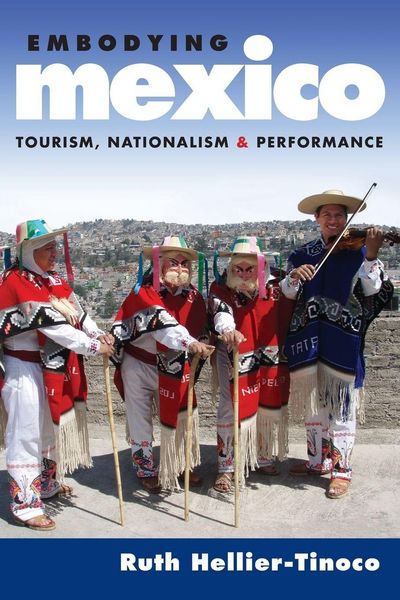
Produktbild: Embodying Mexico

Embodying Mexico Tourism, Nationalism & Performance

Fr. 69.90

inkl. gesetzl. MwSt., Versandkostenfrei


Beschreibung

Produktdetails

Einband

Taschenbuch

Erscheinungsdatum

01.06.2011

Verlag

Oxford Academic

Seitenzahl

354

Maße (L/B/H)

23.4/15.6/2.1 cm

Gewicht

476 g

Sprache

Englisch

ISBN

978-0-19-979081-4

Beschreibung

Zitat


"Hellier-Tinoco focuses on two iconic folk performances to reveal how contemporary Mexican cultural practices emerge from locally rooted traditions, individual agency, and the demands of international touristic representation. Refreshingly observant of each element in the equation, this genuinely interdisciplinary account touches concerns shared by many studying the manifestation of artistic process in the modern-day world." -- Jonathan P. Stock, Department of Music, University of Sheffield, Editor, The World of Music
"Embodying Mexico serves as a single case study that nonetheless illuminates similar processes in other world contexts. This makes the text a good one for undergraduate as well as graduate students in disciplines like Ethnic Studies, Ethnomusicology, and Anthropology." --Brenda Romero, Associate Professor of Musicology and Ethnomusicology, University of Colorado at Boulder
"A wonderful book! With Dance of the Old Men and Night of the Dead, Ruth Hellier-Tinoco shows the insights two performances representing postrevolutionary Mexico offer on nationalism, neoliberalism, and other contemporary issues." --Helena Wulff, Stockholm University
"A solid case study of two iconic traditional practices of Michoacan's P'urhepecha region that can serve as an introduction for undergraduate students learning about Latin American, and particularly Mexican, festivals, dance, music, and cultural/national embodiment." --Journal of FolkloreResearch
"Hellier-Tinoco deftly and convincingly demonstrates her central thesis...This book is essential reading for those interested in Mexico, nationalism and the arts, Latin American studies as pertaining to folklore and indigenous peoples, and indigenous studies in relation to processes of cultural appropriation. It will also be of particular use to those interested in embodiment, performance studies, and tourism. As a well-performed interdisciplinary study, the book is a solid contribution to scholarship

Produktdetails

Einband

Taschenbuch

Erscheinungsdatum

01.06.2011

Verlag

Oxford Academic

Seitenzahl

354

Maße (L/B/H)

23.4/15.6/2.1 cm

Gewicht

476 g

Sprache

Englisch

ISBN

978-0-19-979081-4

Herstelleradresse

Libri GmbH
Europaallee 1
36244 Bad Hersfeld
DE

Email: gpsr@libri.de

Kundinnen und Kunden meinen

0 Bewertungen

Informationen zu Bewertungen

Zur Abgabe einer Bewertung ist eine Anmeldung im Konto notwendig. Die Authentizität der Bewertungen wird von uns nicht überprüft. Wir behalten uns vor, Bewertungstexte, die unseren Richtlinien widersprechen, entsprechend zu kürzen oder zu löschen.

Die Bewertungen sind nach Format, Anzahl Sterne und Datum sortiert.

Verfassen Sie die erste Bewertung zu diesem Artikel

Helfen Sie anderen Kund*innen durch Ihre Meinung

Kundinnen und Kunden meinen

0 Bewertungen filtern

  • Produktbild: Embodying Mexico
    • Part One: Setting the Scene: Many Mexicos

    • Introduction

    • 1.: Beyond Your Expectations: Twentyfirst Century Mexico

    • 2.: Discursive Communities: Performism, Nationalism, and Tourism

    • Part Two: Tracing Ninety Years of Performism

    • 3.: Forging the Nation: the Postrevolutionary Years

    • 4.: Appropriation and Incorporation: From Island Village to Capital City

    • 5.: Destination Lake Pátzcuaro: Creating a Tourist Attraction with Night of the Dead

    • 6.: Authentic Mexican Dances: The Palace of Fine Arts and Across the Border

    • 7.: Films, Visual Images, and Folklórico: Belonging, Difference, and Bodies

    • 8.: Experiencing Night of the Dead: Festivals, Contests, and Souvenirs

    • 9.: Disseminating The Old Men: Mexico City, Europe, the World

    • 10.: Keeping It Local: Reappropriation, Migration, and the Zacán Festival

    • Part Three: Embodiment, Photographs, and Economics

    • 11.: In the Body: Indigenous Corporeality, Work, and Interpretation

    • 12.: Capturing Bodies: Postcards, Advertising, and the World's Fair

    • 13.: Celebrating and Consuming Bodies: Economic and Symbolic Production