• Produktbild: Statistics for the Health Sciences
  • Produktbild: Statistics for the Health Sciences

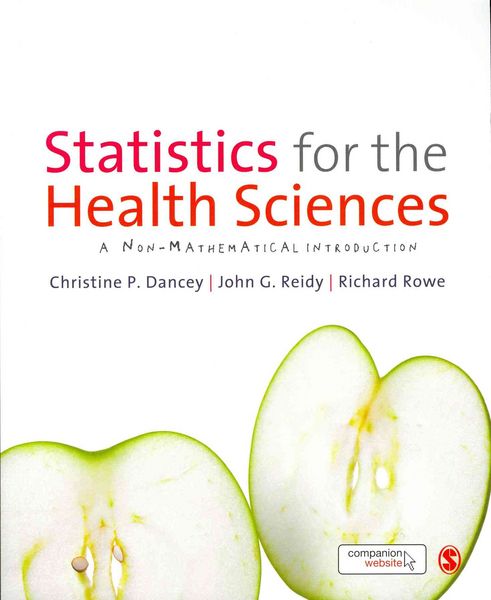
Statistics for the Health Sciences A Non-Mathematical Introduction

Fr. 132.00

inkl. gesetzl. MwSt., Versandkostenfrei


Beschreibung

Produktdetails

Einband

Taschenbuch

Erscheinungsdatum

19.03.2012

Verlag

Sage Publications

Seitenzahl

584

Maße (L/B/H)

23.5/19.1/3.7 cm

Gewicht

1062 g

Sprache

Englisch

ISBN

978-1-84920-336-4

Beschreibung

Rezension

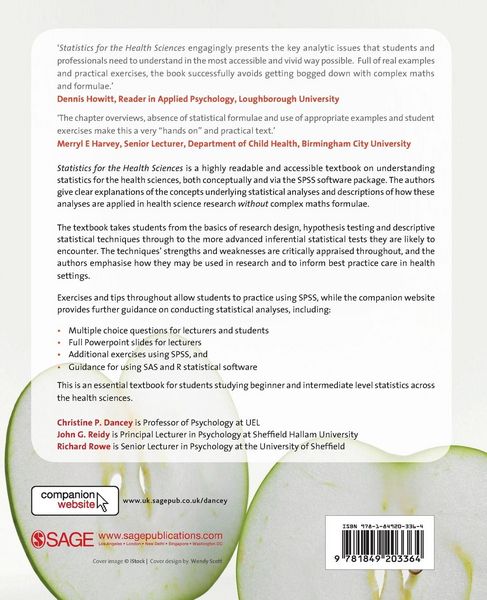
'Statistics for the Health Sciences engagingly presents the key analytic issues that students and professionals need to understand in the most accessible and vivid way possible. Full of real examples and practical exercises, the book successfully avoids getting bogged down with complex maths and formulae' -
Dennis Howitt at Loughborough University

The chapter overviews, absence of statistical formulae and use of appropriate examples and student exercises make this a very 'hands on' and practical text' -

Merryl E Harvey, Birmingham City University

Produktdetails

Einband

Taschenbuch

Erscheinungsdatum

19.03.2012

Verlag

Sage Publications

Seitenzahl

584

Maße (L/B/H)

23.5/19.1/3.7 cm

Gewicht

1062 g

Sprache

Englisch

ISBN

978-1-84920-336-4

EU-Ansprechpartner

Zeitfracht Medien GmbH
Ferdinand-Jühlke-Straße 7|99095|Erfurt|DE

Herstelleradresse

SAGE Publications
1 Oliver's Yard 55 City Road|EC1Y 1SP|London|GB

Noch keine Bewertungen vorhanden

Verfassen Sie die erste Bewertung zu diesem Artikel

Helfen Sie anderen Kundinnen und Kunden durch Ihre Meinung.

Kundinnen und Kunden meinen

Bewertungen (0)

  • Produktbild: Statistics for the Health Sciences
  • Produktbild: Statistics for the Health Sciences
  • PART ONE: AN INTRODUCTION TO THE RESEARCH PROCESS
    Overview
    The Research Process
    Concepts and Variables
    Levels of Measurement
    Hypothesis Testing
    Evidence-Based Practice
    Research Designs
    Multiple-Choice Questions
    PART TWO: COMPUTER-ASSISTED ANALYSIS
    Overview
    Overview of the Three Statistical Packages
    Introduction to SPSS
    Setting out Your Variables for within - and between-Group Designs
    Introduction to R
    Introduction to SAS
    Summary
    Exercises
    PART THREE: DESCRIPTIVE STATISTICS
    Overview
    Anaylsing Data
    Descriptive Statistics
    Numerical Descriptive Statistics
    Choosing a Measure of Central Tendency
    Measures of Variation or Dispersion
    Deviations from the Mean
    Numerical Descriptives in SPSS
    Graphical Statistics
    Bar Charts
    Line Graphs
    Incorporating Variability into Graphs
    Generating Graphs with Standard Deviations in SPSS
    Graphs Showing Dispersion - Frequency Histogram
    Box-Plots
    Summary
    SPSS Exercise
    Multiple Choice Questions
    PART FOUR: THE BASIS OF STATISTICAL TESTING
    Overview
    Introduction
    Samples and Populations
    Distributions
    Statistical Significance
    Criticisms of NHST
    Generating Confidence Intervals in SPSS
    Summary
    SPSS Exercise
    Multiple Choice Questions
    PART FIVE: EPIDEMIOLOGY
    Overview
    Introduction
    Estimating the Prevalence of Disease
    Difficulties in Estimating Prevalence
    Beyond Prevalence: Identifying Risk Factors for Disease
    Risk Ratios
    The Odds-Ratio
    Establishing Causality
    Case-Control Studies
    Cohort Studies
    Experimental Designs
    Summary
    Multiple Choice Questions
    PART SIX: INTRODUCTION TO DATA SCREENING AND CLEANING
    Overview
    Introduction
    Minimising Problems at the Design Stage
    Entering Data into Databases/Statistical Packages
    The Dirty Dataset
    Accuracy
    Using Descriptive Statistics to Help Identify Errors
    Missing Data
    Spotting Missing Data
    Normality
    Screening Groups Separately
    Reporting Data Screning and Cleaning Procedures
    Summary
    Multiple Choice Questions
    PART SEVEN: DIFFERENCES BETWEEN TWO GROUPS
    Overview
    Introduction
    Conceptual Description of the t-Tests
    Generalising to the Population
    Independent Groups t-Test in SPSS
    Cohen¿s d
    Paired t-Test in SPSS
    Two-Sample z-Test
    Non-Parametric Tests
    Mann-Whitney: for Independent Groups
    Mann-Whitney Test in SPSS
    Wilcoxon Signed Rank Test: For Repeated Measures
    Wilcoxon Signed Rank Test in SPSS
    Adjusting for Multiple Tests
    Summary
    Multiple Choice Questions
    PART EIGHT: DIFFERENCES BETWEEN THREE OR MORE CONDITIONS
    Overview
    Introduction
    Conceptual Description of the (Parametric) ANOVA
    One-Way ANOVA
    One-way ANOVA in SPSS
    ANOVA Models for Repeated-Measures Designs
    Repeated Measures ANOVA in SPSS
    Non-parametric Equivalents
    The Kruskal-Wallis Test
    Kruskal-Wallis and the Median Test in SPSS
    The Median Test
    Friedman¿s ANOVA for Repeated Measures
    Friedman¿s ANOVA in SPSS
    Summary
    Multiple Choice Questions
    PART NINE: TESTING ASSOCIATIONS BETWEEN CATEGORICAL VARIABLES
    Overview
    Introduction
    Rationale of Contingency Table Analysis
    Running the Analysis in SPSS
    Measuring Effect Size in Contingency Table Analysis
    Larger Contingency Tables
    Contingency Table Analysis Assumptions
    The X2 Goodness of Fit Test
    Running the X2 Goodness of Fit Test Using SPSS
    Summary
    Multiple Choice Questions
    PART TEN: MEASURING AGREEMENT: CORRELATIONAL TECHNIQUES
    Overview
    Introduction
    Bivariate Relationships
    Perfect Correlations
    Calculating the Correlation Pearson¿s R Using SPSS.
    How to obtain Scatterplots
    Variance Explanation of R
    Obtaining Correlational Analysis in SPSS: Exercise
    Partial Correlations
    Shared and Unique Variance: Conceptual Understanding Relating to Partial Corrections
    Spearman¿s Rho
    Other uses for Correlational Techniques
    Reliability of Measures
    Internal Consistency
    Inter Rater Reliability
    Validity
    Percentage Agreement
    Cohen¿s Kappa
    Summary
    Multiple Choice Questions
    PART 11: LINEAR REGRESSION
    Overview
    Introduction
    Linear Regression in SPSS
    Obtaining teh Scatterplot with Regression Line and Confidence Intervals in SPSS
    Assumptions Underlying Linear Regression
    Dealing with Outliers
    What happens if the Correlation Between X and Y is Near Zero?
    Using Regression to Predict Missing Data in SPSS
    Prediction of Missing Scores on Cognitive Failures in SPSS
    Summary
    Multiple-Choice Questions
    PART TWELVE: STANDARD MULTIPLE REGRESSION
    Overview
    Introduction
    Multiple Regression in SPSS
    Variables in the Equation
    The Regression Equation
    Predicting an Individual¿s Score
    Hypothesis Testing
    Other Types of Multiple Regression
    Hierarchical Multiple Regression
    Summary
    Multiple Choice Questions
    PART THIRTEEN: LOGISTIC REGRESSION
    Overview
    Introduction
    The Conceptual Basis of Logistic Regression
    Writing up the Result
    Logistic Regression with Multiple Predictor Variables
    Logistic Regression with Categorical Predictors
    Categorical Predictors with Three or More Levels
    Summary
    Multiple Choice Questions
    Interventions and Analysis of Change
    Overview
    Interventions
    How do we Know Whether Interventions are Effective?
    Randomised Control Trials (RCTs)
    Designing an RCT: CONSORT
    The CONSORT Flow Chart
    Important Features of an RCT
    Blinding
    Analysis of RCTs
    Running an ANCOVA in SPSS
    McNemar¿s Test of Change
    Running McNemar¿s Test in SPSS
    The Sign Test
    Running the Sign Test using SPSS
    Intention to Treat Analysis
    Crossover Designs
    Single Case Designs (N= 1)
    Generating Single Case Design Graphs Using SPSS
    Summary
    SPSS Exercise
    Multiple Choice Questions
    PART FIFTEEN: SURVIVAL ANALYSIS: AN INTRODUCTION
    Overview
    Introduction
    Survival Curves
    The Kaplan-Meier Survival Function
    Kaplan-Meier Survival Analyses in SPSS
    Comparing Two Survival Curves - the Mantel-Cox test
    Mantel-Cox using SPSS
    Hazard
    Hazard Curves
    Hazard Functions in SPSS
    Writing up a Survival Analysis
    Summary
    SPSS Exercise
    Multiple Choice Questions