• Produktbild: Introduction to Programming with Modula-2
  • Produktbild: Introduction to Programming with Modula-2

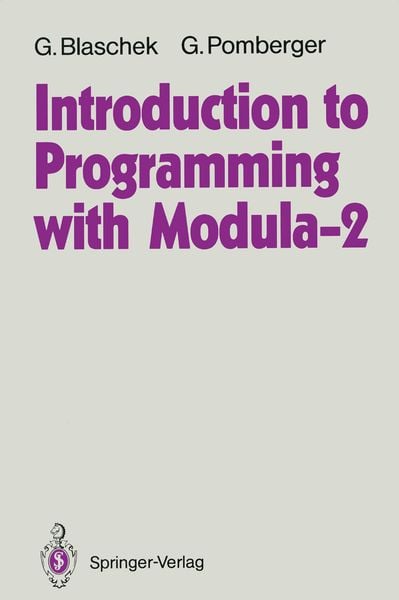
Introduction to Programming with Modula-2

Fr. 72.90

inkl. gesetzl. MwSt., Versandkostenfrei


Beschreibung

Produktdetails

Einband

Taschenbuch

Erscheinungsdatum

22.11.1990

Verlag

Springer Berlin

Seitenzahl

261

Maße (L/B/H)

23.5/15.5/1.5 cm

Gewicht

417 g

Auflage

Softcover reprint of the original 1st ed. 1990

Übersetzt von

R. Bach

Sprache

Englisch

ISBN

978-3-540-52038-2

Beschreibung

Produktdetails

Einband

Taschenbuch

Erscheinungsdatum

22.11.1990

Verlag

Springer Berlin

Seitenzahl

261

Maße (L/B/H)

23.5/15.5/1.5 cm

Gewicht

417 g

Auflage

Softcover reprint of the original 1st ed. 1990

Übersetzt von

R. Bach

Sprache

Englisch

ISBN

978-3-540-52038-2

Herstelleradresse

Springer-Verlag KG
Sachsenplatz 4-6
1201 Wien
AT

Email: GPSR Kontakt

Noch keine Bewertungen vorhanden

Verfassen Sie die erste Bewertung zu diesem Artikel

Helfen Sie anderen Kundinnen und Kunden durch Ihre Meinung.

Kundinnen und Kunden meinen

Bewertungen (0)

  • Produktbild: Introduction to Programming with Modula-2
  • Produktbild: Introduction to Programming with Modula-2
  • 1 Algorithms.- 1.1 Examples of Algorithms.- 1.2 Definition of the Term “Algorithm”.- 1.3 Objects and Actions.- 1.4 Means of Representing Algorithms.- 1.5 Some Simple Algorithms.- 1.6 Algorithms and Programs.- Exercises.- 2 Principles of Program Development.- 2.1 The Principle of Stepwise Refinement.- 2.2 Data Capsules.- 2.3 The Module Concept.- Exercises.- 3 The Programming Language Modula-2.- 3.1 Notation for Language Description.- 3.2 Lexical Elements of Modula-2.- 3.2.1 Identifiers.- 3.2.2 Keywords.- 3.2.3 Numbers.- 3.2.4 Character Strings.- 3.2.5 Operators and Delimiters.- 3.2.6 Separation of Symbols.- 3.2.7 Comments.- Exercises.- 3.3 Elementary Program Structure.- 3.4 Declarations.- 3.4.1 Data Types.- 3.4.1.1 Predefined Data Types.- 3.4.1.2 Elementary User-Defined Data Types.- 3.4.1.3 Structured Data Types.- 3.4.2 Declaration of Constants.- 3.4.3 Declaration of Types.- 3.4.4 Declaration of Variables.- 3.4.5 Type Identity Among Objects.- Exercises.- 3.5 Expressions.- 3.5.1 Classes of Expressions.- 3.5.2 Operands.- 3.5.3 Operators.- 3.5.4 Rules for Writing Expressions.- 3.5.5 Expression Compatibility of Operands.- Exercises.- 3.6 Statements.- 3.6.1 Assignment.- 3.6.2 Conditional Statements.- 3.6.2.1 The IF Statement.- 3.6.2.2 The CASE Statement.- Exercises.- 3.6.3 Loops.- 3.6.3.1 The WHILE Statement.- 3.6.3.2 The REPEAT Statement.- 3.6.3.3 The FOR Statement.- 3.6.3.4 The LOOP and EXIT Statements.- Exercises.- 3.6.4 The WITH Statement.- Exercises.- 3.7 Procedures.- 3.7.1 Declaration of Procedures.- 3.7.2 Invocation of Procedures.- 3.7.3 The RETURN Statement.- 3.7.4 Function Procedures.- 3.7.5 Scope and Lifetime of Objects in Procedures.- 3.7.6 Data Exchange Between Procedures.- 3.7.7 ARRAY Parameters.- 3.7.8 Standard Procedures.- 3.7.9 PROCEDURE Types and Procedure Variables.- Exercises.- 3.8 The Module Concept of Modula-2.- 3.8.1 Local Modules.- 3.8.2 Scope and Lifetime of Objects in Modules.- 3.8.3 Modules and Separate Compilation.- 3.8.3.1 Definition Modules.- 3.8.3.2 Implementation Modules.- Exercises.- 3.9 System-Dependent Language Properties.- 3.9.1 The Module SYSTEM.- 3.9.2 Type Transfer Functions.- 3.9.3 Absolute Addressing of Variables.- 3.10 Processes and Coroutines.- 3.10.1 Creation and Synchronization of Processes.- 3.10.2 Interrupts and Priorities.- 4 Writing Modula-2 Programs.- 4.1 Some Simple Modula-2 Programs.- 4.2 Input/Output.- 4.2.1 The Module Terminal.- 4.2.2 The Modules InOut and RealInOut.- 4.2.3 The Module FileSystem.- 4.3 Dynamic Data Structures.- 4.3.1 Working with Dynamic Data Structures.- 4.3.2 Dynamically Created RECORDS with Variants.- 4.4 Recursion.- 4.4.1 Recursive Procedures.- 4.4.2 Inner Structure of Recursive Procedures and How They Work.- 4.4.3 Some Examples of Recursive Algorithms.- 4.4.4 Advantages and Disadvantages of Recursive Programming.- 4.5 Language Extension Modules.- 4.5.1 The Module MathLib0.- 4.5.2 The Module String.- 4.5.3 The Module Storage.- 4.6 Parallel Processes.- Exercises.- 5 Programming Style and Program Testing.- 5.1 Programming Style.- 5.1.1 Structure.- 5.1.2 Naming Conventions.- 5.1.3 Commentary.- 5.1.4 Outward Form of Programs.- 5.2 Program Testing.- 5.2.1 Types of Error.- 5.2.2 The Testing Procedure.- 5.2.3 Built-in Testing and Debugging Aids.- 5.2.4 Debuggers.- 6 Software Engineering with Modula-2.- 6.1 Modula-2 as a Tool for Specification.- 6.2 Modularizing and Structuring.- 6.3 Data Capsules and Data Abstraction.- 6.4 Separate Compilation and Type Binding.- Appendix A: Syntax Diagrams.- Appendix B: Predefined Identifiers.- Appendix C: Compatibility Rules.- Appendix D: ASCII Table.- References.