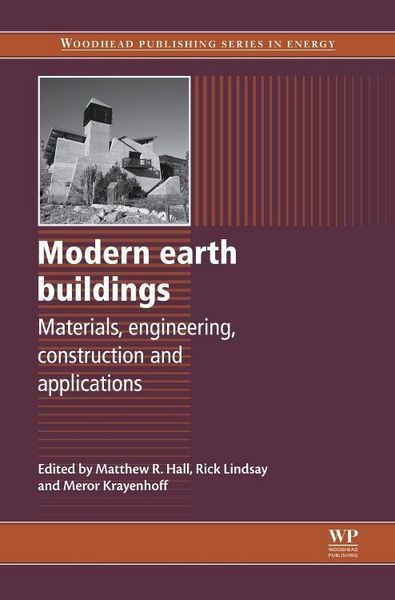
MODERN EARTH BUILDINGS
Aus der Reihe
Woodhead Publishing Series in Energy
-
- Hardcover ausgewählt
- Taschenbuch
- eBook
-
Sprache:Englisch
Fr. 275.00
inkl. gesetzl. MwSt.,
Beschreibung
Produktdetails
Einband
Gebundene Ausgabe
Erscheinungsdatum
11.07.2012
Herausgeber
Matthew R. Hall + weitereVerlag
Woodhead PubSeitenzahl
800
Maße (L/B/H)
23.4/15.5/23.3 cm
Gewicht
1457 g
Sprache
Englisch
ISBN
978-0-85709-026-3
The construction of earth buildings has been taking place worldwide for centuries. With the improved energy efficiency, high level of structural integrity and aesthetically pleasing finishes achieved in modern earth construction, it is now one of the leading choices for sustainable, low-energy building. Modern earth buildings provides an essential exploration of the materials and techniques key to the design, development and construction of such buildings.
Beginning with an overview of modern earth building, part one provides an introduction to design and construction issues including insulation, occupant comfort and building codes. Part two goes on to investigate materials for earth buildings, before building technologies are explored in part three including construction techniques for earth buildings. Modern earth structural engineering is the focus of part four, including the creation of earth masonry structures, use of structural steel elements and design of natural disaster-resistant earth buildings. Finally, part five of Modern earth buildings explores the application of modern earth construction through international case studies.
With its distinguished editors and international team of expert contributors, Modern earth buildings is a key reference work for all low-impact building engineers, architects and designers, along with academics in this field.
Beginning with an overview of modern earth building, part one provides an introduction to design and construction issues including insulation, occupant comfort and building codes. Part two goes on to investigate materials for earth buildings, before building technologies are explored in part three including construction techniques for earth buildings. Modern earth structural engineering is the focus of part four, including the creation of earth masonry structures, use of structural steel elements and design of natural disaster-resistant earth buildings. Finally, part five of Modern earth buildings explores the application of modern earth construction through international case studies.
With its distinguished editors and international team of expert contributors, Modern earth buildings is a key reference work for all low-impact building engineers, architects and designers, along with academics in this field.
Noch keine Bewertungen vorhanden
Verfassen Sie die erste Bewertung zu diesem Artikel
Helfen Sie anderen Kundinnen und Kunden durch Ihre Meinung.