Gutscheinbedingungen

*Gültig bis 05.07.2026 auf (fast) alles. Ausgeschlossen sind Smartboxen, Zeitschriften, Tickets, Lebensmittel, Gaming-Elektroartikel, Tinte/Toner, Gutscheine, Geschenkkarten, Blumen und Abos | Einlösbar in allen Buchhandlungen von Orell Füssli, Barth Bücher, Buchladen Rapunzel, Papeterie Köhler, Schuler Orell Füssli, Stauffacher und ZAP unter Vorweisung des Gutscheins, auf www.orellfüssli.ch durch Eingabe des Gutscheincodes. Beim Service „eBooks verschenken“ und bei eBook-Käufen via eReader nicht einlösbar | Mindesteinkaufswert: Fr. 30.- | Nicht mit anderen Rabatten kumulierbar.

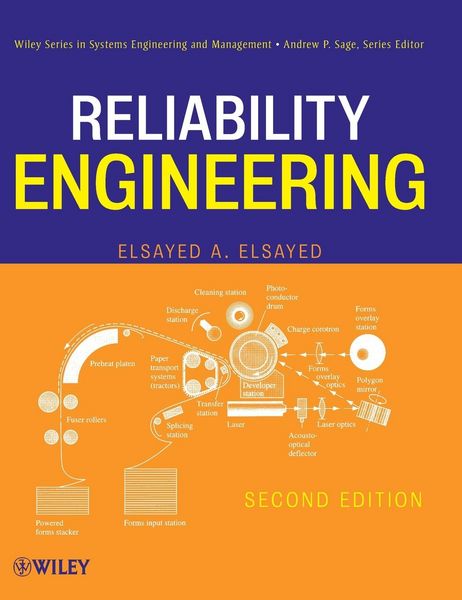
Produktbild: Reliability Engineering
Band 88

Reliability Engineering

Fr. 215.00

inkl. gesetzl. MwSt., Versandkostenfrei


Beschreibung

Produktdetails

Einband

Gebundene Ausgabe

Erscheinungsdatum

01.06.2012

Verlag

John Wiley & Sons Inc

Seitenzahl

792

Maße (L/B/H)

24.1/19.6/4.6 cm

Gewicht

1546 g

Auflage

2. Auflage

Sprache

Englisch

ISBN

978-1-118-13719-2

Beschreibung

Rezension

"The well written book may be used as a reference work for practitioners and as a textbook for courses in reliability engineering, where knowledge in probability calculus and statistics is presumed." (Zentralblatt MATH, 1 December 2012)

"I recommend this book for graduate courses, as it is clear and complete, and treats a vital 21st century problem." ( Computing Reviews , 29 November 2012)

Produktdetails

Einband

Gebundene Ausgabe

Erscheinungsdatum

01.06.2012

Verlag

John Wiley & Sons Inc

Seitenzahl

792

Maße (L/B/H)

24.1/19.6/4.6 cm

Gewicht

1546 g

Auflage

2. Auflage

Sprache

Englisch

ISBN

978-1-118-13719-2

Noch keine Bewertungen vorhanden

Verfassen Sie die erste Bewertung zu diesem Artikel

Helfen Sie anderen Kundinnen und Kunden durch Ihre Meinung.

Kundinnen und Kunden meinen

Bewertungen (0)

Die Leseprobe wird geladen.
  • Produktbild: Reliability Engineering
  • PREFACE xi

    PRELUDE xiv

    CHAPTER 1 RELIABILITY AND HAZARD FUNCTIONS 1
    1.1 Introduction 1
    1.2 Reliability Definition and Estimation 3
    1.3 Hazard Functions 15
    1.4 Multivariate Hazard Rate 55
    1.5 Competing Risk Model and Mixture of Failure Rates 59
    1.6 Discrete Probability Distributions 64
    1.7 Mean Time to Failure 67
    1.8 Mean Residual Life (MRL) 70
    1.9 Time of First Failure 71

    CHAPTER 2 SYSTEM RELIABILITY EVALUATION 87
    2.1 Introduction 87
    2.2 Reliability Block Diagrams 87
    2.3 Series Systems 91
    2.4 Parallel Systems 93
    2.5 Parallel-Series, Series-Parallel, and Mixed-Parallel Systems 95
    2.6 Consecutive-k-out-of-n:F System 104
    2.7 Reliability of k-out-of-n Systems 113
    2.8 Reliability of k-out-of-n Balanced Systems 115
    2.9 Complex Reliability Systems 117
    2.10 Special Networks 131
    2.11 Multistate Models 132
    2.12 Redundancy 138
    2.13 Importance Measures of Components 142

    CHAPTER 3 TIME- AND FAILURE-DEPENDENT RELIABILITY 170
    3.1 Introduction 170
    3.2 Nonrepairable Systems 170
    3.3 Mean Time to Failure (MTTF) 178
    3.4 Repairable Systems 187
    3.5 Availability 198
    3.6 Dependent Failures 207
    3.7 Redundancy and Standby 212

    CHAPTER 4 ESTIMATION METHODS OF THE PARAMETERS OF FAILURE-TIME DISTRIBUTIONS 233
    4.1 Introduction 233
    4.2 Method of Moments 234
    4.3 The Likelihood Function 241
    4.4 Method of Least Squares 256
    4.5 Bayesian Approach 261
    4.6 Generation of Failure-Time Data 265

    CHAPTER 5 PARAMETRIC RELIABILITY MODELS 273
    5.1 Introduction 273
    5.2 Approach 1: Historical Data 273
    5.3 Approach 2: Operational Life Testing 274
    5.4 Approach 3: Burn-In Testing 275
    5.5 Approach 4: Accelerated Life Testing 275
    5.6 Types of Censoring 277
    5.7 The Exponential Distribution 279
    5.8 The Rayleigh Distribution 294
    5.9 The Weibull Distribution 302
    5.10 Lognormal Distribution 314
    5.11 The Gamma Distribution 321
    5.12 The Extreme Value Distribution 329
    5.13 The Half-Logistic Distribution 331
    5.14 Frechet Distribution 338
    5.15 Birnbaum-Saunders Distribution 341
    5.16 Linear Models 344
    5.17 Multicensored Data 346

    CHAPTER 6 MODELS FOR ACCELERATED LIFE TESTING 364
    6.1 Introduction 364
    6.2 Types of Reliability Testing 365
    6.3 Accelerated Life Testing 368
    6.4 ALT Models 372
    6.5 Statistics-Based Models: Nonparametric 386
    6.6 Physics-Statistics-Based Models 404
    6.7 Physics-Experimental-Based Models 412
    6.8 Degradation Models 415
    6.9 Statistical Degradation Models 419
    6.10 Accelerated Life Testing Plans 421

    CHAPTER 7 RENEWAL PROCESSES AND EXPECTED NUMBER OF FAILURES 440
    7.1 Introduction 440
    7.2 Parametric Renewal Function Estimation 441
    7.3 Nonparametric Renewal Function Estimation 455
    7.4 Alternating Renewal Process 465
    7.5 Approximations of M(t) 468
    7.6 Other Types of Renewal Processes 469
    7.7 The Variance of Number of Renewals 471
    7.8 Confidence Intervals for the Renewal Function 477
    7.9 Remaining Life at Time T 479
    7.10 Poisson Processes 481
    7.11 Laplace Transform and Random Variables 485

    CHAPTER 8 PREVENTIVE MAINTENANCE AND INSPECTION 496
    8.1 Introduction 496
    8.2 Preventive Maintenance and Replacement Models: Cost Minimization 497
    8.3 Preventive Maintenance and Replacement Models: Downtime Minimization 506
    8.4 Minimal Repair Models 509
    8.5 Optimum Replacement Intervals for Systems Subject to Shocks 513
    8.6 Preventive Maintenance and Number of Spares 517
    8.7 Group Maintenance 524
    8.8 Periodic Inspection 527
    8.9 Condition-Based Maintenance 535
    8.10 Online Surveillance and Monitoring 537

    CHAPTER 9 WARRANTY MODELS 551
    9.1 Introduction 551
    9.2 Warranty Models for Nonrepairable Products 553
    9.3 Warranty Models for Repairable Products 574
    9.4 Two-Dimensional Warranty 588
    9.5 Warranty Claims 590

    CHAPTER 10 CASE STUDIES 603
    10.1 Case 1: A Crane Spreader Subsystem 603
    10.2 Case 2: Design of a Production Line 609
    10.3 Case 3: An Explosive Detection System 617
    10.4 Case 4: Reliability of Furnace Tubes 623
    10.5 Case 5: Reliability of Smart Cards 629
    10.6 Case 6: Life Distribution of Survivors of Qualification and Certification 632
    10.7 Case 7: Reliability Modeling of Telecommunication Networks for the Air Traffic Control System 639
    10.8 Case 8: System Design Using Reliability Objectives 648
    10.9 Case 9: Reliability Modeling of Hydraulic Fracture Pumps 658
    References 663

    APPENDICES

    AUTHOR INDEX 759

    SUBJECT INDEX 764