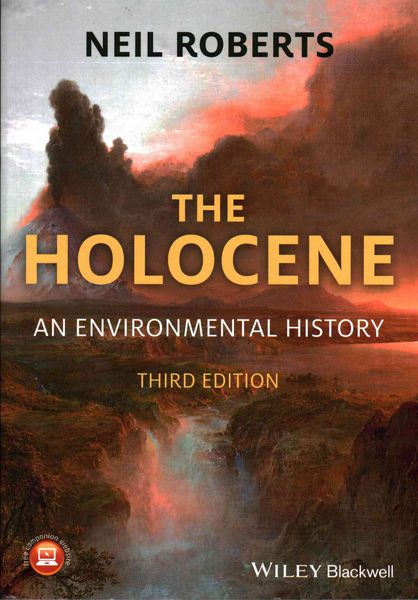
Produktbild: The Holocene

The Holocene An Environmental History

Fr. 68.90

inkl. gesetzl. MwSt., Versandkostenfrei


Beschreibung

Produktdetails

Einband

Taschenbuch

Erscheinungsdatum

24.01.2014

Verlag

John Wiley & Sons

Seitenzahl

376

Maße (L/B/H)

24.4/17/2.1 cm

Gewicht

730 g

Auflage

3. Auflage

Sprache

Englisch

ISBN

978-1-4051-5521-2

Beschreibung

Rezension

"The text makes enjoyable reading, and although the author introduces many technical terms, they are all covered in a glossary at the end and included in the index. Summing Up: Highly recommended. Lower-division undergraduates and above; general readers." (Choice, 1 October 2014)
 
"This excellent book should be mandatory reading for any student taking a palaeobased environmental change module, and academics will also very much enjoy reading Neil Roberts' fine prose." (The Holocene, 1 October 2014)

Produktdetails

Einband

Taschenbuch

Erscheinungsdatum

24.01.2014

Verlag

John Wiley & Sons

Seitenzahl

376

Maße (L/B/H)

24.4/17/2.1 cm

Gewicht

730 g

Auflage

3. Auflage

Sprache

Englisch

ISBN

978-1-4051-5521-2

Kundinnen und Kunden meinen

0 Bewertungen

Informationen zu Bewertungen

Zur Abgabe einer Bewertung ist eine Anmeldung im Konto notwendig. Die Authentizität der Bewertungen wird von uns nicht überprüft. Wir behalten uns vor, Bewertungstexte, die unseren Richtlinien widersprechen, entsprechend zu kürzen oder zu löschen.

Die Bewertungen sind nach Format, Anzahl Sterne und Datum sortiert.

Verfassen Sie die erste Bewertung zu diesem Artikel

Helfen Sie anderen Kund*innen durch Ihre Meinung

Kundinnen und Kunden meinen

0 Bewertungen filtern

Die Leseprobe wird geladen.
  • Produktbild: The Holocene
  • Technical boxes viii

    Preface to the third edition ix

    Acknowledgements xi

    About the companion website xii

    1 Introduction 1

    Sources of information on past environments 2

    Nature and society 5

    The significance of the Holocene 6

    References 7

    2 Reconstructing Holocene environments 10

    Dating the past 10

    Historical and archaeological dating 11

    Radiometric dating methods 13

    Dendrochronology and radiocarbon calibration 19

    Other dating methods 25

    Conclusion 28

    Palaeoecological techniques 32

    Pollen analysis 33

    Plant remains 40

    Creatures great and small 44

    Freshwater and marine organisms 46

    Geological techniques 47

    Ice and ocean 51

    Stable isotope analysis 53

    Geomorphology and climate 55

    Geo-archaeology 59

    Modelling the past 61

    Models of environmental reconstruction 61

    Computer model simulations 64

    Conclusion 66

    References 66

    3 The Pleistocene prelude (>11 700 Cal. yr bp) 83

    Ice Age environments 83

    The glacial-interglacial cycle 83

    Understanding the causes of long-term climatic change 88

    The Last Glacial Maximum and after 92

    The terminal Pleistocene (15 000-11 700 Cal. yr bp) 96

    The Late Glacial in the North Atlantic region 96

    Terminal Pleistocene climatic oscillation: a globally synchronous event? 102

    Adjustment of geomorphic systems 105

    Human ecology at the end of the Pleistocene 107

    Megafaunal extinctions 110

    References 115

    4 Early Holocene adaptations (11 700-6000 Cal. yr bp) 128

    Changes in the physical environment 128

    Ice sheets and sea levels 128

    Human adaptations to coastal environments 131

    Lake ontogeny and soil development 135

    The return of the forests 140

    Europe 140

    Eastern North America 142

    Dry Mediterranean woodland 144

    Tropical forests 145

    Factors affecting forest re-advance 146

    The ecology of Mesolithic Europe 151

    The early Holocene in the tropics 154

    Saharan palaeoecology 155

    Early Holocene climates: Pattern and process 158

    Conclusion 165

    References 167

    5 The first farmers 178

    Agricultural origins 178

    Southwest Asia 179

    China and South Asia 184

    Mesoamerica 186

    Tropical domesticates 190

    Independent innovation or diffusion? 193

    The role of environmental change in early agriculture 194

    Early agricultural impacts 199

    European agricultural dispersals 201

    Ecological consequences of early European agriculture 204

    Conclusion 207

    References 208

    6 The taming of nature (6000-1000 Cal. yr bp) 217

    Introduction 217

    Changes in the natural environment 219

    Climate and vegetation 219

    The origin and development of blanket mires 228

    Coasts and rivers 232

    Cultural evolution 235

    Hydraulic civilisation in Mesopotamia 236

    Environmental impact in pre-Hispanic Mesoamerica 239

    Pastoral nomadism 241

    Mediterranean ecosystems 242

    The making of the landscape: The British Isles 249

    The primaeval forest 250

    Shaugh Moor - a Bronze Age landscape 254

    The environmental impact of permanent agricultural clearance 256

    Conclusion 261

    References 262

    7 The impact of modern times (1000-0 Cal. yr bp) 277

    Introduction 277

    Climatic changes in historical times 280

    Climate history and global warming 282

    Consequences of medieval and Little Ice Age climate change 288

    Expansion at the periphery 291

    Conquest of the Northlands 291

    The Pacific 295

    Ecological imperialism 300

    Land-use history and soil erosion 303

    Pollution histories 312

    Eutrophication: natural or cultural? 312

    Acidification and atmospheric pollution 318

    References 323

    8 The environmental future: A Holocene perspective 336

    Holocene environmental crises 340

    Environmental conservation and Holocene Environmental history 343

    References 347

    Appendix: Calibration table for radiocarbon ages 352

    Glossary 353

    Index 358