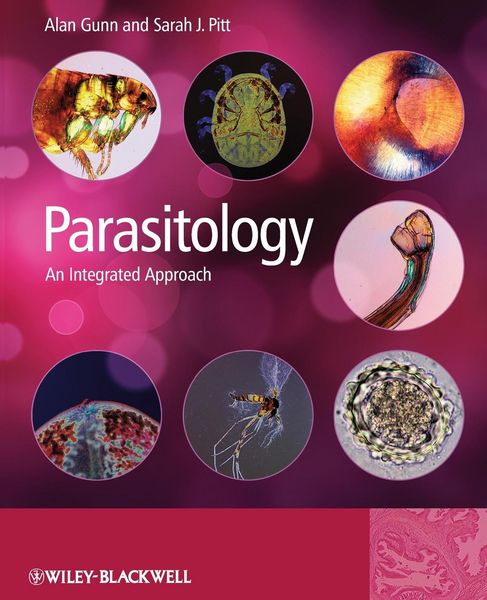
Produktbild: Parasitology

Parasitology An Integrated Approach

Fr. 77.90

inkl. gesetzl. MwSt., Versandkostenfrei


Beschreibung

Produktdetails

Einband

Taschenbuch

Erscheinungsdatum

13.04.2012

Abbildungen

mit Illustrationen

Verlag

John Wiley & Sons Inc

Seitenzahl

464

Maße (L/B/H)

23.5/19.1/2.5 cm

Gewicht

812 g

Auflage

1. Auflage

Sprache

Englisch

ISBN

978-0-470-68423-8

Beschreibung

Rezension

"Overall, a very enjoyable and useful book at a price that is not too astronomical ." ( British Journal of Biomedical Science , 1 January 2013)

"Suitable as an undergraduate text in parasitology courses. Summing Up: Recommended. Lower-and upper-division undergraduates." ( Choice , 1 January 2013)

Produktdetails

Einband

Taschenbuch

Erscheinungsdatum

13.04.2012

Abbildungen

mit Illustrationen

Verlag

John Wiley & Sons Inc

Seitenzahl

464

Maße (L/B/H)

23.5/19.1/2.5 cm

Gewicht

812 g

Auflage

1. Auflage

Sprache

Englisch

ISBN

978-0-470-68423-8

Noch keine Bewertungen vorhanden

Verfassen Sie die erste Bewertung zu diesem Artikel

Helfen Sie anderen Kundinnen und Kunden durch Ihre Meinung.

Kundinnen und Kunden meinen

Bewertungen (0)

Die Leseprobe wird geladen.
  • Produktbild: Parasitology
  • Preface xiii

    1 Animal associations 1

    1.1 Introduction 1

    1.2 Animal associations 1

    1.3 Parasite hosts 11

    1.4 The co-evolution of parasites and their hosts 13

    1.5 Parasitism as a 'lifestyle': advantages and limitations 16

    1.6 The economic cost of parasitic diseases 18

    1.7 Why parasitic diseases remain a problem 21

    1.8 Taxonomy 24

    Questions 27

    2 Parasitic protozoa, fungi and plants 28

    2.1 Introduction 28

    2.2 Parasitic protozoa 28

    2.3 Phylum Rhizopoda 29

    2.4 Phylum Metamonada 34

    2.5 Phylum Apicomplexa 40

    2.6 Subclass Coccidiasina 50

    2.7 Phylum Kinetoplastida 62

    2.8 Phylum Chlorophyta 81

    2.9.1 Microsporidia 83

    2.10 Kingdom plantae 85

    Questions 85

    3 Helminth parasites 86

    3.1 Introduction: invertebrate taxonomy 86

    3.2 Phylum Platyhelminthes 87

    3.3 Class Trematoda 87

    3.4 Class Cestoda 103

    3.5 Phylum Acanthocephala 112

    3.6 Phylum Nematoda (Nemata) 114

    Questions 135

    4 Arthropod parasites 137

    4.1 Introduction 137

    4.2 Phylum Chelicerata 138

    4.3 Phylum Crustacea 148

    4.4 Sub-phylum Hexapoda 153

    Questions 178

    5 Parasite transmission 180

    5.1 Introduction 180

    5.2 Contaminative transmission 181

    5.3 Transmission associated with reproduction 184

    5.4 Autoinfection 189

    5.5 Nosocomial transmission 190

    5.6 Active parasite transmission 191

    5.7 Hosts and vectors 192

    5.8 Host factors 196

    5.9 Co-transmission and interactions between infectious agents 199

    5.10 How religion can influence parasite transmission 202

    5.11 The influence of war on parasite transmission 204

    5.12 The influence of parasites on host behaviour 205

    5.13 Environmental factors 207

    Questions 211

    6 Immune reactions to parasitic infections 212

    6.1 Introduction 212

    6.2 Invertebrate immunity 213

    6.3 Vertebrate immunity 215

    6.4 Innate immunity to parasitic infection 221

    6.5 Adaptive immunity 226

    6.6 Immunity to malaria 233

    6.7 Schistosoma mansoni and Hepatitis C virus interactions 237

    6.8 HIV-AIDS and parasitic disease 238

    Questions 243

    7 Pathology 245

    7.1 Introduction 245

    7.2 Factors that influence pathogenesis 245

    7.3 Mechanisms by which parasites induce pathology 247

    7.4 Types of pathology 250

    7.5 Damage to specific organs 269

    7.6 Co-infections and pathogenesis 289

    Questions 290

    8 The useful parasite 292

    8.1 Introduction: the goodness of parasites? 292

    8.2 The importance of parasites for the maintenance of a healthy immune system 293

    8.3 The use of parasites to treat medical conditions 297

    8.4 Parasites as sources of novel pharmaceutically-active compounds 308

    8.5 Parasites as biological control agents 309

    8.6 Parasites as forensic indicators 312

    Questions 314

    9 Identification of protozoan and helminth parasites 316

    9.1 Introduction 316

    9.2 The importance of correct identification 316

    9.3 Properties of an ideal diagnostic test 318

    9.4 Isolation of parasites 320

    9.5 Identification from gross morphology 323

    9.6 Biochemical techniques 329

    9.7 Immunological techniques 329

    9.8 Molecular techniques 331

    9.9 Rapid diagnostic tests (RDTs) 334

    9.10 MALDI-TOF MS 337

    Questions 338

    10 Parasite treatment and control 339

    10.1 Introduction 339

    10.2 Importance of understanding parasite life cycles for effective treatment and control 339

    10.3 Treatment of parasitic diseases 341

    10.4 Vaccines against parasitic diseases 356

    10.5 Control of parasitic diseases 362

    Questions 373

    References 375

    Index 431