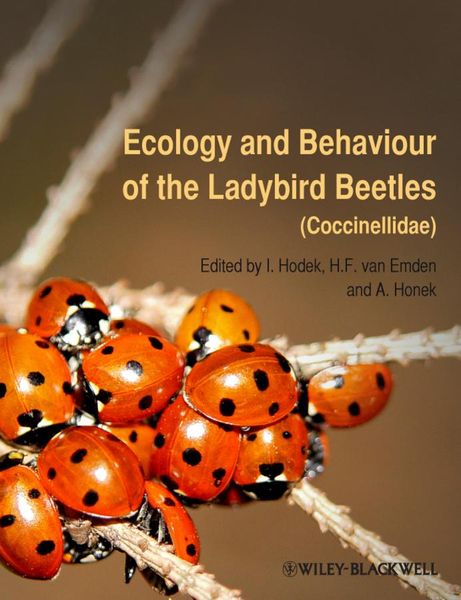
Produktbild: Ecology and Behaviour of the Ladybird Beetles (Coccinellidae)

Ecology and Behaviour of the Ladybird Beetles (Coccinellidae)

Fr. 263.00

inkl. gesetzl. MwSt., Versandkostenfrei


Beschreibung

Produktdetails

Einband

Gebundene Ausgabe

Erscheinungsdatum

21.05.2012

Herausgeber

Helmut F. van Emden + weitere

Verlag

John Wiley & Sons

Seitenzahl

600

Maße (L/B/H)

25.9/20/2.8 cm

Gewicht

1361 g

Auflage

2. Auflage

Sprache

Englisch

ISBN

978-1-4051-8422-9

Beschreibung

Rezension

"The style in which this book is written encourages a response, and invites readers to draw their own conclusions. The inclusion of the final chapter (Chapter 12, Recent progress and possible future trends in the study of Coccinellidae) is particularly welcome. Coccinellid research is a dynamic field and the authors are emphatic in their hope that the information presented in this text will provide inspiration for further research into the specific biology and ecology of these beetles. For me, reading this book has stimulated a great deal of thought." ( Austral Ecology , 1 October 2013)

"This is a very well illustrated and authoritative account, with an excellent set of authors and a very full range of topics . . . Overall this is a rich mine of information and full of important and fascinating detail and it has much to be admired." ( British Ecological Society Bulletin , 1 August 2013)

"In summary, this is a comprehensive, well-written, very thoroughly referenced and clearly laid out book . . . The authors and three editors are congratulated for producing what will no doubt be the seminal work on the Coccinellidae for years to come." ( Journal of Insect Conservation , 15 August 2012)

Zitat

"In summary, this is a comprehensive, well-written, very thoroughly referenced and clearly laid out book ... The authors and three editors are congratulated for producing what will no doubt be the seminal work on the Coccinellidae for years to come." ( Journal of Insect Conservation , 15 August 2012)

Produktdetails

Einband

Gebundene Ausgabe

Erscheinungsdatum

21.05.2012

Herausgeber

Verlag

John Wiley & Sons

Seitenzahl

600

Maße (L/B/H)

25.9/20/2.8 cm

Gewicht

1361 g

Auflage

2. Auflage

Sprache

Englisch

ISBN

978-1-4051-8422-9

Herstelleradresse

Produktsicherheitsverantwortliche/r
Europaallee 1
36244 Bad Hersfeld
DE

Email: gpsr@libri.de

Kundinnen und Kunden meinen

0 Bewertungen

Informationen zu Bewertungen

Zur Abgabe einer Bewertung ist eine Anmeldung im Konto notwendig. Die Authentizität der Bewertungen wird von uns nicht überprüft. Wir behalten uns vor, Bewertungstexte, die unseren Richtlinien widersprechen, entsprechend zu kürzen oder zu löschen.

Die Bewertungen sind nach Format, Anzahl Sterne und Datum sortiert.

Verfassen Sie die erste Bewertung zu diesem Artikel

Helfen Sie anderen Kund*innen durch Ihre Meinung

Kundinnen und Kunden meinen

0 Bewertungen filtern

Die Leseprobe wird geladen.
  • Produktbild: Ecology and Behaviour of the Ladybird Beetles (Coccinellidae)
  • 1 Phylogeny by I. Kovar (Czech Rep.).

    Phylogenetic relations of the subfamilies of Coccinellidae are rather complicated and are now a matter of intensive study. Most recent opinions are summarised..

    2 Variability and Genetic Studies by M. E. N. Majerus & A. Honek (UK & Czech Rep.).

    This chapter considers the range of phenotypic variation exhibited by ladybirds. Particular attention is paid to the mechanistic and evolutionary causes of colour pattern polymorphisms. The chapter also considers chromosomal variation, sex determination and recent advances in the molecular genetics of coccinellids..

    3 Life History and Development by A. Honek & O. Nedved (Czech Rep.).

    The factors (temperature, food, population density) that influence the rate of development of the four developmental stages (egg, larva, pupa, adult) are discussed. The population rate of increase is calculated from data for fecundity, rate of development and survival..

    4 Distribution in Habitats by A. Honek & I. Hodek (Czech Rep.).

    Firstly the impact of factors affecting the distribution of coccinellids in habitats (such as abundance of prey, microclimate, host plants) are analysed, and then examples of communities are given for forests and hedgerows, orchards, and several kinds of fields crops..

    5 Food Relationships by I. Hodek & E. W. Evans (Czech Rep. & USA).

    Although some coccinellids are phyto- or mycetophagous, most species feed on insects, often important agricultural pests, such as aphids, psyllids, aleyrodids and coccids, or even mites. Several aspects of food ecology are dealt with: mainly food specificity with special emphasis on the prey that enable successful development of larvae and reproduction. Discussion includes the tendency to feed on several kinds of complementary foods. Both the causes and consequences of diet choice are explored. Several features of foraging behaviour, important for understanding ladybird impact on pests, are analysed..

    6 Dormancy (Diapause) by I. Hodek (Czech Rep.).

    Coccinellids spend a great part of their adult life in a condition of lowered metabolic rate - hibernation or aestivation diapause. Survival during this long (often 9 month) period without food significantly affects the success of post-diapause population development. The chapter elaborates all aspects of dormancy, such as the regulation of its onset and termination by endogenous processes and environmental signals, changes in behaviour and physiological state. Specific features are dealt with in relation to the 15 most common ladybird species.

    7 Intraguild Relations by E. Lucas (Canada).

    Temporal and spatial distribution of aphids promote interactions between different natural enemies of aphids. Intraguild relations (IGR) are a recent concept, but constitute one of the main forces influencing the structure and dynamics of aphidophagous guilds. Several questions are discussed: Can IGP disrupt or enhance the impact of coccinellids on aphids? How can sublethal effects and defensive mechanisms modify the behaviour of coccinellids? How do ants, tending aphids, modulate the relation between aphids and coccinellids?.

    8 Natural Enemies of Coccinellidae by P. Ceryngier & M. E. N. Majerus (Poland & UK).

    Predators, parasites, parasitoids and pathogenic micro-organisms attacking coccinellids are considered. Information on the biology and ecology of these organisms, their geographical distribution, recorded coccinellid prey/host ranges, and effects on coccinellid individuals (mortality, fecundity, behaviour) and populations (numbers) is provided as well as coccinellid defences against them described. The importance of individual groups of these enemies and their impact on the numbers of particular developmental stages of coccinellids is also discussed..

    9 Role of Semiochemicals by J. Pettersson (Sweden).

    Semiochemicals and aposematism are mechanisms for survival and protection. Characteristic aposematic chemistry of coccinellids is discussed as a basis for other semiochemical-based mechanisms. Aggregation and mating, orientation to habitats and to prey are considered in so far as they are mediated by semiochemicals. Ecological plasticity/adaptivity of these phenomena is discussed..

    10 Impact of Coccinellids in Natural Control by I. Hodek & A. Honek (Czech Rep.).

    Principles of the role of ladybirds in natural regulation of aphid populations are enumerated and attempts at modelling this process described..

    11 Coccinellids in Biological Control: Utilization and Evaluation by J. J. Obrycki & J. P. Michaud (USA).

    The history of coccinellid introductions in "classical" programmes is summarised in the first section, along with a discussion of factors that appear to correlate with their efficacy in particular ecological contexts. Risks inherent to introductions of predatory coccinellids are also discussed against the backdrop of the particular example of Harmonia axyridis in North America which has emerged as an invasive species. The second section deals with approaches for practical augmentation of coccinellid populations in both open and closed systems. The third section summarises research on cultural approaches for the conservation of coccinellid populations in agricultural ecosystems. Methods suitable for evaluating the impact of coccinellid predation on prey populatios are reviewed in the fourth section..

    12 Desirable Trends in Future Studies by H. F. van Emden & I. Hodek (UK & Czech Rep.).

    The chapter will be based on ideas arrived at by the authors of chapters 1-11.