• Produktbild: Online Customer Loyalty
  • Produktbild: Online Customer Loyalty

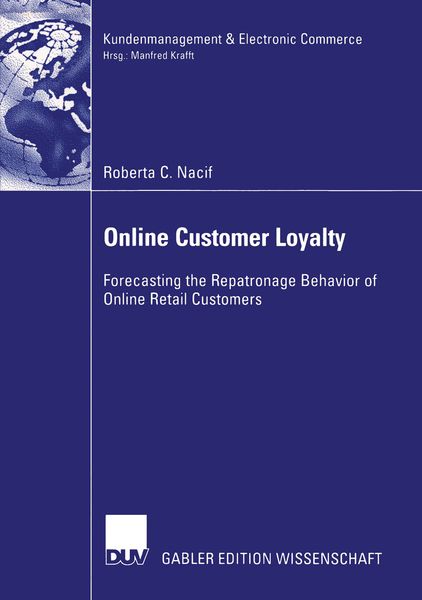
Online Customer Loyalty Forecasting the Repatronage Behavior of Online Retail Customers

Fr. 138.00

inkl. gesetzl. MwSt., Versandkostenfrei


Beschreibung

Produktdetails

Einband

Taschenbuch

Erscheinungsdatum

26.11.2003

Abbildungen

XXII, 1 illus., schwarz-weiss Illustrationen

Verlag

Deutscher Universitätsverlag

Seitenzahl

361

Maße (L/B/H)

21/14.8/2.1 cm

Gewicht

496 g

Auflage

1. Auflage

Sprache

Englisch

ISBN

978-3-8244-7910-8

Beschreibung

Produktdetails

Einband

Taschenbuch

Erscheinungsdatum

26.11.2003

Abbildungen

XXII, 1 illus., schwarz-weiss Illustrationen

Verlag

Deutscher Universitätsverlag

Seitenzahl

361

Maße (L/B/H)

21/14.8/2.1 cm

Gewicht

496 g

Auflage

1. Auflage

Sprache

Englisch

ISBN

978-3-8244-7910-8

Herstelleradresse

Deutscher Universitätsvlg
Abraham-Lincoln-Str. 46
65189 Wiesbaden
DE

Email: ProductSafety@springernature.com

Kundinnen und Kunden meinen

0 Bewertungen

Informationen zu Bewertungen

Zur Abgabe einer Bewertung ist eine Anmeldung im Konto notwendig. Die Authentizität der Bewertungen wird von uns nicht überprüft. Wir behalten uns vor, Bewertungstexte, die unseren Richtlinien widersprechen, entsprechend zu kürzen oder zu löschen.

Die Bewertungen sind nach Format, Anzahl Sterne und Datum sortiert.

Verfassen Sie die erste Bewertung zu diesem Artikel

Helfen Sie anderen Kund*innen durch Ihre Meinung

Kundinnen und Kunden meinen

0 Bewertungen filtern

  • Produktbild: Online Customer Loyalty
  • Produktbild: Online Customer Loyalty
  • 1 Introduction.- 1.1 Problem description.- 1.2 Research Aim.- 1.3 Structure of the Thesis.- 2 Conceptual Foundations.- 2.1 Service Encounters.- 2.2 Self-service Technology Research.- 2.3 The Internet as a Self-service Technology.- 3 Concept and Importance of Repatronage Decisions.- 4 Conceptual Development of a Repatronage Decision Framework.- 4.1 Relational Market Behavior: Analysis of the Customer Perspective.- 4.2 Relevant Theoretical Concepts.- 4.2.1 Behavioral Theories.- 4.2.1.1 Learning Theories.- 4.2.1.2 Information Processing Theories of Consumer Choice.- 4.2.1.3 Risk Theory.- 4.2.1.4 Cognitive Consistency Theories.- 4.2.1.5 Theory of Reasoned Action.- 4.2.1.6 Equity and Social Exchange Theory.- 4.2.1.7 Summary of Behavioral Theories.- 4.2.2 Economic Theories.- 4.2.2.1 Transaction Cost Economics Framework.- 4.2.2.2 Agency Theory.- 4.2.2.3 Summary of Economic Theories.- 4.2.3 Behavioral and Economic Theories and the Antecedents of Repatronage Decisions.- 4.3 Repatronage Decision Modelling: Analysis of Antecedents.- 4.3.1 Customers’ Electronic Service Quality Perception.- 4.3.2 Customer Satisfaction.- 4.3.3 Trust.- 4.3.4 Behavioral Intentions.- 4.3.5 Effect of Decreasing Comparability of Alternatives.- 4.3.6 Justice Perceptions.- 4.3.7 Product Familiarity.- 4.3.8 Customer Behavior that Signals Bonding.- 4.4 Summary of Hypotheses.- 5 Repatronage Decisions as an Empirical Problem.- 5.1 The Study Design.- 5.1.1 Methodology.- 5.1.1.1 Behavioral Intent Modelling.- 5.1.1.2 Incidence Response Modelling.- 5.1.1.3 Usage Levels Decision Modelling.- 5.1.2 Research Design.- 5.1.3 Data Collection Procedure.- 5.2 Operationalization and Measurement of Constructs.- 5.2.1 Methodological Considerations Regarding the Measurement of the Constructs.- 5.2.1.1 Assessing Content and Face Validity.- 5.2.1.2 Assessing Construct Reliability.- 5.2.1.3 Assessing Construct Convergent Validity.- 5.2.1.4 Assessing Discriminant Validity.- 5.2.1.5 Assessing the Model Parameters.- 5.2.1.6 Summary of Construct Evaluation Criteria.- 5.2.2 Operationalization and Validation of Constructs.- 5.2.2.1 Questionnaire Design.- 5.2.2.2 Operationalization of Endogenous Constructs.- 5.2.2.3 Measurement and Validation of Exogenous Constructs.- 5.2.2.4 Discriminant Validity of Exogenous Constructs.- 5.2.2.5 Measures Overview.- 5.2.3 Sample Description.- 5.3 Model Estimation and Results.- 5.3.1 Logistic Regression Model of Customers’ Repurchase Behavior.- 5.3.1.1 The ‘Full’ Logistic Regression Model.- 5.3.1.2 Results of an Alternative Model.- 5.3.1.3 Cross-Validation of Results.- 5.3.2 Tobit Model of Usage Levels Decision.- 5.4 Discussion of Empirical Findings.- 6 Conclusion.- 6.1 Summary of Findings.- 6.2 Managerial Implications.- 6.3 Limitations and Future Research Directions.- A Internet Statistics.- B Questionnaire.- C Comparison Between Groups.- References.