
Gutscheinbedingungen

*Gültig bis 07.06.2026 auf (fast) alles. Ausgeschlossen sind Smartboxen, Zeitschriften, Tickets, Lebensmittel, Gaming-Elektroartikel, Tinte/Toner, Gutscheine, Geschenkkarten, Blumen und Abos | Einlösbar in allen Buchhandlungen von Orell Füssli, Barth Bücher, Buchladen Rapunzel, Schuler Orell Füssli, Stauffacher und ZAP unter Vorweisung des Gutscheins, auf www.orellfüssli.ch durch Eingabe des Gutscheincodes. Beim Service „eBooks verschenken“ und bei eBook-Käufen via eReader nicht einlösbar | Mindesteinkaufswert: Fr. 100.- | Nicht mit anderen Rabatten kumulierbar.

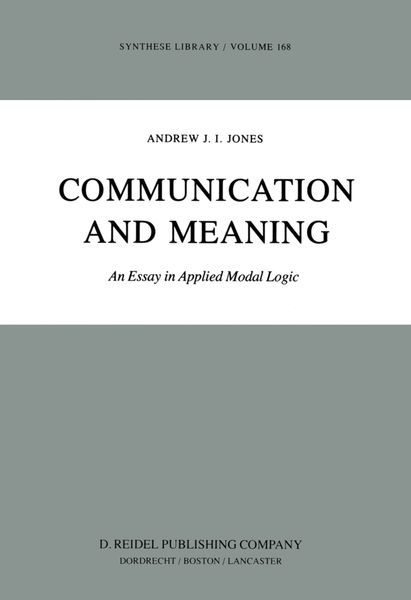
  • Produktbild: Communication and Meaning
  • Produktbild: Communication and Meaning
Band 168

Communication and Meaning An Essay in Applied Modal Logic

Aus der Reihe Synthese Library

Fr. 137.00

inkl. gesetzl. MwSt., Versandkostenfrei


Beschreibung

Produktdetails

Einband

Gebundene Ausgabe

Erscheinungsdatum

31.07.1983

Verlag

Springer Netherland

Seitenzahl

167

Maße (L/B/H)

24.1/16/1.5 cm

Gewicht

448 g

Auflage

1983 edition

Sprache

Englisch

ISBN

978-90-277-1543-2

Beschreibung

Produktdetails

Einband

Gebundene Ausgabe

Erscheinungsdatum

31.07.1983

Verlag

Springer Netherland

Seitenzahl

167

Maße (L/B/H)

24.1/16/1.5 cm

Gewicht

448 g

Auflage

1983 edition

Sprache

Englisch

ISBN

978-90-277-1543-2

Herstelleradresse

Libri GmbH
Europaallee 1
36244 Bad Hersfeld
DE

Email: gpsr@libri.de

Kundinnen und Kunden meinen

0 Bewertungen

Informationen zu Bewertungen

Zur Abgabe einer Bewertung ist eine Anmeldung im Konto notwendig. Die Authentizität der Bewertungen wird von uns nicht überprüft. Wir behalten uns vor, Bewertungstexte, die unseren Richtlinien widersprechen, entsprechend zu kürzen oder zu löschen.

Die Bewertungen sind nach Format, Anzahl Sterne und Datum sortiert.

Verfassen Sie die erste Bewertung zu diesem Artikel

Helfen Sie anderen Kund*innen durch Ihre Meinung

Kundinnen und Kunden meinen

0 Bewertungen filtern

  • Produktbild: Communication and Meaning
  • Produktbild: Communication and Meaning
  • I: Signs and Signalling.- I.1. Lewis on Signalling Systems.- I.2. Signs and Meaning.- I.3. Sign Systems and the Possibility of Deceit.- I.4. Generalization of Rules of Information.- I.5. ISS’s and Lewis Indicative Signalling Systems.- I.6. Conventions of Truthfulness and Trust v. Rules of Information.- II: A Formal Language.- II.1. LC: its Syntax and the General Form of its Semantics.- II.2. Action Modalities.- II.3. Normative Modalities.- II.4. The Belief Modality.- II.5. Mutual Belief.- II.6. The Modality Va.- II.7. Deontic Modalities.- II.8. Knowledge that p.- II.9. On the Alleged Circularity of Possible-World Semantics.- III: Some Features of Communication Situations.- III.1. Truthfulness and Trust.- III.2. Moore’s Paradox of Saying and Disbelieving.- III.3. Informing and Asserting.- III.4. Trust of Type No-Deceit, Communicators’ Intentions and “Saying One Thing and Meaning Another”.- III.5. Non-Deceiving Performances and the Implementation of Rules of Information.- IV: Non-Indicatives.- IV.1. Non-Indicatives and Truth Conditions.- IV.2. Performatives.- IV.3. Sketch for a Logic of Imperative Inference.- IV.4. Other Types of Non-Indicatives.- IV.5. Non-Indicative Usage of Indicatives.- V: Intention-Dependent Evidence.- V.1. Bennett’s Defence of the Gricean Theory.- V.2. The Modality Shall and the Analysis of Signalling.- VI: The Double Bind.- VI.1. General Features of a Double-Bind Situation.- VI.2. The Illustration from Clinical Data — a Formal Description.- VI.3. Bateson’s Theory of Communication.- VI.4. The Double Bind and Levels of Communication.- Concluding Remarks.- Index of Names.- Index of Subjects.