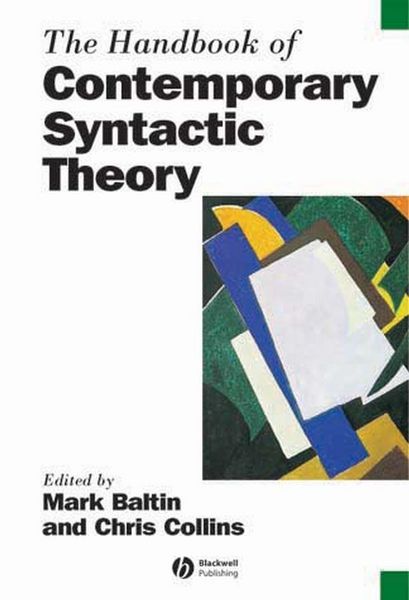
Produktbild: The Handbook of Contemporary Syntactic Theory

The Handbook of Contemporary Syntactic Theory

Fr. 108.00

inkl. gesetzl. MwSt., Versandkostenfrei


Beschreibung

Produktdetails

Einband

Taschenbuch

Erscheinungsdatum

24.02.2003

Herausgeber

Mark Baltin + weitere

Verlag

John Wiley & Sons Inc

Seitenzahl

880

Maße (L/B/H)

24.5/16.9/5 cm

Gewicht

1494 g

Sprache

Englisch

ISBN

978-1-4051-0253-7

Beschreibung

Rezension

" The Handbook of Contemporary Syntactic Theory is an extraordinary accomplishment. Baltin and Collins have succeeded in assembling a sizeable number of the world s leading syntacticians, each of whom has produced a readable overview of the issues in his or her area of specialization. It is to the credit of the editors that this book is valuable both as a reference work and as a critical evaluation of current thinking. All linguists, not just syntacticians, stand to benefit from having a copy within reach." Frederick J. Newmeyer, University of Washington

"Here is yet another impressive addition to Blackwell s series of Handbooks in Linguistics" Canadian Journal of Linguistics

Produktdetails

Einband

Taschenbuch

Erscheinungsdatum

24.02.2003

Herausgeber

Verlag

John Wiley & Sons Inc

Seitenzahl

880

Maße (L/B/H)

24.5/16.9/5 cm

Gewicht

1494 g

Sprache

Englisch

ISBN

978-1-4051-0253-7

Noch keine Bewertungen vorhanden

Verfassen Sie die erste Bewertung zu diesem Artikel

Helfen Sie anderen Kundinnen und Kunden durch Ihre Meinung.

Kundinnen und Kunden meinen

Bewertungen (0)

  • Produktbild: The Handbook of Contemporary Syntactic Theory
  • Contributors.

    Introduction.

    Part I: Derivation Versus Representation:.

    1. Explaining Morphosyntactic Competition: Joan Bresnan (Stanford University).

    2. Economy Conditions in Syntax: Chris Collins (Cornell University).

    3. Derivation and Representation in Modern Transformational Syntax: Howard Lasnik (University of Connecticut).

    4. Relativized Minimality Effects: Luigi Rizzi (Université de Geneve).

    Part II: Movement:.

    5. Head Movement: Ian Roberts (University of Stuttgart).

    6. Object Shift and Scrambling: Höskuldur Thráinsson (University of Iceland).

    7. Wh-in-situ Languages: Akira Watanabe (University of Tokyo).

    8. A-Movements: Mark Baltin (New York University).

    Part III: Argument Structure and Phrase Structure:.

    9. Thematic Relations in Syntax: Jeffrey S. Gruber (independent scholar).

    10. Predication: John Bowers (Cornell University).

    11. Case: Hiroyuki Ura.

    12. Phrase Structure: Naoki Fukui (University of California).

    13. The Natures of Nonconfigurationality: Mark C. Baker (McGill University).

    14. What VP Ellipsis Can Do, and What it Can't, but not Why: Kyle Johnson (University of Massachusetts at Amherst).

    Part IV: Functional Projections:.

    15. Agreement Projections: Adriana Belletti (Universitá di Siena).

    16. Sentential Negation: Raffaella Zanuttini (Georgetown University).

    17. The DP Hypothesis: Identifying Clausal Properties in the Nominal Domain: Judy B. Bernstein (Syracuse University).

    18. The Structure of DPs: Some Principles, Parameters and Problems: Giuseppe Longobardi (University of Trieste).

    Part V: Interface With Interpretation:.

    19. The Syntax of Scope: Anna Szabolcsi (New York University).

    20. Deconstructing Binding: Eric Reuland and Martin Everaert (both Utrecht Institute of Linguistics).

    21. Syntactic Reconstruction Effects: Andrew Barss (University of Arizona).

    Part VI: External Evaluation of Syntax:.

    22. Syntactic Change: Anthony S. Kroch (University of Pennsylvania).

    23. Setting Syntactic Parameters: Janet Dean Fodor (City University of New York).

    Bibliography.

    Index.