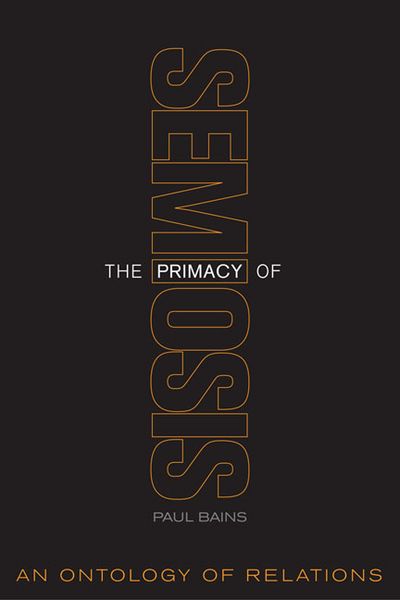
Produktbild: Bains, P: The Primacy of Semiosis

Bains, P: The Primacy of Semiosis An Ontology of Relations

Fr. 72.90

inkl. gesetzl. MwSt., Versandkostenfrei


Beschreibung

Produktdetails

Einband

Gebundene Ausgabe

Erscheinungsdatum

01.06.2006

Verlag

University of Toronto Pre

Seitenzahl

200

Maße (L/B/H)

23.6/15.9/1.9 cm

Gewicht

460 g

Sprache

Englisch

ISBN

978-0-8020-9003-4

Beschreibung

Produktdetails

Einband

Gebundene Ausgabe

Erscheinungsdatum

01.06.2006

Verlag

University of Toronto Pre

Seitenzahl

200

Maße (L/B/H)

23.6/15.9/1.9 cm

Gewicht

460 g

Sprache

Englisch

ISBN

978-0-8020-9003-4

Kundinnen und Kunden meinen

0 Bewertungen

Informationen zu Bewertungen

Zur Abgabe einer Bewertung ist eine Anmeldung im Konto notwendig. Die Authentizität der Bewertungen wird von uns nicht überprüft. Wir behalten uns vor, Bewertungstexte, die unseren Richtlinien widersprechen, entsprechend zu kürzen oder zu löschen.

Die Bewertungen sind nach Format, Anzahl Sterne und Datum sortiert.

Verfassen Sie die erste Bewertung zu diesem Artikel

Helfen Sie anderen Kund*innen durch Ihre Meinung

Kundinnen und Kunden meinen

0 Bewertungen filtern

  • Produktbild: Bains, P: The Primacy of Semiosis
  • Preface Abbreviations Introduction: The Drama of Relation and Its Characters 1 An Even Briefer History of Relations * Terminology * Discussion in and after the Latin West 2 Deleuze and External (or Ontological) Relations * The Circle of the Proposition * The Complex Theme of the Proposition 3 Poinsot and Deely on Relations and Signs * Objective Being * The Doctrine of 'Species' * Ideas * FormalSigns * Scotist and Thomist Accounts * Objective Being as Umwelt 4 Umwelten * Jakob von Uexkull and Umwelten * The Tick as an Interpreter - the Functional Cycle * Deleuze and Guattari's Appropriation * Contemporary Value and Semiotic Use * Species-Specific Objective Worlds * Heideggerean Umwelten * The Transformation of Umwelt into Lebenswelt 5 Autopoiesis and Languaging * Background and Context * Cognitive Systems * Living Systems * Languaging Conclusion Notes Bibliography Index