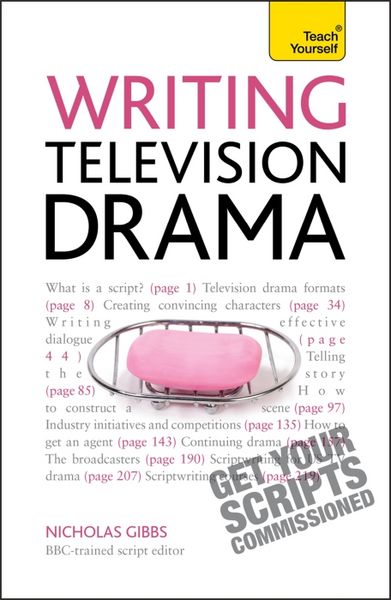
Produktbild: Writing Television Drama

Writing Television Drama Get Your Scripts Commissioned

Fr. 33.90

inkl. gesetzl. MwSt., Versandkostenfrei


Beschreibung

Produktdetails

Einband

Taschenbuch

Erscheinungsdatum

27.07.2012

Verlag

Hodder & Stoughton

Seitenzahl

242

Maße (L/B/H)

19.8/12.9/1.4 cm

Gewicht

242 g

Sprache

Englisch

ISBN

978-1-4441-6759-7

Beschreibung

Produktdetails

Einband

Taschenbuch

Erscheinungsdatum

27.07.2012

Verlag

Hodder & Stoughton

Seitenzahl

242

Maße (L/B/H)

19.8/12.9/1.4 cm

Gewicht

242 g

Sprache

Englisch

ISBN

978-1-4441-6759-7

Herstelleradresse

Libri GmbH
Europaallee 1
36244 Bad Hersfeld
DE

Email: gpsr@libri.de

Kundinnen und Kunden meinen

0 Bewertungen

Informationen zu Bewertungen

Zur Abgabe einer Bewertung ist eine Anmeldung im Konto notwendig. Die Authentizität der Bewertungen wird von uns nicht überprüft. Wir behalten uns vor, Bewertungstexte, die unseren Richtlinien widersprechen, entsprechend zu kürzen oder zu löschen.

Die Bewertungen sind nach Format, Anzahl Sterne und Datum sortiert.

Verfassen Sie die erste Bewertung zu diesem Artikel

Helfen Sie anderen Kund*innen durch Ihre Meinung

Kundinnen und Kunden meinen

0 Bewertungen filtern

  • Produktbild: Writing Television Drama
    • 1.: Introduction - providing a background to the subject and outlining the purpose of the guide and who it is aimed at.
    • a.: What is a Script? - Nuts and bolts definition of what a script actually is.
    • b.: b. The Script - Format.  Television Drama has different formats. Is it a series? Is it a Serial? Is it a one-off? Is it a two-, three-, four-parter? The difference between BBC, ITV, C4 and Sky drama.
    • c.: The Spec Script - The script that is going to get you noticed
    • 2.: The Idea - What to do before writing begins. The logline. The theme. The synopsis.
    • 3.: The Characters - How to create compelling characters: The Protagonist and The Antagonist
    • 4.: The Characters #2 - Supporting Characters
    • 5.: The World - The where
    • 6.: The Script - Structure
    • a.: a. The First Ten Pages - A new writer is judged on the first ten pages of his script as to whether that the rest of the script is read.  We look at why this is and also what are the key elements that those first ten pages must have.
    • b.: Inciting Incident - The reason you are telling this story at this time in your protagonist's life.
    • c.: Structure. 3-Acts, 4-Acts, 5-Acts. Classical storytelling.
    • d.: Main Plot and Sub-Plots. Story arcs. Conflicts. Reversals. Surprises.
    • 7.: The Script - Nuts and Bolts
    • a.: Show Not Tell.
    • e.: Writing Action. Writing 'stage' directions.
    • f.: Dialogue. Speech patterns, interaction.
    • g.: Scene Construction. What should every scene be doing?
    • 8.: Other Documents
    • h.: h. Character Biographies.  Episode summaries.
    • i.: Treatments.
    • j.: Writing is re-writing.
    • 9.: Continuing Drama - The different demands and what can be learned writing for Casualty, Doctors, Holby, Eastenders, Coronation Street, Emmerdale, Hollyoaks.
    • 10.: Online Drama. The opportunities and constraints of drama online.
    • 11.: Who Does What?
    • a.: a. Script Readers. What do they do? What do they look for?  Who are they?
    • b.: Script Editor. What do they do? Notes.
    • c.: c. How to get an agent?  Why do I need an agent?
    • d.: d. No agent.  What can you do?
    • 12.: 12. Industry events.  Workshops. Courses. Competitions. Organisations.
    • 13.: 13. From script to screen.  The process can take up to two years (or more) so what happens.
    • 14.: 14. USA Television.  What are the differences and opportunities?
    • 15.: Contacts including new writer friendly production companies.
    • 16.: Glossary/Bibliography