Gutscheinbedingungen

*Gültig bis 20.07.2026 auf alle Bücher. Ausgeschlossen sind Zeitschriften, Prozentbücher und Abos | Einlösbar in allen Buchhandlungen von Orell Füssli, Barth Bücher, Buchladen Rapunzel, Papeterie Köhler, Schuler Orell Füssli, Stauffacher und ZAP unter Vorweisung des Gutscheins, auf www.orellfüssli.ch durch Eingabe des Gutscheincodes. Beim Service „eBooks verschenken“ und bei eBook-Käufen via eReader nicht einlösbar | Mindesteinkaufswert: Fr. 30.- | Nicht mit anderen Rabatten kumulierbar.

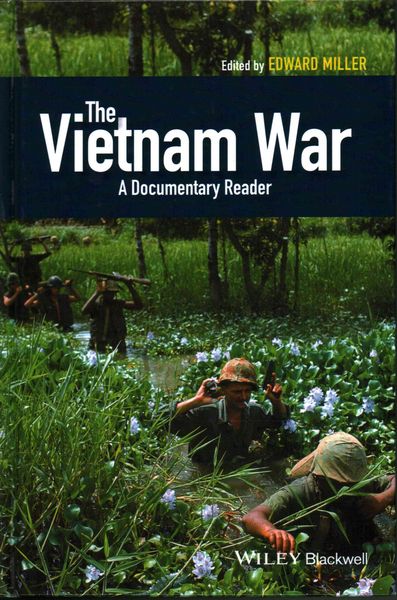
Produktbild: The Vietnam War

The Vietnam War A Documentary Reader

Fr. 112.00

inkl. gesetzl. MwSt., Versandkostenfrei


Beschreibung

Produktdetails

Einband

Gebundene Ausgabe

Erscheinungsdatum

22.01.2016

Verlag

John Wiley & Sons Inc

Seitenzahl

296

Maße (L/B/H)

23.6/15.4/2.2 cm

Gewicht

538 g

Auflage

1. Auflage

Sprache

Englisch

ISBN

978-1-4051-9677-2

Beschreibung

Produktdetails

Einband

Gebundene Ausgabe

Erscheinungsdatum

22.01.2016

Verlag

John Wiley & Sons Inc

Seitenzahl

296

Maße (L/B/H)

23.6/15.4/2.2 cm

Gewicht

538 g

Auflage

1. Auflage

Sprache

Englisch

ISBN

978-1-4051-9677-2

Noch keine Bewertungen vorhanden

Verfassen Sie die erste Bewertung zu diesem Artikel

Helfen Sie anderen Kundinnen und Kunden durch Ihre Meinung.

Kundinnen und Kunden meinen

Bewertungen (0)

Die Leseprobe wird geladen.
  • Produktbild: The Vietnam War
  • Series Editors' Preface x
    Acknowledgements xii
    Introduction xiii
    Chapter 1 Colonialism, Nationalism, and Communism 1
    1.1 Tam Lang, I Pulled a Rickshaw (1932) 1
    1.2 The Trial Testimony of Phan Boi Chau (1925) 5
    1.3 Ho Chi Minh, The Path which Led Me to Leninism (1960) 7
    1.4 Nguyen Ai Quoc (Ho Chi Minh), Appeal Made on the Occasion of the Founding of the Vietnamese Communist Party (1930) 9
    1.5 Ho Chi Minh, The Declaration of Independence of the Democratic Republic of Vietnam (1945) 11
    Chapter 2 The First Indochina War and the Origins of American Involvement 15
    2.1 Oral History of Xuan Vu, Viet Minh War Reporter and Propagandist (1987) 15
    2.2 US Department of State Airgram on French-Vietnamese Relations (1946) 20
    2.3 Truong Chinh, "We Struggle for Independence and Democracy" (1948) 22
    2.4 US National Security Council, Report on the Position of the United States with Respect to Indochina (1950) 26
    2.5 Robert Blum, Telegram on US Economic Aid to France in Indochina (1951) 29
    2.6 Memorandum of a Conversation with President Eisenhower about Dien Bien Phu (1954) 31
    2.7 Final Declaration of the Geneva Conference (1954) 32
    Chapter 3 The Two Vietnams 37
    3.1 Col. Edward G. Lansdale, Report on the activities of the Saigon Military Mission (1955) 37
    3.2 Ngo Dinh Diem,Message to the RVN National Assembly on the Foundations of the Constitution (1956) 46
    3.3 Wolf Ladejinsky, A Visit with President Ngo Dinh Diem (1955) 49
    3.4 Vietnam Workers' Party Politburo, Directive Regarding Land Reform (1953) 52
    3.5 Oral History of Han Vi, Musicologist and Communist Party Cadre 55
    Chapter 4 The Rise of the "Viet Cong" 61
    4.1 Le Duan, The Path to Revolution in the South (1956) 61
    4.2 A Communist Party Account of the Situation in the Nam Bo Region of South Vietnam (1961) 69
    4.3 A Poor Farmer's Account of the 1960 "Concerted Uprising" in My Tho Province (1967) 72
    4.4 Program of the National Liberation Front of South Vietnam (1960) 75
    Chapter 5 The Fall of Diem 81
    5.1 The Caravelle Manifesto (1960) 81
    5.2 Report of the Taylor Mission to South Vietnam (1961) 88
    5.3 The Self-Immolation of Thich Quang Duc (1963) 90
    5.4 Transcript of a Phone Conversation between Ngo Dinh Diem and Henry Cabot Lodge (November 1, 1963) 92
    5.5 John F. Kennedy, Comments on the Saigon Coup (November 4, 1963) 93
    Chapter 6 Escalation 96
    6.1 Resolution of the Central Committee of the Vietnam Workers' Party: Strive to Struggle, Rush Forward to Win New Victories in the South (December 1963) 96
    6.2 Recording of a Phone Conversation between Lyndon Johnson and Robert McNamara (April 30, 1964) 100
    6.3 The Tonkin Gulf Resolution (August 1964) 103
    6.4 US Senator Wayne Morse, Speech on the Tonkin Gulf Resolution (August 5, 1964) 104
    6.5 George Ball, "A Compromise Solution for South Vietnam" (1965) 106
    6.6 Notes of a Meeting at the White House (July 21, 1965) 110
    Chapter 7 On the Battlefield 115
    7.1 A South Vietnamese Account of the Battle of Ap Bac (1995) 115
    7.2 Interrogation of a Captured NLF Fighter (1967) 120
    7.3 Oral History of Tom Esslinger, US Marine Lieutenant and Veteran of the Battle of Khe Sanh (2003) 124
    7.4 Varnado Simpson, Testimony about the My Lai Massacre (1969) 132
    7.5 Oral History of Wilson Key, US Navy Pilot and Prisoner of War (2004) 135
    7.6 A North Vietnamese soldier remembers the Bombing of North Vietnam (1970) 142
    7.7 Kim Phuc and the Napalm Attack on Trang Bang Village (1972) 144
    Chapter 8 The Tet Offensive 147
    8.1 Resolution of the 14th Plenum of the VWP Central Committee (January 1968) 147
    8.2 US Central Intelligence Agency Report on the Communist Tet Offensive (January 31, 1968) 152
    8.3 The Execution of Nguyen Van Lem 155
    8.4 General Huynh Cong Than, "The General Offensive and Uprising in the Southern Sector of Saigon" (1994) 156
    8.5 Walter Cronkite, Remarks on the Tet Offensive (February 1968) 163
    8.6 Lyndon B. Johnson, Address to the Nation Announcing Steps to Limit the War in Vietnam (March 31, 1968) 165
    Chapter 9 Home Fronts 172
    9.1 Students for a Democratic Society, "Build, Not Burn" (1965) 172
    9.2 Young Americans for Freedom, "Aid and Comfort to the Enemy" (1965) 174
    9.3 Student Non-violent Coordinating Committee, Statement Against the War in Vietnam (1966) 176
    9.4 Nicholas Garland, Cartoon of Lyndon Johnson (1966) 178
    9.5 Pete Seeger, "Waist Deep in the Big Muddy"(1967) 179
    9.6 Senator George McGovern, Speech in Support of the McGovern-Hatfield Amendment to End the War in Indochina (1970) 181
    9.7 Ngo Cong Duc, "Anti-Americanism: Common Cause in Vietnam" (1970) 183
    9.8 Terry Nelson and C-Company, "The Battle Hymn of Lt Calley" (1971) 190
    9.9 Daniel Ellsberg, "Murder and the Lying Machine" (2002) 192
    Chapter 10 Pacification, Vietnamization, and "Fighting While Negotiating" 197
    10.1 William Westmoreland, "The Refugee Problem" (1968) 197
    10.2 Robert Komer, "The Phoenix Program and the Attack on the Viet Cong Infrastructure" (1969) 200
    10.3 A Communist Cadre Describes Pacification in My Tho Province During 1969-1970 204
    10.4 Le Duc Tho and Chinese Foreign Minister Chen Yi Discuss the Paris Peace Talks (1968) 205
    10.5 Henry Kissinger Negotiates with Le Duc Tho (1971) 207
    10.6 Richard Nixon and Henry Kissinger Discuss the Fate of South Vietnam (August 1972) 213
    Chapter 11 Victory and Defeat 216
    11.1 Jacques Leslie, A Visit to Viet Cong Territory (1995) 216
    11.2 Bui Tin, An Account of the Surrender of South Vietnam (1981) 221
    11.3 Nguyen Thi Hoa, "Mom, I'm leaving now. I will make you very proud of me." 223
    Chapter 12 Memories and Legacies 226
    12.1 The POW/MIA Flag 226
    12.2 Excerpt from Quang X. Pham, Excerpt from A Sense of Duty: Our Journey from Vietnam to America (2005) 227
    12.3 A US Army Nurse Remembers Vietnam (2004) 232
    12.4 A Letter Left at the Vietnam Veterans Memorial 238
    12.5 George W. Bush, Speech at a Veterans of Foreign Wars Convention (2007) 239
    12.6 Vo Van Kiet, "Healing the Wound" (2005) 243
    Index 249