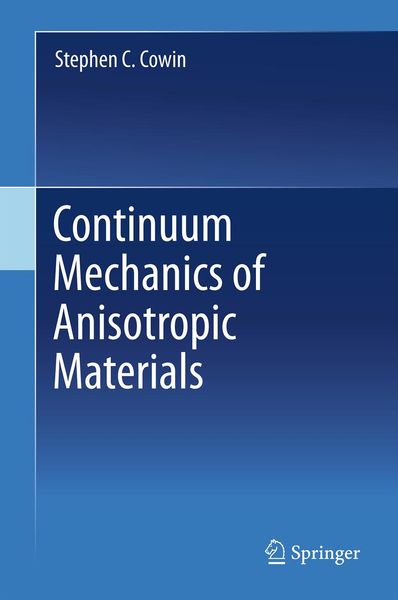
• Produktbild: Continuum Mechanics of Anisotropic Materials
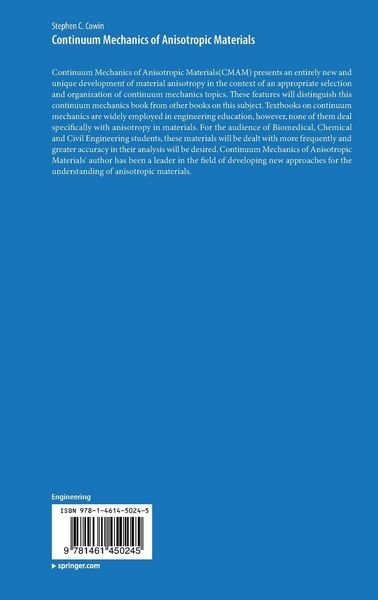
  • Produktbild: Continuum Mechanics of Anisotropic Materials

Continuum Mechanics of Anisotropic Materials

Fr. 73.90

inkl. gesetzl. MwSt., Versandkostenfrei


Beschreibung

Produktdetails

Einband

Gebundene Ausgabe

Erscheinungsdatum

08.01.2013

Verlag

Springer Us

Seitenzahl

425

Maße (L/B/H)

24.1/16/2.9 cm

Gewicht

822 g

Auflage

2013

Sprache

Englisch

ISBN

978-1-4614-5024-5

Beschreibung

Produktdetails

Einband

Gebundene Ausgabe

Erscheinungsdatum

08.01.2013

Verlag

Springer Us

Seitenzahl

425

Maße (L/B/H)

24.1/16/2.9 cm

Gewicht

822 g

Auflage

2013

Sprache

Englisch

ISBN

978-1-4614-5024-5

Herstelleradresse

Springer-Verlag KG
Sachsenplatz 4-6
1201 Wien
AT

Email: GPSR Kontakt

Noch keine Bewertungen vorhanden

Verfassen Sie die erste Bewertung zu diesem Artikel

Helfen Sie anderen Kundinnen und Kunden durch Ihre Meinung.

Kundinnen und Kunden meinen

Bewertungen (0)

  • Produktbild: Continuum Mechanics of Anisotropic Materials
  • Produktbild: Continuum Mechanics of Anisotropic Materials
  • Chapter 1. Introduction
    Chapter 2. Mechanical modeling of materials
    2.1 Introduction
    2.2 Models and the real physical world
    2.3 Guidelines for modeling objects and solving mechanics problems
    2.4 The types of models used in mechanics
    2.5 The particle model
    2.6 The rigid object model
    2.7 The deformable continuum model
    2.8 Lumped parameter models
    2.9 Statistical models
    2.10 Cellular automata
    2.11 The limits of reductionism
    2.12 References
    Appendix 2A Laplace transform refresher
    Appendix 2B First order differential equations
    Appendix 2C Electrical analogs of the spring and dashpot models
    Chapter 3. Basic continuum kinematics
    3.1 The deformable material model, the continuum
    3.2 Rates of change and the spatial representation of motion
    3.3 Infinitesimal motions
    3.4 The strain conditions of compatibility
    Chapter 4. Continuum formulations of conservation laws
    4.1 The conservation principles
    4.2 The conservation of mass
    4.3 The state of stress at a point
    4.4 The stress equations of motion
    4.5 The conservation of energy
    Chapter 5. Formulation of constitutive equations
    5.1 Guidelines for the formulation of constitutive equations
    5.2 Constitutive ideas
    5.3 Localization
    5.4 Invariance under rigid object motions
    5.5 Determinism
    5.6 Linearization
    5.7 Coordinate invariance
    5.8 Homogeneous versus inhomogeneous constitutive models
    5.9 Restrictions due to material symmetry
    5.10 The symmetry of the material coefficient tensors
    5.11 Restrictions on the coefficients representing material properties
    5.12 Summary of results
    5.13 Relevant literature
    Chapter 6 Modeling material symmetry
    6.1 Introduction
    6.2 The representative volume element (RVE)
    6.3 Crystalline materials and textured materials
    6.4 Planes of mirror symmetry
    6.5 Characterization of material symmetries by planes of symmetry
    6.6 The forms of the 3D symmetric linear transformation A
    6.7 The forms of the 6D symmetric linear transformation
    6.8 Curvilinear anisotropy
    6.9 Symmetries that permit chirality
    6.10 Relevant literature
    Chapter 7. Four linear continuum theories
    7.1 Formation of continuum theories
    7.2 The theory of fluid flow through rigid porous media
    7.3 The theory of elastic solids
    7.4 The theory of viscous fluids
    7.5 The theory of viscoelastic materials
    7.6 Relevant literature
    Chapter 8 Modeling material microstructure
    8.1 Introduction
    8.2 The representative volume element (RVE)
    8.3 Effective material parameters
    8.4 Effective elastic constants
    8.5 Effective permeability
    8.6 Structural gradients
    8.7 Tensorial representations of microstructure
    8.8 Relevant literature
    Chapter 9. Poroelasticity
    9.1 Poroelastic materials
    9.2 The stress-strain-pore pressure constitutive relation
    9.3 The fluid content-stress-pore pressure constitutive relation
    9.4 Darcy’s Law
    9.5 Matrix material and pore fluid incompressibility constraints
    9.6 The undrained elastic coefficients
    9.7 Expressions of mass and momentum conservation
    9.8 The basic equations of poroelasticity
    9.9 The basic equations of incompressible poroelasticity
    9.10 Some example isotropic poroelastic problems
    9.11 An example: the unconfined compression of an anisotropic disc
    9.12 Relevant literature
    Chapter 10 Mixture
    10.1 Introduction
    10.2 Kinematics of mixtures
    10.3 The conservation laws for mixtures
    10.4 A statement of irreversibility in mixture processes
    10.5 Donnan equilibrium and osmotic pressure
    10.6 Continuum model for a charged porous medium; the governing equations
    10.7 Linear irreversible thermodynamics and the four constituent mixture
    10.8 Modeling swelling and compression experiments on the intervertebral disc
    10.9 Relevant literature
    Chapter 11. Kinematics and mechanics of large deformations
    11.1 Large deformations
    11.2 Large homogeneous deformations
    11.3 Polar decomposition of the deformation gradients
    11.4 The strain measures for large deformations
    11.5 Measures of volume and surface change in large deformations
    11.6 Stress measures
    11.7 Finite deformation elasticity
    11.8 The isotropic finite deformation stress-strain relation
    11.9 Finite deformation hyperelasticity
    11.10 Incompressible elasticity
    11.11 Relevant literature
     
    Chapter 12. Plasticity Theory
    12.1 Extension of von Mises criterion to anisotropic materials
    12.2 Yield criteria for pressure sensitive anisotropic materials
    12.3 Some particular deformation characteristics exhibited by granular materials (dilatancy/contractancy, anisotropy, hardening/softening, and shear localization).
    12.4 Dilatant double shearing kinematics
    12.5 Evolution equations for the material parameters
    12.6 Numerical biaxial compression test of anisotropic granular materials
    12.6 Numerical triaxial compression test of anisotropic granular materials
    12.7 Plasticity theories for crystalline materials
    Appendix A. Matrices and tensors
    A.1 Introduction and rationale
    A.2 Definition of square, column and row matrices
    A.3 The types and algebra of square matrices
    A.4 The algebra of n-tuples
    A.5 Linear transformations
    A.6 Vector spaces
    A.7 Second rank tensors
    A.8 The moment of inertia tensor
    A.9 The alternator and vector cross products
    A.10 Connection to Mohr’s circles
    A.11 Special vectors and tensors in six dimensions
    A.12 The gradient operator and the divergence theorem
    A.13 Tensor components in cylindrical coordinates