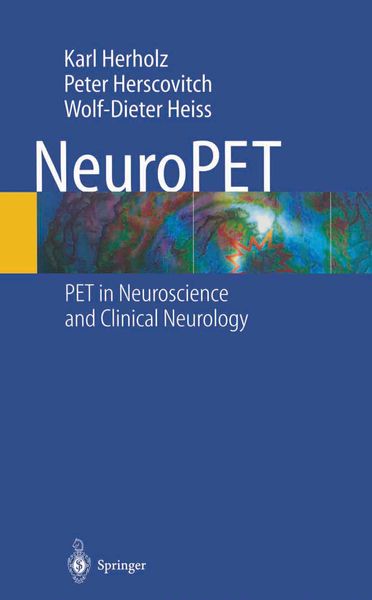

• Produktbild: Neuropet
  • Produktbild: Neuropet

Neuropet Positron Emission Tomography in Neuroscience and Clinical Neurology

Fr. 76.90

inkl. gesetzl. MwSt., Versandkostenfrei


Beschreibung

Produktdetails

Einband

Set mit diversen Artikeln

Erscheinungsdatum

16.06.2004

Abbildungen

6 schw.-w. und 60 farbige Abbildungen, 11 schw.-w. Tabellen, 3 schw.-w. und 53 farbige Fotos, 3 schw.-w. und 7 farbige Zeichnungen

Verlag

Springer Berlin

Seitenzahl

297

Maße (L/B/H)

24.1/16/2.3 cm

Gewicht

728 g

Auflage

2004

Sprache

Englisch

ISBN

978-3-540-00691-6

Beschreibung

Rezension

From the reviews:

This is the most comprehensive book written to date which reviews applications of PET in brain disorders, measurements of regional brain function, molecular imaging and PET methodology.

Rarer states are reviewed as well as those not normally considered as presenting with functional brain lesions such as pain and migraine.

For those with clinical PET facilities, this book will indentify how this technology could be exploited for the care of brain disorder patients.

RAD Magazine, December, 2005

"This book is by world authorities in both the methodology of positron emission tomography (PET) and its applications in clinical neurology. According to the authors, it is intended to ‘guide both nuclear medicine specialists and also neurologists and psychiatrists in the use of PET’; I assume they also meant to include neurosurgeons, neurophysiologists and clinical neuroscientists. … This book is unique in its kind. … it will prove an invaluable source of historical information about one of the major revolutions in understanding brain diseases." (J. –C. Baron, Acta Neurochirurgica, Vol. 147, 2005)

Produktdetails

Einband

Set mit diversen Artikeln

Erscheinungsdatum

16.06.2004

Abbildungen

6 schw.-w. und 60 farbige Abbildungen, 11 schw.-w. Tabellen, 3 schw.-w. und 53 farbige Fotos, 3 schw.-w. und 7 farbige Zeichnungen

Verlag

Springer Berlin

Seitenzahl

297

Maße (L/B/H)

24.1/16/2.3 cm

Gewicht

728 g

Auflage

2004

Sprache

Englisch

ISBN

978-3-540-00691-6

Herstelleradresse

Springer-Verlag GmbH
Heidelberger Platz 3
14197 Berlin
Deutschland
Email: sdc-bookservice@springer.com
Url: www.springer.com
Telephone: +49 6221 3454301
Fax: +49 30 8214091

Kundinnen und Kunden meinen

0 Bewertungen

Informationen zu Bewertungen

Zur Abgabe einer Bewertung ist eine Anmeldung im Konto notwendig. Die Authentizität der Bewertungen wird von uns nicht überprüft. Wir behalten uns vor, Bewertungstexte, die unseren Richtlinien widersprechen, entsprechend zu kürzen oder zu löschen.

Die Bewertungen sind nach Format, Anzahl Sterne und Datum sortiert.

Verfassen Sie die erste Bewertung zu diesem Artikel

Helfen Sie anderen Kund*innen durch Ihre Meinung

Kundinnen und Kunden meinen

0 Bewertungen filtern

  • Produktbild: Neuropet
  • Produktbild: Neuropet
  • 1 Introduction.- 2 Clinical Studies.- 2.1 Dementia and Memory Disorders.- 2.1.1 Clinical and Research Issues.- 2.1.2 Alzheimer’s Disease and Mild Cognitive Impairment.- 2.1.2.1 Cerebral Glucose Metabolism.- 2.1.2.2 Cholinergic Degeneration.- 2.1.2.3 Other Receptors and Transmitters.- 2.1.2.4 Amyloid Imaging.- 2.1.2.5 Activation Studies.- 2.1.3 Dementia with LewyBodies.- 2.1.4 Frontotemporal Dementia and Related Disorders.- 2.1.5 Vascular Dementia.- 2.1.6 Creutzfeldt-Iakob Disease.- 2.1.7 Other Memory Disorders.- 2.1.7.1 Hypoxic and Global Ischemic Brain Damage.- 2.1.7.2 Other Amnesic Syndromes.- 2.2 Movement Disorders.- 2.2.1 Idiopathic Parkinson Disease.- 2.2.1.1 Diagnostic Issues.- 2.2.1.2 Dopamine Synthesis.- 2.2.1.3 Dopamine Release and Turnover.- 2.2.1.4 Dopamine Transporters.- 2.2.1.5 Vesicular Monoamine Transporter.- 2.2.1.6 Dopamine Receptors.- 2.2.1.7 Mesocortical Dopaminergic Innervation.- 2.2.1.8 Other Transmitters.- 2.2.1.9 Resting Glucose Metabolism.- 2.2.1.10 Activation Studies.- 2.2.1.11 Familial PD.- 2.2.1.12 Disease Progression.- 2.2.1.13 Depression in PD.- 2.2.1.14 Improving and Understanding Treatment Effects.- 2.2.2 Multiple System Atrophy.- 2.2.2.1 Olivo-ponto-cerebellar Atrophy.- 2.2.2.2 Striatonigral Degeneration.- 2.2.2.3 Shy-Drager Syndrome.- 2.2.3 Other Neurodegenerative Disorders.- 2.2.3.1 Progressive Supranuclear Palsy.- 2.2.3.2 Corticobasal Degeneration.- 2.2.3.3 Disorders with Abnormal Deposition of Metals.- 2.2.3.4 Parkinsonism Attributable to Toxic and Inflammatory Brain Damage.- 2.2.3.5 Amyotrophic Lateral Sclerosis.- 2.2.3.6 Other Rare Disorders.- 2.2.4 Hyperkinetic Syndromes.- 2.2.4.1 Huntington’s Chorea (Huntington Disease).- 2.2.4.2 Other Choreic Disorders.- 2.2.4.3 Restless LegsSyndrome.- 2.2.4.4 Essential and Orthostatic Tremor.- 2.2.4.5 Tourette Syndrome.- 2.2.5 Dystonia and Related Disorders.- 2.2.5.1 Idiopathic Dystonia and Torticollis.- 2.2.5.2 DOPA-responsiveDystonia.- 2.2.5.3 Dystonia Attributable to Localized Lesions or Degeneration.- 2.2.6 Ataxia.- 2.2.6.1 Spinocerebellar Ataxia.- 2.2.6.2 Friedreich’s Ataxia.- 2.2.6.3 Other Ataxias.- 2.3 Brain Tumors.- 2.3.1 Biological Grading.- 2.3.1.1 Glucose Consumption.- 2.3.1.2 Amino Acid Uptake.- 2.3.1.3 Nucleoside Uptake.- 2.3.2 PET-Guided Stereotactic Biopsy.- 2.3.3 Differentiation Between Recurrent Tumor and Radiation Necrosis.- 2.3.4 Monitoring of Therapy.- 2.3.5 Identification of Hypoxic Tumor Tissue.- 2.3.6 Improving and Planning Therapy.- 2.3.7 New Therapies.- 2.3.8 Other Tracers for Brain Tumors.- 2.3.9 Extracranial Tumors of the Nervous System.- 2.3.10 Detection of Primary Tumors.- 2.3.11 Activation Studies.- 2.3.11.1 Motor Function.- 2.3.11.2 Language.- 2.4 Cerebrovascular Disease.- 2.4.1 Ischemic Stroke.- 2.4.2 Intracerebral and Subdural Hemorrhage.- 2.4.3 Subarachnoid Hemorrhage.- 2.4.4 Remote Effects (Diaschisis).- 2.4.5 Chronic Hemodynamic Impairment.- 2.4.6 Moyamoya Disease.- 2.4.7 Genetic Disorders (MELAS, CADASIL).- 2.4.8 Brain Function and RecoveryAfter Stroke.- 2.4.8.1 Aphasia.- 2.4.8.2 Motor Function.- 2.4.8.3 Neglect.- 2.5 Epilepsy.- 2.5.1 Localization of Epileptogenic Foci.- 2.5.1.1 Temporal Lobe Epilepsy.- 2.5.1.2 Neocortical Focal Epilepsy.- 2.5.1.3 Ictal Studies.- 2.5.1.4 GABA-A and Benzodiazepine Receptors.- 2.5.1.5 Other Transmitters and Receptors.- 2.5.1.6 Inflammatory Lesions and Glial Reaction.- 2.5.2 Progression of Epileptic Lesions.- 2.5.3 Prediction of Surgical Outcome.- 2.5.4 Malformations of Cortical Development.- 2.5.5 Childhood Epileptic Syndromes.- 2.5.6 Language Dominance.- 2.5.7 Effects of Surgical Intervention and Medical Treatment.- 2.5.8 Generalized Epilepsy.- 2.6 Other Neurological Disorders.- 2.6.1 Traumatic Brain Injury.- 2.6.2 Persistent VegetativeState.- 2.6.3 Perinatal Brain Damage.- 2.6.4 Inflammatory Disease.- 2.6.5 Pain.- 2.6.6 Migraine and Cluster Headache.- 2.6.7 Narcolepsy.- 2.6.8 Hypoparathyroidism (Fahr’s Disease).- 2.6.9 Systemic Inherited Metabolic Disorders.- 2.7 Psychiatric Disorders.- 2.7.1 Depression.- 2.7.1.1 Cerebral Blood Flowand Cerebral Metabolic Rate (Glucose).- 2.7.1.2 Serotonin Receptors.- 2.7.1.3 Serotonin Transporters.- 2.7.1.4 Other Transmitter Systems.- 2.7.2 Fatigue.- 2.7.3 Schizophrenia.- 2.7.3.1 CBF and Energy Metabolism.- 2.7.3.2 Activation Studies.- 2.7.3.3 Dopamine Receptors and Dopamine Release.- 2.7.3.4 Other Receptors.- 2.7.3.5 Receptor Binding of Antipsychotic Drugs.- 2.7.4 Anxiety Disorders.- 2.7.4.1 Panic Disorder.- 2.7.4.2 Phobic Disorders.- 2.7.4.3 Obsessive-compulsive Disorder.- 2.7.4.4 Posttraumatic Stress Disorder.- 2.7.5 Drug and Substance Abuse.- 2.7.5.1 Alcoholism.- 2.7.5.2 Cocaine.- 2.7.5.3 Amphetamine and Derivatives.- 2.7.5.4 Opiates.- 2.7.5.5 Nicotine.- 2.7.5.6 Hallucinogens.- 2.7.5.7 Phencyclidine.- 2.7.6 Personality and Behavioral Disorders.- 2.7.6.1 Borderline Personality Disorder.- 2.7.6.2 Violence and Suicide.- 2.7.7 Anorexia Nervosa and Bulimia.- 3 Imaging Brain Function.- 3.1 Blood-Brain Barrier Transfer.- 3.2 Cerebral Blood Flow.- 3.3 Oxygen Consumption.- 3.4 Glucose Consumption.- 3.5 Influence of Brain Function on CBF and Metabolism.- 3.5.1 Wakefulness and Sleep.- 3.5.2 Effect of Drugs.- 3.5.3 The “Resting State”.- 3.5.4 Activation Studies.- 3.6 Tissue Oxygen Pressureand pH.- 3.7 Amino Acid Transport and Protein Synthesis.- 3.7.1 Transport-only Tracers.- 3.7.2 Tracers with Incorporation into Proteins.- 3.7.3 Precursors and Analogues for Transmitter Systems.- 3.8 Nucleosides and DNA Synthesis.- 3.9 Molecular Imaging.- 3.9.1 Herpes Simplex Virus Thymidine Kinase Imaging.- 3.9.2 Reporter Gene Imaging.- 3.9.3 Oligonucleotides.- 3.9.4 Apoptosis and p53.- 3.9.5 Cell Trafficking.- 3.9.6 Angiogenesis.- 3.10 Dopamine System.- 3.10.1 Precursors and Analogues of Dopamine.- 3.10.2 Dopamine Transporter.- 3.10.3 Vesicular Monoamine Transporter.- 3.10.4 D1 Receptors.- 3.10.5 D2 Receptors.- 3.10.6 Studies of Synaptic Dopamine Release.- 3.10.7 Monoamine Oxidase.- 3.11 Cholinergic System.- 3.11.1 Acetylcholine Synthesis.- 3.11.2 Vesicular Acetylcholine Transporter.- 3.11.3 Nicotinic Receptors.- 3.11.4 Muscar inic Receptors.- 3.11.5 Acetylcholine Esterase.- 3.12 Serotonin System.- 3.12.1 Serotonin Precursors.- 3.12.2 Serotonin Transporter.- 3.12.3 Serotonin Receptors.- 3.12.3.1 Serotonin 1A Receptors.- 3.12.3.2 Serotonin 2A Receptors.- 3.13 Gamma-aminobutyric acid (GABA).- 3.13.1 Central Benzodiazepine-binding Sites.- 3.13.2 Peripheral Benzodiazepine Receptors.- 3.14 Glutamate and NMDA Receptors.- 3.15 Adenosine Receptors.- 3.16 Histamine Receptors.- 3.17 Cannabinoid Receptors.- 3.18 Opioid Receptors and Sigma Receptor.- 3.19 Steroid Receptors.- 3.20 Substance P.- 3.21 Secondary Neurotransmitters.- 4 Data Acquisition, Reconstruction, Modeling, Statistics.- 4.1 Positron Emitters and Tracers.- 4.2 Scanners and Detector Systems.- 4.3 Data Acquisition.- 4.4 Image Reconstruction.- 4.5 Motion Detection and Correction.- 4.6 Data Visualization.- 4.7 Image Coregistration.- 4.7.1 Fiducial Markers.- 4.7.2 Matching of Brain Structures.- 4.7.3 Algorithms for Maximization of Similarity.- 4.7.4 PET/CT and PET/MRI Scanners.- 4.8 Anatomical Standardization.- 4.8.1 Orientation of Transaxial Slices.- 4.8.2 Matching of Individual Brains to Image Templates (“Spatial Normalization”).- 4.8.3 Atlases for Identification of Anatomical Structures.- 4.9 Physiological Modeling.- 4.9.1 Blood and Homogeneous Tissue (One Tissue Compartment).- 4.9.1.1 Transport across the BBB.- 4.9.1.2 Cerebral Blood Flow.- 4.9.1.3 Mixed Effects of Transport and Blood Flow.- 4.9.1.4 Measurement of the Partition Coefficient.- 4.9.1.5 Saturable Transport and Enzyme Reactions.- 4.9.2 Metabolism.- 4.9.2.1 Irreversible Metabolism (Metabolic Trapping).- 4.9.2.2 Measurement of Local Cerebral Glucose Metabolism.- 4.9.2.3 The Reference Tissue Model for Dopamine Synthesis and Storage.- 4.9.2.4 Reversible Metabolism or Binding.- 4.9.3 Receptor Binding.- 4.9.3.1 Irreversible Receptor Binding.- 4.9.3.2 Equilibrium Approaches for Quantification of Reversible Receptor Binding.- 4.9.4 Extraction of Model Parameters from Kinetic Data.- 4.10 Quantitative Data Analysis.- 4.10.1 Regions/Volumes of Interest.- 4.10.2 Partial Volume Correction.- 4.10.3 Statistical Models for Quantitative Data.- 4.10.4 Parametric Imaging.- 4.10.5 Statistical Parametric Mapping.- 4.10.6 Lesion Detection and Pattern Recognition.- References.