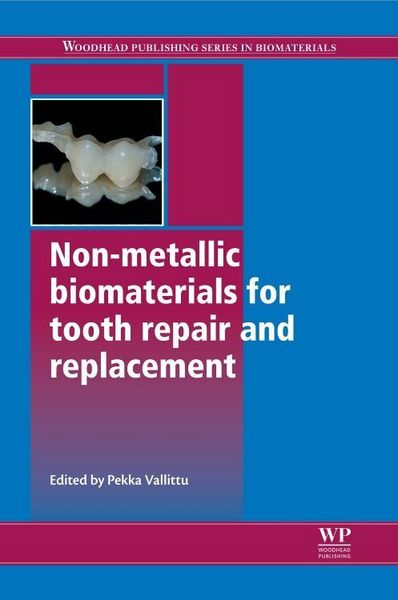
Vallittu, P: Non-Metallic Biomaterials for Tooth Repair and
Aus der Reihe
Woodhead Publishing Series in Biomaterials
Fr. 268.00
inkl. gesetzl. MwSt.,
Beschreibung
Produktdetails
Einband
Gebundene Ausgabe
Erscheinungsdatum
11.12.2012
Herausgeber
P. VallittuVerlag
Elsevier Science & TechnologySeitenzahl
432
Maße (L/B/H)
23.4/15.5/23.3 cm
Gewicht
790 g
Sprache
Englisch
ISBN
978-0-85709-244-1
As the demand for healthy, attractive teeth increases, the methods and materials employed in restorative dentistry have become progressively more advanced. Non-metallic biomaterials for tooth repair and replacement focuses on the use of biomaterials for a range of applications in tooth repair and, in particular, dental restoration.
Part one reviews the structure, modification and repair of dental tissues. The properties of enamel and dentin and their role in adhesive dental restoration are discussed, along with biomineralization and biomimicry of tooth enamel, and enamel matrix proteins (EMPs) for periodontal regeneration. Part two goes on to discuss the processing, bonding and wear properties of dental ceramics, glasses and sol-gel derived bioactive glass ceramics for tooth repair and replacement. Dental composites for tooth repair and replacement are then the focus of part three, including composite adhesive and antibacterial restorative materials for dental applications. The effects of particulate filler systems on the properties and performance of dental polymer composites are considered, along with composite based oral implants, fibre reinforced composites (FRCs) as dental materials and luting cements for dental applications.
With its distinguished editor and international team of expert contributors, Non-metallic biomaterials for tooth repair and replacement provides a clear overview for all those involved in the development and application of these materials, including academic researchers, materials scientists and dental clinicians.
Part one reviews the structure, modification and repair of dental tissues. The properties of enamel and dentin and their role in adhesive dental restoration are discussed, along with biomineralization and biomimicry of tooth enamel, and enamel matrix proteins (EMPs) for periodontal regeneration. Part two goes on to discuss the processing, bonding and wear properties of dental ceramics, glasses and sol-gel derived bioactive glass ceramics for tooth repair and replacement. Dental composites for tooth repair and replacement are then the focus of part three, including composite adhesive and antibacterial restorative materials for dental applications. The effects of particulate filler systems on the properties and performance of dental polymer composites are considered, along with composite based oral implants, fibre reinforced composites (FRCs) as dental materials and luting cements for dental applications.
With its distinguished editor and international team of expert contributors, Non-metallic biomaterials for tooth repair and replacement provides a clear overview for all those involved in the development and application of these materials, including academic researchers, materials scientists and dental clinicians.
Noch keine Bewertungen vorhanden
Verfassen Sie die erste Bewertung zu diesem Artikel
Helfen Sie anderen Kundinnen und Kunden durch Ihre Meinung.