
Recent Developments in Foresight Methodologies
-
- Hardcover ausgewählt
- Taschenbuch
- eBook
-
Sprache:Englisch
Fr. 202.00
inkl. gesetzl. MwSt.,
Beschreibung
Produktdetails
Einband
Gebundene Ausgabe
Erscheinungsdatum
27.11.2012
Herausgeber
Maria Giaoutzi + weitereVerlag
Springer UsSeitenzahl
310
Maße (L/B/H)
24.1/16/2.1 cm
Gewicht
602 g
Auflage
2013
Sprache
Englisch
ISBN
978-1-4614-5214-0
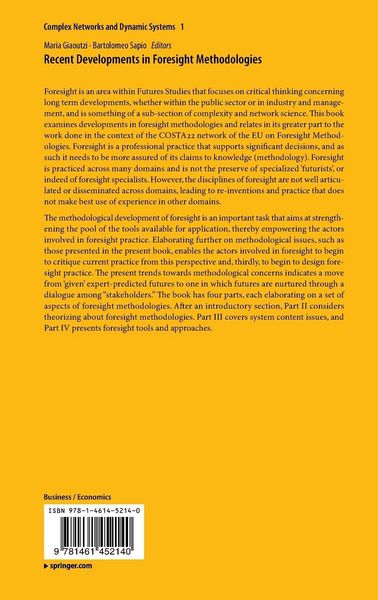
Foresight is an area within Futures Studies that focuses on critical thinking concerning long term developments, whether within the public sector or in industry and management, and is something of a sub-section of complexity and network science. This book examines developments in foresight methodologies and relates in its greater part to the work done in the context of the COSTA22 network of the EU on Foresight Methodologies. Foresight is a professional practice that supports significant decisions, and as such it needs to be more assured of its claims to knowledge (methodology). Foresight is practiced across many domains and is not the preserve of specialized ‘futurists’, or indeed of foresight specialists. However, the disciplines of foresight are not well articulated or disseminated across domains, leading to re-inventions and practice that does not make best use of experience in other domains.
The methodological development of foresight is an important task that aims at strengthening the pool of the tools available for application, thereby empowering the actors involved in foresight practice. Elaborating further on methodological issues, such as those presented in the present book, enables the actors involved in foresight to begin to critique current practice from this perspective and, thirdly, to begin to design foresight practice. The present trends towards methodological concerns indicates a move from ‘given’ expert-predicted futures to one in which futures are nurtured through a dialogue among “stakeholders.” The book has four parts, each elaborating on a set of aspects of foresight methodologies. After an introductory section, Part II considers theorizing about foresight methodologies. Part III covers system content issues, and Part IV presents foresight tools and approaches.
Noch keine Bewertungen vorhanden
Verfassen Sie die erste Bewertung zu diesem Artikel
Helfen Sie anderen Kundinnen und Kunden durch Ihre Meinung.