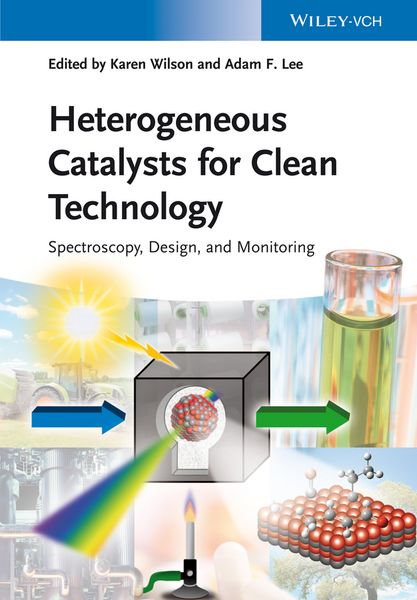
Produktbild: Heterogeneous Catalysts for Clean Technology

Heterogeneous Catalysts for Clean Technology Spectroscopy, Design, and Monitoring

Fr. 209.00

inkl. gesetzl. MwSt., Versandkostenfrei


Beschreibung

Produktdetails

Einband

Gebundene Ausgabe

Erscheinungsdatum

23.10.2013

Herausgeber

Karen Wilson + weitere

Verlag

Wiley-VCH

Seitenzahl

504

Maße (L/B/H)

25.1/17.4/3.2 cm

Gewicht

1240 g

Auflage

1. Auflage

Sprache

Englisch

ISBN

978-3-527-33213-7

Beschreibung

Portrait

Karen Wilson graduated in1992 from the University of Cambridge with a BA in Natural Sciences, and obtained an MSc with distinction in heterogeneous catalysis in 1993 from the University of Liverpool. She returned to Cambridge (1993-98) where she undertook both PhD and post-doctoral research in heterogeneous catalysis and surface science with Prof. Richard Lambert. In 1998 she moved to the University of York, to pursue post-doctoral research on the development of new mesoporous solid acids for clean technologies with Prof. James Clark, and was subsequently appointed to a lectureship at York in 1999. Dr Wilson was promoted to Senior Lecturer in 2007, prior to her appointment in 2009 as a Reader in Physical Chemistry at Cardiff University. She is currently a Royal Society Industry Fellow working with Johnson Matthey. Her research interests lie in the design of heterogeneous catalysts for clean chemical synthesis, particularly the design of tuneable porous materials for sustainable biofuels and chemicals production.


Adam F. Lee obtained a BA in Natural Sciences and a PhD in surface science and catalysis from the University of Cambridge, and was appointed a Lecturer in Physical Chemistry at the University of Hull in 1997. After moving to the University of York and promotion to Senior Lecturer, he was appointed Professor of Physical Chemistry at Cardiff University in 2009, where he is a senior member of the Cardiff Catalysis Institute and also holds an EPSRC Leadership Fellowship. His research spans heterogeneous catalysis, nanoporous solids, green chemistry and synchrotron science, in which he has authored over 130 articles. Professor Lee was awarded the 2000 CR Burch Prize by the British Vacuum Council, the 2004 Fonda-Fasella Prize of the Elettra synchrotron, the 2011 McBain Medal of the Royal Society of Chemistry and Society of Chemical Industry, and 2012 Beilby Medal of the Royal Society of Chemistry, IOM3 and Society of Chemical Industry for outstanding contributions in the field of heterogeneous catalysis and surface science.

Produktdetails

Einband

Gebundene Ausgabe

Erscheinungsdatum

23.10.2013

Herausgeber

Verlag

Wiley-VCH

Seitenzahl

504

Maße (L/B/H)

25.1/17.4/3.2 cm

Gewicht

1240 g

Auflage

1. Auflage

Sprache

Englisch

ISBN

978-3-527-33213-7

Herstelleradresse

Wiley-VCH GmbH
product_safety@wiley.com
Wiley-VCH GmbH, Boschstrasse 12, DE-69469 Weinheim

Noch keine Bewertungen vorhanden

Verfassen Sie die erste Bewertung zu diesem Artikel

Helfen Sie anderen Kundinnen und Kunden durch Ihre Meinung.

Kundinnen und Kunden meinen

Bewertungen (0)

Die Leseprobe wird geladen.
  • Produktbild: Heterogeneous Catalysts for Clean Technology
  • INTRODUCTION TO CLEAN TECHNOLOGY AND CATALYSIS

    Green Chemistry and Clean Technology

    Green Chemistry Metrics

    Alternative Solvents

    Heterogeneous or Homogeneous

    Alternative Energy Reactors for Green Chemistry

    Concluding Remarks


    MECHANISTIC STUDIES OF ALCOHOL SELECTIVE OXIDATION

    Introduction

    Metal-Catalyzed Alcohol Selox

    Oxide, Sulfide, and Vanadate Catalysts

    Solvent Selection

    In Situ and Operando X-Ray Studies of Selox Catalysts

    Conclusions


    REACTION MONITORING IN MULTIPHASE SYSTEMS: APPLICATION OF COUPLED IN SITU SPECTROSCOPIC TECHNIQUES IN ORGANIC SYNTHESIS

    Introduction

    Method Coupling

    Spectroscopic Reactors and Practical Aspects

    Selected Examples of Use

    Conclusion and Outlook


    IN SITU STUDIES ON PHOTOCATALYTIC MATERIALS, SURFACE INTERMEDIATES, AND REACTION MECHANISM

    Introduction

    In Situ Investigations

    Concluding Remarks


    ENANTIOSELECTIVE HETEROGENEOUS CATALYSIS

    Introduction

    Strategies for the Creation of Enantioselective Heterogeneous Catalysts

    Concluding Remarks - A Comparison of the Various Approaches to Heterogeneous Enantioselective Catalysts


    MECHANISTIC STUDIES OF SOLID ACIDS AND BASE-CATALYZED CLEAN TECHNOLOGIES

    Introduction

    New Catalytic Systems

    Biomass Conversions

    Summary


    SITE-ISOLATED HETEROGENEOUS CATALYSTS

    Introduction

    Assembled Monolayers of Metal Complexes on Single-Crystal Surfaces

    Reaction-Induced and Photoinduced Formation of Unsaturated Ru Complexes Supported on SiO2 Surfaces

    Manganese Triazacyclononane Catalysts Grafted under Reaction Conditions

    Well-Defined Silica-Supported Mo-Imido Alkylidene Complexes for Metathesis

    Double Catalytic Activation Using a Bifunctional Catalyst with both Acid and Base on Solid Surfaces

    Summary


    DESIGNING POROUS INORGANIC ARCHITECTURES

    Introduction

    Templated Methods for the Preparation of Ordered Porous Materials

    Hierarchical Porous Materials

    Concluding Remarks


    TAILORED NANOPARTICLES FOR CLEAN TECHNOLOGY - ACHIEVING SIZE AND SHAPE CONTROL

    Introduction

    Size Effects-Setting the Scene

    Size Effects Illustrated by Way of Examples of Selected Industrially Important Reactions

    Shape Effects

    Conclusion


    APPLICATIO OF METAL-ORGANIC FRAMEWORKS IN FINE CHEMICAL SYNTHESIS

    Metal-Organic Frameworks as Heterogeneous Catalysts

    Applications in Carbon-Carbon Bond Formation

    Applications in Oxidation, Carbon-Oxygen, and Carbon-Nitrogen Bond Formation

    Applications in Asymmetric Synthesis

    Concluding Remarks


    PROCESS INTENSIFICATION FOR CLEAN CATALYTIC TECHNOLOGY

    Introduction

    Effect of Transport Phenomena on Heterogeneous Catalysis

    Conclusion


    RECENT TRENDS IN OPERANDO AND IN SITU CHARACTERIZATION: TECHNIQUES FOR RATIONAL DESIGN OF CATALYSTS

    Introduction

    Catalyst Nascence

    Synthesis of Silicalite-1 Molecular Sieves

    Preparation of Supported Metal Catalysts

    Catalyst Life

    Elucidating the Reaction Mechanism of Aerobic Oxidation of Benzyl Alcohol

    Determination of the Active Sites in Aerobic Oxidation of Benzyl Alcohol

    Catalyst Death

    Methanol to Hydrocarbons

    Propane Dehydrogenation

    Summary and Conclusions


    APPLICATION OF NMR IN ONLINE MONITORING OF CATALYST PERFORMANCE

    Online Monitoring with NMR Spectroscopy

    Quantitative NMR Spectroscopy in Technical Samples

    Flow and High-Pressure NR Spectroscopy for Reaction Monitoring

    Selected Applications of NMR in Online Monitoring of Catalyst Performance

    Conclusions


    AMBIENT-PRESSURE X-RAY PHOTOELECTRON SPECTROSCOPY

    Introduction

    Technical Aspects

    Applications of APXPS

    Outlook