• Produktbild: Cosmology
  • Produktbild: Cosmology

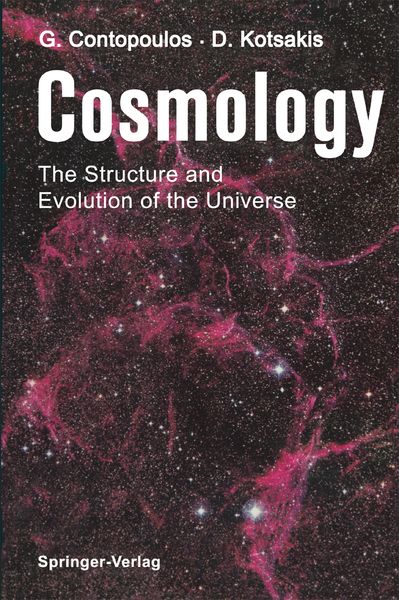
Cosmology The Structure and Evolution of the Universe

Fr. 137.00

inkl. gesetzl. MwSt., Versandkostenfrei


Beschreibung

Produktdetails

Einband

Taschenbuch

Erscheinungsdatum

27.02.1987

Verlag

Springer Berlin

Seitenzahl

236

Maße (L/B/H)

22.9/15.2/1.4 cm

Gewicht

458 g

Auflage

Softcover reprint of the original 1st ed. 1987

Übersetzt von

M. Petrou + weitere

Sprache

Englisch

ISBN

978-3-540-16922-2

Beschreibung

Produktdetails

Einband

Taschenbuch

Erscheinungsdatum

27.02.1987

Verlag

Springer Berlin

Seitenzahl

236

Maße (L/B/H)

22.9/15.2/1.4 cm

Gewicht

458 g

Auflage

Softcover reprint of the original 1st ed. 1987

Übersetzt von

  • M. Petrou
  • P.L. Palmer

Sprache

Englisch

ISBN

978-3-540-16922-2

Herstelleradresse

Springer-Verlag KG
Sachsenplatz 4-6
1201 Wien
AT

Email: GPSR Kontakt

Noch keine Bewertungen vorhanden

Verfassen Sie die erste Bewertung zu diesem Artikel

Helfen Sie anderen Kundinnen und Kunden durch Ihre Meinung.

Kundinnen und Kunden meinen

Bewertungen (0)

  • Produktbild: Cosmology
  • Produktbild: Cosmology
  • I Observations.- 1. Our Galaxy.- 1.1 Observing Our Galaxy.- 1.2 The Hertzsprung-Russell Diagram.- 1.3 Globular Clusters.- 1.4 Open Clusters.- 1.5 OB Associations.- 1.6 Interstellar Medium.- 1.7 Interstellar Clouds.- 1.7.1 Bright Nebulae.- 1.7.2 Dark Nebulae.- 1.7.3 Neutral Hydrogen Nebulae.- 1.8 Radio Waves from Our Galaxy.- 1.8.1 Radio Sources.- 1.8.2 The 21 cm-Line and the Distribution of Hydrogen in the Galaxy.- 1.8.3 Recombination Lines.- 1.8.4 Microwave Radiation from Molecules.- 1.8.5 Continuous Radio Emission.- 1.9 x-Ray, ?-Ray, Ultraviolet and Infrared Astronomy.- 1.10 Pulsars (Neutron Stars).- 1.11 Magnetic Fields and Cosmic Rays.- 1.11.1 Magnetic Fields.- 1.11.2 Cosmic Rays.- 1.12 Stellar Populations.- 1.13 The Spiral Shape of Our Galaxy.- 1.14 Kinematics of the Galaxy.- 1.14.1 Motion of the Sun.- 1.14.2 Distribution of Stellar Velocities.- 1.14.3 Rotation of the Galaxy.- 1.15 Dynamics of the Galaxy.- 1.16 A General Picture of the Galaxy.- 2. Galaxies and Clusters of Galaxies.- 2.1 Classification of Galaxies.- 2.2 Observations of Galaxies.- 2.3 Magellanic Clouds.- 2.4 The Andromeda Galaxy.- 2.5 Spiral Galaxies.- 2.6 Elliptical Galaxies.- 2.7 The Local Group.- 2.8 Multiple Galaxies and Clusters of Galaxies.- 2.9 Collisions of Galaxies.- 2.10 Distances of Galaxies and Clusters of Galaxies.- 2.11 Masses of Galaxies and Clusters of Galaxies.- 2.12 The Virial Theorem.- 2.13 Peculiar Galaxies.- 2.14 Quasars.- 3. Distribution of Matter in the Universe.- 3.1 Intergalactic Matter.- 3.2 Superclusters.- 3.3 Voids.- 3.4 Isotropy and Homogeneity of the Universe.- 3.5 Counts of Galaxies.- 3.6 Microwave Background Radiation.- 3.7 Expansion of the Universe.- II Theory.- 4. Introduction to the Study of the Universe.- 4.1 Olbers’ Paradox.- 4.2 Calculation of the Energy Which Comes from all the Stars.- 5. General Theory of Relativity.- 5.1 The Concept of Curved Spacetime.- 5.2 Tensors and the General Theory of Relativity.- 5.3 Einstein’s Field Equations.- 5.4 Experimental Verification of the General Theory of Relativity.- 5.5 Gravitational Waves.- 5.6 Black Holes.- 5.7 Formulae Related to Black Holes.- 5.8 Schwarzschild Black Holes.- 5.9 Observations of Black Holes.- 5.10 Rotating Black Holes.- 5.11 Thermodynamics and Quantum Mechanics of Black Holes.- 6. Relativistic Cosmology.- 6.1 Cosmological Solutions of Einstein’s Equations.- 6.2 The Geometry of the Universe.- 6.3 Spherical Space of Three Dimensions.- 6.4 The Theory of the Expanding Universe.- 6.5 Theoretical Interpretation of Hubble’s Law.- 6.6 Is the Universe Finite or Not?.- 6.6.1 Intergalactic Gas and Dust.- 6.6.2 Intergalactic Stars.- 6.6.3 Photons and Gravitons.- 6.6.4 Neutrinos.- 6.6.5 Magnetic Monopoles and Other Exotic Particles.- 6.6.6 Limits Imposed by Cosmic Nucleosynthesis.- 6.7 The Big Bang Theory.- 6.8 The Distribution of Radiogalaxies.- 6.9 The Age of the Universe.- 6.9.1 The Expansion of the Universe.- 6.9.2 The Ages of the Radioactive Elements.- 6.9.3 The Ages of the Globular Clusters.- 6.10 The Ages of the Chemical Elements.- 6.11 Different Models Derived from the General Theory of Relativity.- 7. Other Cosmological Theories.- 7.1 Newtonian Cosmology.- 7.2 Kinematic Relativity.- 7.3 The Theory of Continuous Creation.- 7.4 The Brans-Dicke Theory.- 7.5 Dime’s Theory.- 7.6 Jordan’s Theory.- 7.7 Conclusions.- 8. The Beginning of the Universe.- 8.1 The First Stages of the Expansion.- 8.1.1 Temperature 1011 K (Age of the Univers t = 0.01 sec).- 8.1.2 Temperature 1010 K (Age of the Universe t = 1.1 sec).- 8.1.3 Temperature 109 K (Age of the Universe t = 3 min).- 8.2 Energy of Radiation and Matter.- 8.3 The Formation of Galaxies and Clusters of Galaxies.- 8.3.1 Theories of the Formation of Protogalaxies and Protoclusters.- 8.3.2 Theories of Galaxy Formation from the Collapse of Protogalaxies.- 8.4 Jeans’ Instability.- 8.5 Cosmology and Elementary Particles.- 8.6 Matter and Antimatter.- 8.7 Quantum Gravity.- 8.8 The Inflationary Universe.- 9. The Evolution of the Universe.- 9.1 The Arrow of Time.- 9.1.1 The Increase of Entropy.- 9.1.2 Psychological Time.- 9.1.3 The Expansion of the Universe.- 9.1.4 The Decay of Ko Particles.- 9.2 The Future of the Universe.- 9.2.1 Pulsating Universe.- 9.2.2 Continuously Expanding Universe.- III Fundamental Problems.- 10. The Physics of the Universe.- 10.1 The Unity of Nature.- 10.2 The Laws of the Universe.- 10.3 The Uncertainty of the Physical Laws.- 10.3.1 The Uncertainty in the Knowledge of the Physical Laws.- 10.3.2 Instabilities.- 10.3.3 The Finite Speed of Light.- 10.3.4 Heisenberg’s Principle of Uncertainty and the Uncertainty of Human Actions.- 10.4 How Certain Are Our Conclusions?.- 11. Cosmological Problems.- 11.1 Inflation and Causality.- 11.2 Space and Time at the Beginning of the Expansion.- 11.3 Is the Universe Cyclic?.- 11.4 Is There an “Ultimate” Theory of the Universe?.- 11.5 Causality and Teleology.- 11.6 Cosmology and Metaphysics.- References.- Further References for the Figures.- Name Index.