Gutscheinbedingungen

*Gültig bis 05.07.2026 auf (fast) alles. Ausgeschlossen sind Smartboxen, Zeitschriften, Tickets, Lebensmittel, Gaming-Elektroartikel, Tinte/Toner, Gutscheine, Geschenkkarten, Blumen und Abos | Einlösbar in allen Buchhandlungen von Orell Füssli, Barth Bücher, Buchladen Rapunzel, Papeterie Köhler, Schuler Orell Füssli, Stauffacher und ZAP unter Vorweisung des Gutscheins, auf www.orellfüssli.ch durch Eingabe des Gutscheincodes. Beim Service „eBooks verschenken“ und bei eBook-Käufen via eReader nicht einlösbar | Mindesteinkaufswert: Fr. 30.- | Nicht mit anderen Rabatten kumulierbar.

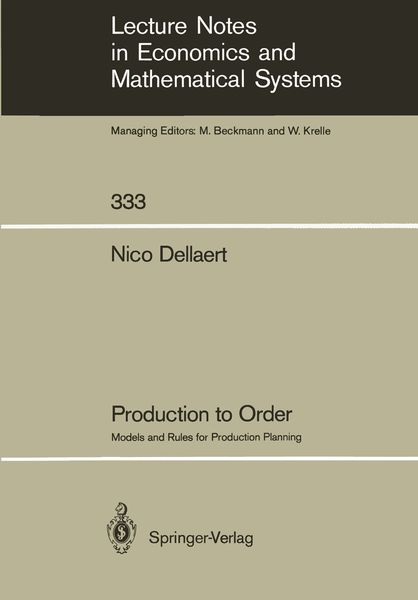
  • Produktbild: Production to Order
  • Produktbild: Production to Order
Band 333

Production to Order Models and Rules for Production Planning

Fr. 72.90

inkl. gesetzl. MwSt., Versandkostenfrei


Beschreibung

Produktdetails

Einband

Taschenbuch

Erscheinungsdatum

21.06.1989

Verlag

Springer Berlin

Seitenzahl

158

Maße (L/B/H)

24.4/17/0.9 cm

Gewicht

309 g

Auflage

Softcover reprint of the original 1st ed. 1989

Sprache

Englisch

ISBN

978-3-540-51309-4

Beschreibung

Produktdetails

Einband

Taschenbuch

Erscheinungsdatum

21.06.1989

Verlag

Springer Berlin

Seitenzahl

158

Maße (L/B/H)

24.4/17/0.9 cm

Gewicht

309 g

Auflage

Softcover reprint of the original 1st ed. 1989

Sprache

Englisch

ISBN

978-3-540-51309-4

Herstelleradresse

Springer-Verlag KG
Sachsenplatz 4-6
1201 Wien
AT

Email: GPSR Kontakt

Noch keine Bewertungen vorhanden

Verfassen Sie die erste Bewertung zu diesem Artikel

Helfen Sie anderen Kundinnen und Kunden durch Ihre Meinung.

Kundinnen und Kunden meinen

Bewertungen (0)

  • Produktbild: Production to Order
  • Produktbild: Production to Order
  • 1. Introduction.- 1.1. Production to order.- 1.2. Description of the problem.- 1.3. The control rules.- 1.3.1. The control rules for the lead times.- 1.3.2. The control rules for the production planning.- 1.4. The performance of the control rules.- 1.5. Influences on the control rules.- 1.5.1. Influence of the market.- 1.5.2. Influence of the production facilities.- 1.6. The methods.- 1.7. Overview of the text.- 2. Preliminaries.- 2.1. The situation and the model.- 2.2. Costs as instruments for decision making.- 2.3. Control rules for production planning.- 2.4. Control rules for lead times and order acceptance.- 3. A Fixed Production Cycle.- 3.1. Introduction.- 3.2. Analysis of fixed production cycles.- 3.2.1. Extended gating cyclic service model.- 3.2.2. Normal gating cyclic service with strict capacity.- 3.2.3. Normal gating service with flexible capacity.- 4. Non Cyclic Methods for One Product Type.- 4.1. Introduction.- 4.2. Fixed lead times.- 4.2.1. Introduction.- 4.2.2. Description of the model.- 4.2.3. The optimal production policy.- 4.2.4. Heuristic procedures.- 4.2.4.1. Notation.- 4.2.4.2. The Silver-Meal approach.- 4.2.4.3. The Wagner-Whitin approach.- 4.2.4.4. The (x,T)-rule.- 4.2.5. Numerical results.- 4.2.5.1. Conclusions.- 4.2.6. Orders with different priorities.- 4.2.6.1. Introduction.- 4.2.6.2. Model.- 4.3. A fluctuating demand rate.- 4.3.1. Introduction.- 4.3.2. Model.- 4.3.3. Example of lateness-dependent demand.- 4.3.4. Numerical results.- 4.4. A decision rule for lead times.- 4.4.1. Introduction.- 4.4.2. The model.- 4.4.3. A cyclic approach.- 4.4.4. The dynamic programming rule.- 4.4.5. Simplified dynamic programming rule.- 4.4.6. Numerical results.- 5. Several Types of Products on One Machine.- 5.1. Introduction.- 5.1.1. Description of the model.- 5.1.2. Notation.- 5.2. No possibilities for working overtime.- 5.2.1 Introduction.- 5.2.2. Extended (x,T)-rule.- 5.2.2.1. Introduction to the extended (x,T)-rule.- 5.2.2.2. Formulation of the extended (x,T)-rule.- 5.2.3. The two-step rule.- 5.2.3.1. Introduction to the two-step rule.- 5.2.3.2. Formulation of the first part.- 5.2.3.3. Formulation of the second part.- 5.2.4. A semi-fixed cycle rule.- 5.2.4.1. Introduction.- 5.2.4.2. Determining a semi-fixed cycle.- 5.2.5. Numerical results.- 5.3. Situation in which extra capacity is available.- 5.3.1. Introduction.- 5.3.2. Extended overtime (x,T)-rule.- 5.3.2.1. Introduction to the extended overtime (x,T)-rule.- 5.3.2.2. Formulation of the extended overtime (x,T)-rule.- 5.3.3. The two-step overtime rule.- 5.3.4. The semi-fixed cycle rule.- 5.3.5. Numerical results.- 6. Analysis of Multi-Type Models.- 6.1. Introduction.- 6.2. The multi (x,T)-rule.- 6.2.1. Analysis of the multi (x,T)-rule.- 6.2.2. Numerical results.- 6.2.3. Other possibilities and conclusions.- 6.3. Continuous review model.- 6.3.1. Introduction.- 6.3.2. Production model.- 6.3.3. Decomposition model.- 6.3.4. Results for the normal extended service.- 6.3.5. Numerical results and comparison with fixed cycle.- 7. The (x,T)-Rule in Complex Situations.- 7.1. Description of the problem.- 7.2. The elements of the extended (x,T)-rule.- 7.2.1. The penalty points.- 7.2.2. The allocation of capacity.- 7.2.3. Planning on different machines.- 7.3. Determination of lead times.- 7.3.1. Acceptance of the lead times.- 7.4. Numerical results.- 8. Summary and Conclusions.- 8.1. Summary and conclusions.- References.