Economic Efficiency of the Organizational Decisions of the Firm
-
- Englisch ausgewählt
Fr. 72.90
inkl. gesetzl. MwSt.,
Beschreibung
Produktdetails
Einband
Taschenbuch
Erscheinungsdatum
13.10.1989
Verlag
Springer BerlinSeitenzahl
227
Maße (L/B/H)
24.2/17/1.4 cm
Gewicht
425 g
Auflage
Softcover reprint of the original 1st ed. 1989
Sprache
Englisch
ISBN
978-3-540-51570-8
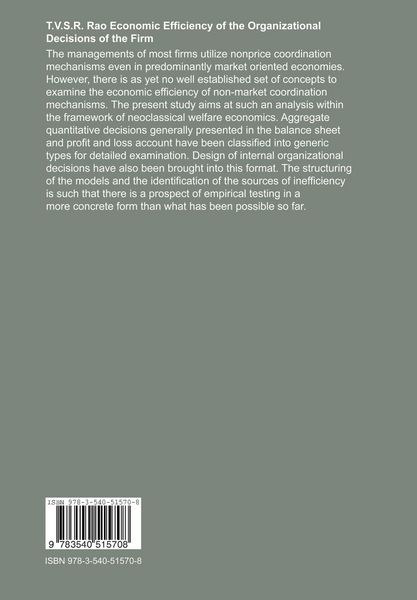
Over the past several years there has been an awareness that mar kets, contractual arrangements, and hierarchical organizations can be uti lized as alternative modes of coordinating resource utilization in the con text of the firm. In most practical situations mixed forms of organization are more frequent. That is, non-market coordination mechanisms are being utilized even in predominantly market oriented economies. The reasons for the use of one of these organizational modes over the others are still being examined extensively. Very often, asset specificity and bilateral monopoly, risk sharing under uncertainty, transaction cost considerations, and/or technological externalities (economies of scope) have been considered as the major reasons for preferring one of these modes over the others. However, the ultimate effect on the performance of the firm, of any of these aspects which result in the adoption of any specific organizational pattern, has to be through the cost curve and/or the demand curve. The neoclassical welfare concepts, which have been developed to examine the efficiency in the functioning of markets, are well known. The sources of inefficiency in the performance of the firm under different mar ket structures are also well documented. However, there is as yet no well established set of concepts to examine the economic efficiency of the other organizational forms. It is not clear that the neoclassical welfare concepts are not relevant even under the new organizational setting. Studies of this nature are a relatively new area of economic research.
Kundinnen und Kunden meinen
Verfassen Sie die erste Bewertung zu diesem Artikel
Helfen Sie anderen Kund*innen durch Ihre Meinung