Band 222
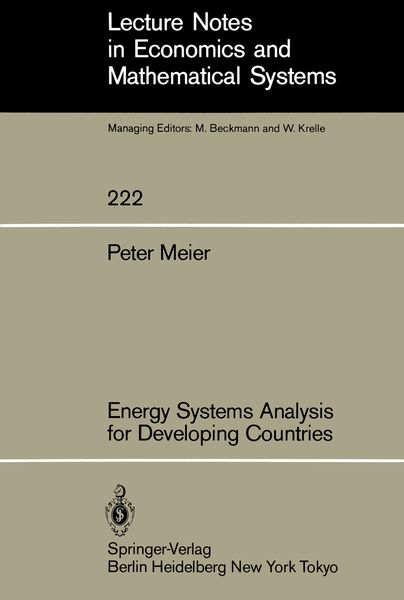
Energy Systems Analysis for Developing Countries
Aus der Reihe
Lecture Notes in Economics and Mathematical Systems
-
- Englisch ausgewählt
Fr. 72.90
inkl. gesetzl. MwSt.,
Beschreibung
Produktdetails
Einband
Taschenbuch
Erscheinungsdatum
01.01.1984
Verlag
Springer BerlinSeitenzahl
348
Maße (L/B/H)
24.4/17/2 cm
Gewicht
615 g
Auflage
Softcover reprint of the original 1st ed. 1984
Sprache
Englisch
ISBN
978-3-540-12879-3
The lecture notes presented in these pages were originally developed for use in the Energy Management Training Program (EMTP), sponsored by the Office of Energy, U. S. Agency for International Development. This program, held at Brookhaven National Laboratory (BNL) and the Institute for Energy Research, State University of New York at Stony Brook, is designed to train mid-career and senior government officials in developing countries in the techniques of energy policy analysis and planning, and covers, in addition to the material presented here, more detailed case studies in resource evaluation, pricing, conservation, financial analysis, and investment planning. Since its incep tion in 1978, some 220 individuals from 57 countries have attended the course. These notes have also been used in executive level seminars and in country training programs in the Sudan, the Dominican Republic, and the People's Republic of China. Attendance at the course is diverse, and typically includes planners, managers, engineers, and economists from energy planning agencies, ministries of finance and economic development, electric utilities, refineries and State Oil Companies, and specialized energy planning units for energy conservation and for regional cooperation. The monograph is designed not just as reading material to support lectures, but also as a general self-contained reference text for a very diverse audience: we have therefore included much introduc tory material. The presentation is focused on a discussion of the basic principles of systems analysis: and the case material has been specially designed to illustrate these principles.
Noch keine Bewertungen vorhanden
Verfassen Sie die erste Bewertung zu diesem Artikel
Helfen Sie anderen Kundinnen und Kunden durch Ihre Meinung.