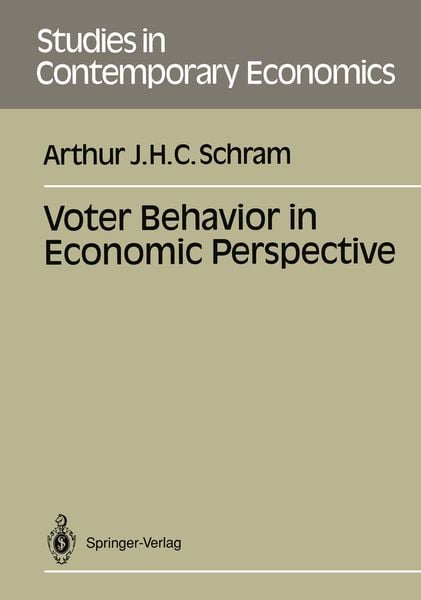

• Produktbild: Voter Behavior in Economics Perspective
  • Produktbild: Voter Behavior in Economics Perspective

Voter Behavior in Economics Perspective

Fr. 138.00

inkl. gesetzl. MwSt., Versandkostenfrei


Beschreibung

Produktdetails

Einband

Taschenbuch

Erscheinungsdatum

03.04.1991

Verlag

Springer Berlin

Seitenzahl

274

Maße (L/B/H)

24.2/17/1.6 cm

Gewicht

503 g

Auflage

Softcover reprint of the original 1st ed. 1991

Sprache

Englisch

ISBN

978-3-540-53650-5

Beschreibung

Produktdetails

Einband

Taschenbuch

Erscheinungsdatum

03.04.1991

Verlag

Springer Berlin

Seitenzahl

274

Maße (L/B/H)

24.2/17/1.6 cm

Gewicht

503 g

Auflage

Softcover reprint of the original 1st ed. 1991

Sprache

Englisch

ISBN

978-3-540-53650-5

Herstelleradresse

Springer-Verlag KG
Sachsenplatz 4-6
1201 Wien
AT

Email: ProductSafety@springernature.com

Kundinnen und Kunden meinen

0 Bewertungen

Informationen zu Bewertungen

Zur Abgabe einer Bewertung ist eine Anmeldung im Konto notwendig. Die Authentizität der Bewertungen wird von uns nicht überprüft. Wir behalten uns vor, Bewertungstexte, die unseren Richtlinien widersprechen, entsprechend zu kürzen oder zu löschen.

Die Bewertungen sind nach Format, Anzahl Sterne und Datum sortiert.

Verfassen Sie die erste Bewertung zu diesem Artikel

Helfen Sie anderen Kund*innen durch Ihre Meinung

Kundinnen und Kunden meinen

0 Bewertungen filtern

  • Produktbild: Voter Behavior in Economics Perspective
  • Produktbild: Voter Behavior in Economics Perspective
  • I: Introducing the Subject.- 1. Introduction.- 1.1. Voter behavior and economics.- 1.2. An outline of the book.- 2. Existing Studies in the Field.- 2.1. Introduction.- 2.2. Economic analyses of voter behavior.- 2.3. Median voter models.- 2.4. Conclusions.- II: Empirical Models Applied to the Netherlands.- 3. An Empirical Analysis of Voter Turnout in the Netherlands.- 3.1. Introduction.- 3.2. Survey of the literature.- 3.3. Data and selection of variables.- 3.4. Multivariate analysis.- 3.5. Some special topics.- 3.5.1 A comparison of the voting behavior of partners.- 3.5.2 National versus local elections.- 3.6. Concluding remarks.- Appendix 3A.- Appendix 3B.- 4. An Empirical Analysis of Party Choice in the Netherlands.- 4.1. Introduction.- 4.2. The model.- 4.3. Characteristics of Dutch parties and expected effects of variables.- 4.3.1 Dutch party characteristics.- 4.3.2 Expected effects of the variables distinguished.- 4.4. Data and first results.- 4.4.1 The data.- 4.4.2 The sequential decision voter.- 4.4.3 Former party choice.- 4.5. The sequential versus the simultaneous decision voter.- 4.5.1 The simultaneous decision voter.- 4.5.2 The sequential versus the simultaneous decision model: a test.- 4.6. Some implications.- 4.6.1 The ‘left-right’ scale.- 4.6.2 Marginal effects.- 4.7. Concluding discussion.- Appendix 4A.- Appendix 4B.- Appendix 4C.- III: A Behavioral Model of Party Choice and the Demand for Public Goods.- 5. A Behavioral Model of Party Choice.- 5.1. Introduction.- 5.2. The model.- 5.2.1 Individual versus group interests.- 5.2.2 Party choice.- 5.2.3 The reduced form equations.- 5.3. A comparison with existing models.- 5.3.1 Economic models: popularity functions.- 5.3.2 Other economic models.- 5.3.3 Spatial models of voting behavior.- 5.4. Concluding remarks.- Appendix 5A.- 6. Empirical Applications: the Demand for Public Goods.- 6.1. Introduction.- 6.2. An empirical application to the Netherlands.- 6.2.1 The equations to be estimated.- 6.2.2 The empirical results.- 6.3. An empirical application to Great Britain.- 6.3.1 The equations to be estimated.- 6.3.2 The results for workers.- 6.3.3 Other groups.- 6.3.4 Original parameters.- 6.4. Concluding remarks.- Appendix 6A.- 7. Expressed Preferences for Public Goods.- 7.1. Introduction.- 7.2. The survey method.- 7.3. Two surveys applied.- 7.3.1 The SCP-survey.- 7.3.2 The Amsterdam-survey.- 7.4. Conclusions.- IV: The Calculus of Voting.- 8. Voter Turnout and Social Pressure.- 8.1. Introduction.- 8.2. Optimal group behavior.- 8.3. Individual turnout I: producers of social pressure.- 8.4. Individual turnout II: consumers of social pressure.- 8.5. Concluding discussion.- Appendix 8A.- Appendix 8B.- Appendix 8C.- Appendix 8D.- 9. Some Implications of the Turnout Model.- 9.1. Introduction.- 9.2. Equilibrium analysis.- 9.3. Winner-takes-all elections.- 9.4. Empirics.- 9.4.1 Party or election specific variables.- 9.4.2 Socio-economic variables.- 9.5. Conclusion.- Appendix 9A.- Appendix 9B.- Appendix 9C.- Epilogue.- 10. Summary and Evaluation.- 10.1. Introduction.- 10.2. Summary.- 10.2.1 General summary of the book.- 10.2.2 Summary of Part II.- 10.2.3 Summary of Part III.- 10.2.4 Summary of Part IV.- 10.3. Evaluation.- 10.3.1 The importance of the group-framework.- 10.3.2 Voter turnout and party choice.- 10.3.3 The economic perspective.- References.- Author Index.- List of Symbols.