• Produktbild: Basic Exercises in Immunochemistry
  • Produktbild: Basic Exercises in Immunochemistry

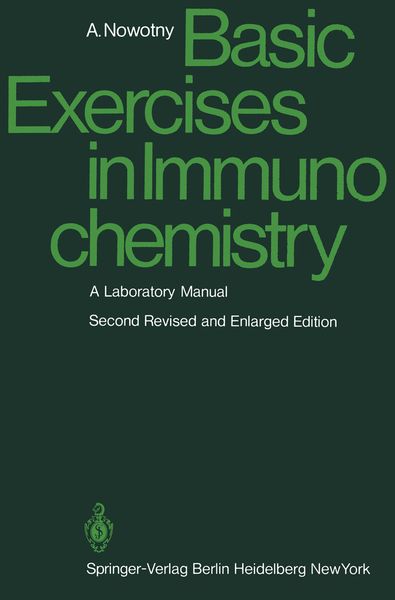
Basic Exercises in Immunochemistry A Laboratory Manual

Fr. 137.00

inkl. gesetzl. MwSt., Versandkostenfrei


Produktdetails

Einband

Taschenbuch

Erscheinungsdatum

01.09.1979

Verlag

Springer Berlin

Seitenzahl

314

Maße (L/B/H)

24.4/17/1.9 cm

Gewicht

535 g

Auflage

2. Auflage

Sprache

Englisch

ISBN

978-3-540-09453-1

Produktdetails

Einband

Taschenbuch

Erscheinungsdatum

01.09.1979

Verlag

Springer Berlin

Seitenzahl

314

Maße (L/B/H)

24.4/17/1.9 cm

Gewicht

535 g

Auflage

2. Auflage

Sprache

Englisch

ISBN

978-3-540-09453-1

Herstelleradresse

Springer Heidelberg
Tiergartenstr. 17
69121 Heidelberg
DE
buchhandel-buch@springer.com

Kundinnen und Kunden meinen

0 Bewertungen

Informationen zu Bewertungen

Zur Abgabe einer Bewertung ist eine Anmeldung im Konto notwendig. Die Authentizität der Bewertungen wird von uns nicht überprüft. Wir behalten uns vor, Bewertungstexte, die unseren Richtlinien widersprechen, entsprechend zu kürzen oder zu löschen.

Die Bewertungen sind nach Format, Anzahl Sterne und Datum sortiert.

Verfassen Sie die erste Bewertung zu diesem Artikel

Helfen Sie anderen Kund*innen durch Ihre Meinung

Kundinnen und Kunden meinen

0 Bewertungen filtern

  • Produktbild: Basic Exercises in Immunochemistry
  • Produktbild: Basic Exercises in Immunochemistry
  • 1 Isolations and Preparations.- Exercise No. 1 Fractionation of Serum Proteins by Ammonium Sulfate.- Exercise No. 2 Isolation of Immunoglobulins by Gel Filtration on Sephadex G 200 Column.- Exercise No. 3 Isolation of IgG by DEAE Cellulose.- A Column Chromatography.- B Batch-Type Operation.- Exercise No. 4 Dissociation of Macroglobulins With 2-Mercaptoethanol.- A.- B.- Exercise No. 5 Enzymatic Cleavage of IgG..- Exercise No. 6 Chromatographic Separation of the IgG Fragments.- Exercise No. 7 Separation and Isolation of H and L Chains of IgG.- Exercise No. 8 Affinity Chromatography and Its Application to Antibody Isolation.- Exercise No. 9 Cellulose Acetate Paper Electrophoresis of Human Serum.- Exercise No. 10 Disc Electrophoresis in Polyacrylamide Gel.- A Separation of Serum Proteins.- B SDS Gel Electrophoresis of Erythrocyte Membrane Proteins.- c Molecular Weight Determination by SDS Gel Electrophoresis.- Exercise No. 11 Separation of Human Hemoglobins by Electro-focusing.- Exercise No. 12 Conjugation of Antibodies With Fluorescein and Rhodamine.- A Fluorescein.- B Rodamine.- Exercise No. 13 Enzymatic Labeling of Proteins With 125I.- A.- B.- Exercise No. 14 Preparation of Peroxidase-Labeled Antibody.- Exercise No. 15 Preparation of Soluble Dinitrophenyl Proteins.- Exercise No. 16 Preparation of Dinitrophenyl- and Trinitrophenyl-Labeled Erythrocytes.- A.- B.- Exercise No. 17 Isolation of Cell Membranes From Ascites Tumors.- Exercise No. 18 Preparation and Use of Synthetic Liposomes.- Exercise No. 19 Isolation of Murine Transplantation Antigen Preparation.- Exercise No. 20 Isolation of Bacterial H-Antigens.- Exercise No. 21 Extraction of Bacterial 0 Antigens (Endotoxins or Lipopolysaccharides).- A Trichloroacetic Acid Method.- B Phenol-Water Procedure.- c Chloroform-Methanol Extraction of Endotoxic Glycolipid (EGL) From Rough Mutants.- Exercise No. 22 Preparation of 14C-Labeled Endotoxin and Endotoxic Glycolipid (EGL).- Exercise No. 23 Isolation of Bacterial Capsular Polysaccharides, K Antigens.- Exercise No. 24 Extraction of Teichoic Acid.- Exercise No. 25 Extraction of Pneumococcus Type XIV Polysaccharide.- Exercise No. 26 Isolation of Phytohemagglutinin.- Exercise No. 27 A and B Blood Group Antigen Preparations From Erythrocytes.- A Solubilization With Dilute NaOH.- B The Use of Detergent.- Exercise No. 28 Isolation of NN Blood Group Antigen From Human Erythrocytes.- Exercise No. 29 Isolation of Forssman Hapten From Erythrocytes.- Exercise No. 30 Isolation of Ragweed Pollen Allergens.- Exercise No. 31 Ultrasonic Disruption of Bacteria and Density-Gradient Centrifugation of the Products.- Exercise No. 32 Vacuum Distillation and Freeze Drying.- 2 Structural Studies.- 2.1 2.1.1 Qualitative Methods, Hydrolytic Procedures.- Exercise No. 33 Determination of Optimal Hydrolytic Conditions.- A Carbohydrate Liberation.- B Liberation of Amino Acids and Amino Sugars.- Exercise No. 34 Hydrolysis of Lipopolysaccharide With Acid.- Exercise No. 35 Partial Hydrolysis of Lipopolysaccharide With Ion Exchanger.- A Discontinuous Method.- B Continuous System.- 2.1.2 Separation and Isolation of the Split Products.- Exercise No. 36 The Methods of Analytic and Preparative Paper Chromatography.- A Preliminary Runs.- B Preparative Procedure.- Exercise No. 37 Separation and Isolation of Peptides or Oligosaccharides by High-Voltage Paper Electrophoresis.- Exercise No. 38 Demonstration of Ion Exchange Column Chromatography of Amino Acids.- Exercise No. 39 Gas-Liquid Chromatography for Fatty Acid Separation,.- Exercise No. 40 Carbohydrate Analysis by Gas-Liquid Chromatography.- Exercise No. 41 Gas-Liquid Chromatographic Analysis of Amino Acids.- Exercise No. 42 Demonstration of Thin-Layer Chromatography.- 2.1.3 Some Other Qualitative Methods for Structural Studies.- Exercise No. 43 Qualitative Analyses of the Constituents of an Unknown Natural Product.- Exercise No. 44 Identification of N-Terminal and C-Terminal Amino Acids.- A N-Terminus.- B C-Terminus 1.- C Paper Chromatography of the Amino Acids and Their Derivatives.- Exercise No. 45 Staining of Gels for Carbohydrates.- Exercise No. 46 Methylation of Carbohydrates.- 2.2 Quantitative Analytical Determinations.- Exercise No. 47 Dry Weight and Inorganic Ash Determinations.- A Total Dry Weight.- B Inorganic Ash.- Exercise No. 48 Microdetermination of Nitrogen.- Exercise No. 49 Microdetermination of Phosphorus.- Exercise No. 50 Protein Determination by the Biuret Method.- Exercise No. 51 Determination of Primary Amino Compounds With Ninhydrin.- Exercise No. 52 Carbohydrate Determination by Phenol-Sulfuric Acid.- Exercise No. 53 Ultramicrodetermination of Reducing Carbohydrates.- Exercise No. 54 Enzymatic Determination of Carbohydrates.- A Glucose.- B Galactose.- Exercise No. 55 Determination of Amino Sugars.- Exercise No. 56 Determination of Heptoses and Pentoses.- A Heptose 1.- B Pentose.- Exercise No. 57 Determination of Sialic Acid and 2-Keto-3-Deoxyoctonic Acid Derivatives.- A Sialic Acid.- B 2-Keto-3-Deoxyoctonic Acid.- Exercise No. 58 Chemical and Biologic Analysis of Compounds Separated by Preparative Thin-Layer Chromatography.- A Chemical Analyses.- B Measurements of Biologic Activities.- Exercise No. 59 Oxydation of Carbohydrates With Periodate. Quantitative Spectrophotometric Determination.- Exercise No. 60 Measurements of the Products of Periodate Oxydation.- A Formaldehyde Determination.- B Formic Acid Determination.- Exercise No. 61 Reduction of Carbohydrates With NaBH4.- A Determination of the Degree of Polymerization.- B Identification of the Reducing Terminal Carbohydrate.- c Investigation of the Glycosidic Linkages by Periodate and Borohydrate Treatment (Smith Degradation).- Exercise No. 62 Quantitative Determination of Free Hydroxyl Groups.- Exercise No. 63 Lipid Determination With the Hydroxylamine Method.- Exercise No. 64 Qualitative and Quantitative Analysis of Carboxylic Acids.- 3 Immunologic and Other Biologic Assays.- 3.1 Antibody Production.- Exercise No. 65 Immunization and Adjuvant Effect.- A Soluble Immunogen.- B Particulate Immunogen.- Exercise No. 66 Demonstration of Antibody Production at Cellular Level (Immunoplaque Method).- 3.2 3.2.1 Antigen-Antibody Interactions, Methods of Agglutination.- Exercise No. 67 Bacterial Agglutination.- Exercise No. 68 Hemagglutination and Its Inhibition.- Exercise No. 69 Passive Hemagglutination and Its Inhibition.- A Neter’s Method.- B Boyden’s Procedure.- C Carbodiimide Coupling Method.- D Inhibition of Passive Hemagglutination.- Exercise No. 70 Charcoal Agglutination.- 3.2.2 Precipitation Methods.- Exercise No. 71 Double Gel Diffusion/Ouchterlony Method.- Exercise No. 72 Immunoelectrophoresis.- Exercise No. 73 Quantitative Immunoelectrophoresis/Rocket Method.- Exercise No. 74 Crossed Immunoelectrophoresis.- Exercise No. 75 Counter Immunoelectrophoresis.- Exercise No. 76 Semiquantitative Micro-Precipitin Assays.- A Microtitration in Gel.- B Determination of Optimal Antigen/Antibody Ratio by Gel Diffusion.- Exercise No. 77 Quantitative Precipitation.- Exercise No. 78 Quantitative Radial Immunodiffusion.- Exercise No. 79 Radioimmunoassays for Cyclic AMP and Cyclic GMP Determinations.- A Cyclic AMP.- B Cyclic GMP.- Exercise No. 80 Solid-Phase Radioimmunoassay.- 3.2.3 Other Reactions of Antibodies and Immunocytes.- Exercise No. 81 Complement Fixation.- A Preparation of Reagents.- B Hemolysin Titration.- c Titration of the Complement.- D Qualitative Complement Fixation (Determination of the Proper Antigen Dose for Quantitative Complement Fixation Test).- E Anticomplementary Controls.- F Quantitative Complement Fixation.- Exercise No. 82 Total and Viable Cell Counts.- Exercise No. 83 Direct and Indirect Staining of Bacteria With Fluorescein-Labeled Antibodies.- Exercise No. 84 Unlabeled Antibody-Enzyme Method to Localize Antigens.- Exercise No. 85 Isolation of Human Lymphocytes by Sedimentation.- Exercise No. 86 Isolation of Adhering Leukocytes.- A.- B.- Exercise No. 87 Rosette-Forming Cell Assay.- Exercise No. 88 Passive Cutaneous Anaphylaxis.- Exercise No. 89 Lymphoblast Assay.- Exercise No. 90 T Cell-Mediated Cytotoxicity of Influenza Virus-Infected Cells.- 3.2.4 Miscellaneous Biologic Reactions.- Exercise No. 91 The Local Shwartzman Phenomenon.- Exercise No. 92 Measurement of the Activity of the Reticuloendothelial System.- Exercise No. 93 Enhancement of Nonspecific Resistance to Infection.- Exercise No. 94 Determination of Toxicity.- Exercise No. 95 Measurement of Pyrogenicity.