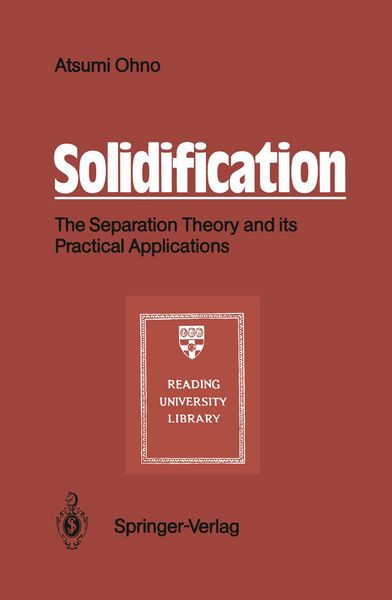
Solidification The Separation Theory and its Practical Applications
-
- Taschenbuch ausgewählt
- eBook
-
Sprache:Englisch
Fr. 137.00
inkl. gesetzl. MwSt.,
Beschreibung
Produktdetails
Einband
Taschenbuch
Erscheinungsdatum
27.11.1987
Verlag
Springer BerlinSeitenzahl
123
Maße (L/B/H)
21.6/14/0.8 cm
Gewicht
250 g
Auflage
Softcover reprint of the original 1st ed. 1987
Übersetzt von
Judy Wakabayashi
Sprache
Englisch
ISBN
978-3-540-18233-7
It was when I saw the countless number of icebergs floating in the North Atlantic Ocean in August 1964 that I decided to commence research into the solidification mechanism of metals, and already I have been continu ing this research for two decades. In 1970 my former professor Susumu Miyata received a letter from Pre sident Jiro Komatsu of the Tokyo Keigokin Seisaskusho Co., Ltd. The letter enclosed a copy of an article written by Mr. Imao Sasaki, chief of the casting research section at Daihatsu Motor Co., Ltd., entitled "Aruminyumu gyoko riron no shimpo" (Progress in aluminum solidi fication theory) from a journal called "Kinzoku Zairyo" (Metals in En gineering). This article introduced my research in considerable detail and well-written style. After stating that I "rebuffed conventional theories and enlightened casting engineers", Sasaki wrote that "These research results deserve great attention from casting engineers for the progress they have brought about in basic theories on improved soundness in casting quality." The letter from President Komatsu was a request to arrange a meeting with me. Saying that "I've heard you mention your theory occasionally, but I'd like to hear a full discussion of it for once", Professor Miyata accompanied me to the Tokyo Keigokin Seisakusho Co., Ltd. at Gyoda in Saitama Pre fecture.
Kundinnen und Kunden meinen
Verfassen Sie die erste Bewertung zu diesem Artikel
Helfen Sie anderen Kund*innen durch Ihre Meinung