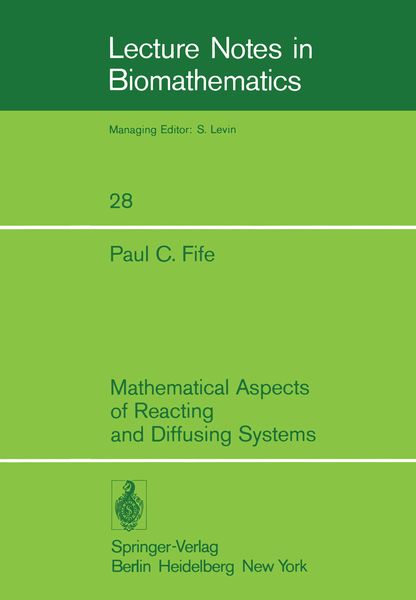
Band 28
Mathematical Aspects of Reacting and Diffusing Systems
Aus der Reihe
Lecture Notes in Biomathematics
-
- Englisch ausgewählt
Fr. 72.90
inkl. gesetzl. MwSt.,
Beschreibung
Produktdetails
Einband
Taschenbuch
Erscheinungsdatum
05.03.1979
Verlag
Springer BerlinSeitenzahl
185
Maße (L/B/H)
24.4/17/1.1 cm
Gewicht
334 g
Auflage
Softcover reprint of the original 1st ed. 1979
Sprache
Englisch
ISBN
978-3-540-09117-2
Modeling and analyzing the dynamics of chemical mixtures by means of differ- tial equations is one of the prime concerns of chemical engineering theorists. These equations often take the form of systems of nonlinear parabolic partial d- ferential equations, or reaction-diffusion equations, when there is diffusion of chemical substances involved. A good overview of this endeavor can be had by re- ing the two volumes by R. Aris (1975), who himself was one of the main contributors to the theory. Enthusiasm for the models developed has been shared by parts of the mathematical community, and these models have, in fact, provided motivation for some beautiful mathematical results. There are analogies between chemical reactors and certain biological systems. One such analogy is rather obvious: a single living organism is a dynamic structure built of molecules and ions, many of which react and diffuse. Other analogies are less obvious; for example, the electric potential of a membrane can diffuse like a chemical, and of course can interact with real chemical species (ions) which are transported through the membrane. These facts gave rise to Hodgkin's and Huxley's celebrated model for the propagation of nerve signals. On the level of populations, individuals interact and move about, and so it is not surprising that here, again, the simplest continuous space-time interaction-migration models have the same g- eral appearance as those for diffusing and reacting chemical systems.
Kundinnen und Kunden meinen
Verfassen Sie die erste Bewertung zu diesem Artikel
Helfen Sie anderen Kund*innen durch Ihre Meinung