• Produktbild: Viscoelasticity — Basic Theory and Applications to Concrete Structures
  • Produktbild: Viscoelasticity — Basic Theory and Applications to Concrete Structures
Band 16

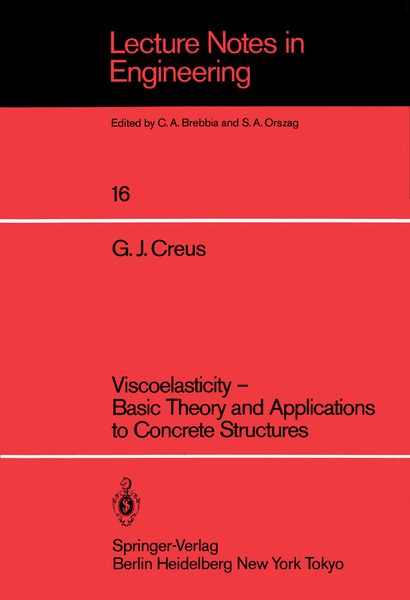
Viscoelasticity — Basic Theory and Applications to Concrete Structures

Fr. 138.00

inkl. gesetzl. MwSt., Versandkostenfrei


Beschreibung

Produktdetails

Einband

Taschenbuch

Erscheinungsdatum

01.01.1986

Verlag

Springer Berlin

Seitenzahl

169

Maße (L/B/H)

24.4/17/1.1 cm

Gewicht

322 g

Auflage

Softcover reprint of the original 1st ed. 1986

Sprache

Englisch

ISBN

978-3-540-16151-6

Beschreibung

Produktdetails

Einband

Taschenbuch

Erscheinungsdatum

01.01.1986

Verlag

Springer Berlin

Seitenzahl

169

Maße (L/B/H)

24.4/17/1.1 cm

Gewicht

322 g

Auflage

Softcover reprint of the original 1st ed. 1986

Sprache

Englisch

ISBN

978-3-540-16151-6

Herstelleradresse

Springer-Verlag GmbH
Tiergartenstr. 17
69121 Heidelberg
DE

Email: GPSR Kontakt

Kundinnen und Kunden meinen

0 Bewertungen

Informationen zu Bewertungen

Zur Abgabe einer Bewertung ist eine Anmeldung im Konto notwendig. Die Authentizität der Bewertungen wird von uns nicht überprüft. Wir behalten uns vor, Bewertungstexte, die unseren Richtlinien widersprechen, entsprechend zu kürzen oder zu löschen.

Die Bewertungen sind nach Format, Anzahl Sterne und Datum sortiert.

Verfassen Sie die erste Bewertung zu diesem Artikel

Helfen Sie anderen Kund*innen durch Ihre Meinung

Kundinnen und Kunden meinen

0 Bewertungen filtern

  • Produktbild: Viscoelasticity — Basic Theory and Applications to Concrete Structures
  • Produktbild: Viscoelasticity — Basic Theory and Applications to Concrete Structures
  • I: Basic Concepts; Integral Representation.- I. 1. Constitutive relations.- I. 2. Basic experimental results.- I. 2.1. Linearity.- I. 2.2. Aging.- I. 3. Integral representation of linear aging viscoelasticity.- I. 3.1. Alternative forms of the integral representation.- I. 4. Determination of the relaxation function from the creep function.- I. 5. Numerical solution of Volterra equation.- I. 6. Notes and references.- II: Rheological Models; Differential Representation.- II. 1. The basic elements: spring and dashpot.- II. 2. Maxwell model.- II. 3. Kelvin model.- II. 3.1. Numerical solution for the Kelvin model.- II. 4. Generalized models.- II. 5. Models with variable parameters.- II. 6. Representation by means of state variables.- II. 7. Identification.- II. 8. A nonlinear model.- II. 9. Notes and references.- III: Examples of Viscoelastic behavior.- III. 1. Tests with constant stress rate.- III. 2. Tests with constant strain rate.- III. 3. Tests with periodic loading.- III. 4. Solids and fluids.- III. 4.1. Stability.- III. 4.2. Fading memory.- III. 5. Reduced modulus.- III. 5.1. Trost-Bažant modulus.- III. 6. Notes and references.- IV: Viscoelasticity in Three Dimensions.- IV. 1. Constitutive relations.- IV. 2. Cor re spondence method.- IV. 3. Asymptotic behavior.- IV. 4. Notes and references.- V: Representation of Concrete’s behavior.- V. 1. Concrete as a porous-adsorbent material.- V. 2. Basic experimental facts and definitions.- V. 3. Some basic mathematical expressions.- V. 4. Prediction of creep.- V. 5. Formulas for structural analysis.- V. 5.1. Dischinger’s formula.- V. 5.2. Improved Dischinger’s formula.- V. 5.3. Arutyunyan’s formula.- V. 5.4. Exponential series.- V. 5.5. Bažant-Panula formula.- V. 5.6. Expressions used in the Codes.- V. 6. Nonlinear behavior.- V. 7. Notes and references.- VI: Structural Analysis.- VI. 1. General method.- VI. 1.1. Basic relations.- VI. 1.2. Correspondence method.- VI. 1.3. General results; classification of problems.- VI. 2. Generalized force method.- VI. 3. Approximate solutions; more examples.- VI. 3.1. Effective modulus and TB-modulus.- VI. 3.2. Redistribution of stresses in a concrete column.- VI. 3.3. Single elastic restraint.- VI. 4. Notes and references.- VII: Finite Elements Viscoelastic Analysis.- VII. 1. Finite elements; basic equations.- VII. 2. Constitutive relations.- VII. 3. Incremental formulation for viscoelasticity problems.- VII. 4. A computer program for viscoelastic analysis of trusses.- VII. 5. Notes and references.- VIII: Viscoelastic Buckling.- VIII. 1. The stability concept.- VIII. 2. Simplified column analysis.- VIII. 2.1. Elastic analysis.- VIII. 2.2. Linear viscoelastic analysis.- VIII. 3. Beam-column analysis.- VIII. 4. Nonlinear viscoelastic analysis.- VIII. 5. Practical formulas and Codes.- VIII. 6. Notes and references.- Appendix A: Some Mathematical Formulae.- Appendix B: Some Elasticity Formulae.- References.