• Produktbild: SMS — A Program Package for Simulation and Gaming of Stochastic Market Processes and Learning Behavior
  • Produktbild: SMS — A Program Package for Simulation and Gaming of Stochastic Market Processes and Learning Behavior
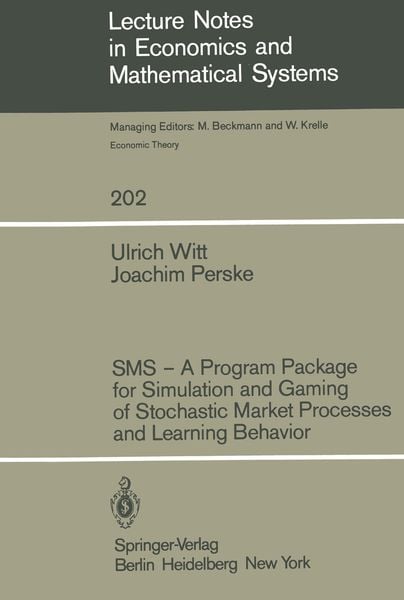
Band 202

SMS — A Program Package for Simulation and Gaming of Stochastic Market Processes and Learning Behavior

Fr. 72.90

inkl. gesetzl. MwSt., Versandkostenfrei


Produktdetails

Einband

Taschenbuch

Erscheinungsdatum

01.09.1982

Verlag

Springer Berlin

Seitenzahl

271

Maße (L/B/H)

24.4/17/1.6 cm

Gewicht

488 g

Auflage

Softcover reprint of the original 1st ed. 1982

Sprache

Englisch

ISBN

978-3-540-11551-9

Produktdetails

Einband

Taschenbuch

Erscheinungsdatum

01.09.1982

Verlag

Springer Berlin

Seitenzahl

271

Maße (L/B/H)

24.4/17/1.6 cm

Gewicht

488 g

Auflage

Softcover reprint of the original 1st ed. 1982

Sprache

Englisch

ISBN

978-3-540-11551-9

Herstelleradresse

Springer-Verlag KG
Sachsenplatz 4-6
1201 Wien
AT

Email: ProductSafety@springernature.com

Kundinnen und Kunden meinen

0 Bewertungen

Informationen zu Bewertungen

Zur Abgabe einer Bewertung ist eine Anmeldung im Konto notwendig. Die Authentizität der Bewertungen wird von uns nicht überprüft. Wir behalten uns vor, Bewertungstexte, die unseren Richtlinien widersprechen, entsprechend zu kürzen oder zu löschen.

Die Bewertungen sind nach Format, Anzahl Sterne und Datum sortiert.

Verfassen Sie die erste Bewertung zu diesem Artikel

Helfen Sie anderen Kund*innen durch Ihre Meinung

Kundinnen und Kunden meinen

0 Bewertungen filtern

  • Produktbild: SMS — A Program Package for Simulation and Gaming of Stochastic Market Processes and Learning Behavior
  • Produktbild: SMS — A Program Package for Simulation and Gaming of Stochastic Market Processes and Learning Behavior
  • I Problems and Results.- 1 — Theoretical Background.- 1.1 Introductory Remarks on the Problems.- 1.2 The Micro-dynamics of Simultaneous Search.- 1.3 Learning and Adaptation with Sequentially Revealed Information.- 1.4 How are the Search Market Processes to be Explored?.- 2 — Some Applications and Results.- 2.1 The Theory of Monopoly with Imperfect Demand Information.- 2.2 The Theory of Monopolistic Competition if the Market Structure Results from the Existence of Imperfect Information.- 2 .3 Conclusions.- II The Economic Model of Individual Behavior and the Market Interaction.- 3 — Restrictions on the Firm’s Behavior.- 3.1 The Main Ideas in the Setting-up of SMS.- 3.2 Production, Costs, and Expected Yields : Boundary Conditions and Inital Offers in the Subroutine ANGEB.- 3.3 Structure and Size of the Market Demand : The Subroutine NACHFR and NACHUM.- 4 — Simulating Interaction in the Market.- 4.1 The ‘Why’ and ‘How’ of Simulation — Some Theoretical Reflections.- 4.2 Simulating Interaction Explicitly : the Subroutines MATRIX, UMSPEI, and MATDRU.- 4.3 A Second Simulation Variant for the Case of an Isolated Monopoly : Subroutine HYPER.- 5 — Simulating the Behavioral Response.- 5.1 The Function of the REA..Subroutines, their Selection by the Subroutine WAHL, and the Associated Data Processing by the Subroutine AUSWER.- 5.2 Composition, Common Components, and Free Variables for Alternative Designs of REA..subroutines.- 5.3 Search for an Optimum and Control by an Adaptive Aspiration Level Combined : the Subroutine REAKT1.- 5.4 Pure Satisficing Behavior : the Subroutine REASAT.- 5.5 Search for an Optimum Along the Profit Gradient without Adaptive Aspiration Level : the Subroutine REAKT2.- 5.6 Estimating the Optimum on the Basis of a Simple Quasi Regression Procedure : the Subroutine REAOPT.- 6 — Applications of SMS in Laboratory Experimentation and Classroom-Teaching : The Gaming Version.- 6.1 Alternative Gaming Arrangements — With or Without Utilizing the Program Package : the Subroutines SPIEL and SPILES and the Alternative External Generation of Experimenter ‘ s Gaming Lists.- 6. 2 The Rules of the SMS-Game.- 6.3 Remarks on a Pilot Experiment.- III Program Organization and Input-Output-Facilities : The Technical Part.- 7 — The Controlling Program Sections.- 7.1 Monitoring Computer Operation in the First Part of SMS : the Main Program MONTE and the COMMON Block ADDELT.- 7.2 Simulating Individual Realizations of the Stochastic Market Process : the Subroutine HAUPT and the Auxiliary Routine ZUFALL.- 7.3 Some Remarks on Discretionary Parameter Changes in Simulation and Gaming with SMS.- 8 — Input and Control Facilities.- 8.1 Control Input in Batch Processing : Control Cards ‘M’, ‘D’, and ‘G’.- 8.2 Data Input for Numerical Specification of the Model : Data cards ‘1’ — ‘9’, and ‘ Z’.- 8.3 Peculiarities in the Gaming Variant : Data Cards ‘F’ and ‘S’.- 8.4 Input Data Processing and Recording in the Data Input List by the Subroutine EINLES.- 9 — Outputfacilities.- 9.1 Current Output Identification by the Subroutine DATUHR.- 9.2 Output Control for Documenting the Results, of a Single Run in a Monte Carlo Sequence.- 9.3 Printer Diagrams for Selected Trajectories Generated by the Subroutine GRAFIK.- 9.4 Processing the Data of a Monte Carlo Run in the Second Part of SMS : the Main Program HAUPT2 and the COMMON Block ADDELT2.- 9.5 Output Control for Documenting Results of a Monte Carlo Run.- 9.6 Generating Graphical Output in Part Two : Subroutines GRAF2 and PLOT1(K), PLOT2.- IV Appendices.- 10. Annotated Name List.- 11. Cross-Reference Listing.- References.