• Produktbild: Sampling and Sample Preparation
  • Produktbild: Sampling and Sample Preparation

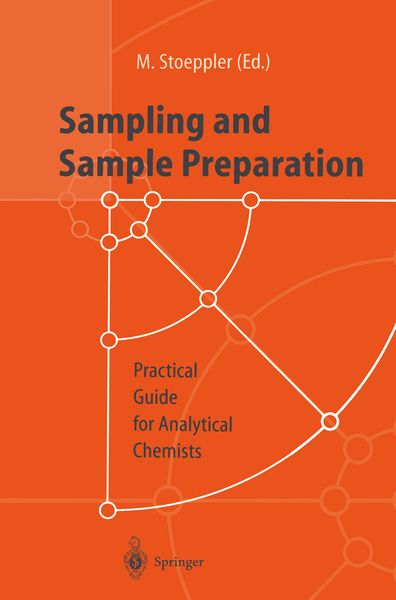
Sampling and Sample Preparation Practical Guide for Analytical Chemists

Fr. 137.00

inkl. gesetzl. MwSt., Versandkostenfrei


Beschreibung

Produktdetails

Einband

Taschenbuch

Erscheinungsdatum

18.09.2011

Herausgeber

Markus Stoeppler

Verlag

Springer Berlin

Seitenzahl

202

Maße (L/B/H)

23.5/15.5/1.3 cm

Gewicht

340 g

Auflage

Softcover reprint of the original 1st ed. 1997

Sprache

Englisch

ISBN

978-3-642-64486-3

Beschreibung

Portrait

Sampling and sample preparation are important steps within an analytical procedure. The book offers practical strategies for state-of-the-art sampling and sample preparation.

Produktdetails

Einband

Taschenbuch

Erscheinungsdatum

18.09.2011

Herausgeber

Markus Stoeppler

Verlag

Springer Berlin

Seitenzahl

202

Maße (L/B/H)

23.5/15.5/1.3 cm

Gewicht

340 g

Auflage

Softcover reprint of the original 1st ed. 1997

Sprache

Englisch

ISBN

978-3-642-64486-3

Herstelleradresse

Springer-Verlag KG
Sachsenplatz 4-6
1201 Wien
AT

Email: ProductSafety@springernature.com

Kundinnen und Kunden meinen

0 Bewertungen

Informationen zu Bewertungen

Zur Abgabe einer Bewertung ist eine Anmeldung im Konto notwendig. Die Authentizität der Bewertungen wird von uns nicht überprüft. Wir behalten uns vor, Bewertungstexte, die unseren Richtlinien widersprechen, entsprechend zu kürzen oder zu löschen.

Die Bewertungen sind nach Format, Anzahl Sterne und Datum sortiert.

Verfassen Sie die erste Bewertung zu diesem Artikel

Helfen Sie anderen Kund*innen durch Ihre Meinung

Kundinnen und Kunden meinen

0 Bewertungen filtern

  • Produktbild: Sampling and Sample Preparation
  • Produktbild: Sampling and Sample Preparation
  • 1 Sampling:an Introduction.- 1.1 General Remarks.- 1.2 Error Sources Prior to Total Element Determination.- 1.3 Sampling for Subsequent Determination of Chemical Species.- 1.4 Studies to Evaluate Sampling Errors.- 1.5 References.- 2 Human Specimens.- 2.1 Introduction.- 2.2 Human Specimens.- 2.3 Characterization.- 2.4 Sampling Procedures.- 2.4.1 Whole Blood/Blood Plasma.- 2.4.2 Urine.- 2.4.3 Scalp Hair.- 2.4.4 Human Milk.- 2.5 References.- 3 Wet Precipitation:Rain and Snow.- 3.1 Introduction.- 3.2 Sampling Strategy.- 3.2.1 Sampling Area.- 3.2.2 Sampling Period.- 3.3 Sampling Equipment.- 3.4 Sampling in Winter.- 3.5 Sample Storage.- 3.6 Sample Preparation.- 3.7 Analytical Procedures.- 3.8 Results and Discussion.- 3.9 Conclusions.- 3.10 References.- 4 Sampling of Sea- and Fresh Water for the Analysis of Trace Elements.- 4.1 Introduction.- 4.2 Sample Handling.- 4.2.1 Preparatory Steps.- 4.2.1.1 Clean Room Requirements and Behaviour of Personnel.- 4.2.1.2 Selection of Labware and Sampling Bottles, Cleaning Procedures.- 4.2.1.3 Purification of Water and Acids.- 4.2.2 Contamination Effects: an Example.- 4.2.3 Need for Filtration and Filtration Design.- 4.2.4 Storage.- 4.3 Sampling Procedures.- 4.3.1 Collection of Sea Water.- 4.3.1.1 Water Column.- 4.3.1.2 Surface Sea Water.- 4.3.2 Collection of Fresh Water: Lakes, Rivers, Estuaries.- 4.4 Digestion.- 4.4.1 Digestion of (Filtered) Water.- 4.4.2 Digestion of Particulates.- 4.5 Typical Concentration Levels of Selected Trace Elements in the Aquatic Environment and Suitable Analytical Methods.- 4.6 Quality Assurance During Analysis and Data Evaluation.- 4.6.1 General Aspects.- 4.6.2 Trend Monitoring: Decrease/Increase Verification.- 4.7 References.- 5 Soils and Soil Solutions.- 5.1 Introduction.- 5.2 Materials.- 5.2.1 Soil.- 5.2.2 Soil Solution.- 5.3 Aspects of Soil Sampling and Recommendations for Its Realization….- 5.3.1 Soil Sampling Report.- 5.3.2 Details of Soil Solution Sampling.- 5.4 Sample Storage.- 5.4.1 Soils.- 5.4.2 Soil Solutions.- 5.5 Quality Control.- 5.6 Safety Precautions.- 5.7 References.- 6 Waste.- 6.1 Introduction.- 6.2 Theoretical Considerations for Sampling.- 6.2.1 General Terms.- 6.2.2 Deduction of a Criterion for Representativeness.- 6.2.3 Relation Between Sampling Error and Analytical Error.- 6.2.4 Variables which Affect the Sampling Error.- 6.2.5 Estimation of the Required Number of Samples.- 6.2.6 Examples.- 6.3 Sampling and Storage.- 6.4 Decomposition and Analysis.- 6.5 Legal Requirements, Standards and Instruction Leaflets.- 6.6 Specific Problems.- 6.6.1 Monitoring Metal Concentrations in Municipal Waste and Incineration Residues.- 6.6.2 Elemental Analysis of Sewage Sludge and Sewage Sludge Ash.- 6.6.3 Metal and Metalloid Species in Gases from Sewage Sludges and Domestic Waste Deposits.- 6.7 References.- 7 Collection, Preparation and Long-Term Storage of Marine Samples.- 7.1 Introduction.- 7.2 Tasks of the Environmental Specimen Bank.- 7.2.1 Institutions Involved.- 7.2.2 Selected Representative Ecosystems in Germany.- 7.3 Collection.- 7.3.1 Collection Principles.- 7.3.2 Collection of Marine Matrices.- 7.4 Sample Preparation.- 7.4.1 Preparation of Homogenized Sub-Samples.- 7.4.2 Cryogenic Grinding.- 7.4.2.1 Sediments.- 7.4.2.2 Bladderwrack.- 7.4.2.3 Common Mussel.- 7.4.2.4 Eelpout.- 7.4.2.5 Herring Gull (Egg).- 7.4.3 Bottling of Homogenized Standard Sub-Samples.- 7.5 Conclusions.- 7.6 References.- 8 Biological Samples.- 8.1 Introduction: Ecological Basis – Information Content, Function and Indicative Value of Biological Specimens.- 8.2 Quality Assurance in Biological Sampling.- 8.2.1 Repesentativeness of Biological Specimens and Samples.- 8.2.2 Potential Errors in Biological Sampling.- 8.3 Development of Specified Sampling Plans.- 8.3.1 Standardization of Sampling Procedures.- 8.3.2 Definition and Delimitation of the Sampling Area(s).- 8.3.3 Necessary Sample Size and Confidence Intervals.- 8.3.4 Sampling Time and Age of the Material.- 8.4 Specific Problems of Sampling and Preparation of Biological Environmental Specimens.- 8.4.1 Difficulties of Sampling Caused by Abiotic and Biotic Factors.- 8.4.2 Semi-Experimental Solutions of Sampling Problems.- 8.4.3 Contamination or Deterioration of Plant Samples: the Problem of Washing.- 8.4.4 Principles Governing the Sampling and Preparation of Animal Tissues for Environmental Analysis;.- 8.5 References.- 9 Sampling of Industrial Material (Sampling for the Balancing of Elements in the Cement Industry).- 9.1 Introduction.- 9.2 The Cement Clinker Burning Process.- 9.2.1 Generalities.- 9.2.2 Balancing.- 9.2.3 Preheater Systems.- 9.2.4 Sampling Points.- 9.2.5 Determining Masses.- 9.2.6 Frequency of Sampling.- 9.3 Sampling.- 9.3.1 Conveyor Belts.- 9.3.2 Pneumatic Conveyors.- 9.3.3 Used Tires.- 9.3.4 Fuel Oil.- 9.3.5 Crude-Gas Dust.- 9.3.6 Precipitated Dust.- 9.3.7 Waste-Gas Dust.- 9.3.8 Volatile Elements.- 9.4 Sample Preparation, Decomposition and Analysis.- 9.5 Checking Mass Flows.- 9.6 Conclusions.- 9.7 References.- 10 Food Products of Animal and Plant Origin.- 10.1 Introduction.- 10.2 Recommendations, Standards and Estimations of the Tolerable Intake of Toxic Metals via Food.- 10.3 Sample Collection.- 10.4 Sample Preparation.- 10.5 Homogenization.- 10.6 Decomposition Procedures.- 10.7 Analysis and Quality Control.- 10.8 Consumption Recommendations.- 10.9 References.- 11 Sample Preparation:an Introduction.- 11.1 General Remarks.- 11.2 Error Sources.- 11.3 Decomposition Directly Prior to Determination in Analytical Systems.- 11.3.1 Liquid Samples.- 11.3.2 Solid Samples.- 11.4 Quality Assurance.- 11.5 References.- 12 Pressure Digestion: Apparatus, Problems and Applications.- 12.1 Introduction.- 12.2 Liner.- 12.3 Body.- 12.4 Safety Devices.- 12.5 Heating System.- 12.6 Conditions for Digestion.- 12.7 Completeness of Sample Decomposition.- 12.8 References.- 13 Microwave-Assisted Decomposition.- 13.1 Introduction.- 13.1.1 Fundamentals of Microwave Systems.- 13.1.2 Fields of Application.- 13.2 Microwave-Assisted Decomposition Apparatus.- 13.2.1 Safety Precautions.- 13.2.2 Microwave-Assisted Digestion Techniques.- 13.2.2.1 Low-Pressure Systems with Home Appliance Microwave Ovens.- 13.2.2.2 Commercial Low-Pressure Microwave Systems.- 13.2.2.3 High-Pressure Microwave Systems.- 13.2.2.4 Non-Pressurized Microwave Systems.- 13.2.2.5 Dry Ashing in a Microwave Oven.- 13.3 Comparison of Different Microwave-Assisted Digestion Systems.- 13.3.1 Microwave-Assisted Digestion Systems.- 13.3.2 Conventional Digestion Procedures.- 13.4 Criteria for the Evaluation of Microwave Digestion Systems.- 13.5 Conclusions.- 13.6 References.- 14 Decomposition Methods for the Electrochemical Determination of Elements.- 14.1 Introduction.- 14.2 Determination without Sample Decomposition.- 14.3 Oxidative UV-Digestion !..- 14.4 Mineralization by Oxygen.- 14.5 Open Wet Digestion.- 14.6 Pressurized Digestion.- 14.7 Conclusions.- 14.8 References.- 15 Decomposition of Materials for Trace Analysis in the Cement Industry.- 15.1 Introduction.- 15.2 Decomposition Methods.- 15.3 Examples.- 15.3.1 Leaching with Water.- 15.3.2 Leaching with Acids.- 15.3.3 Dissolution under Pressure.- 15.3.4 Combustion.- 15.3.5 Fusion.- 15.3.6 Evaporation.- 15.4 References.