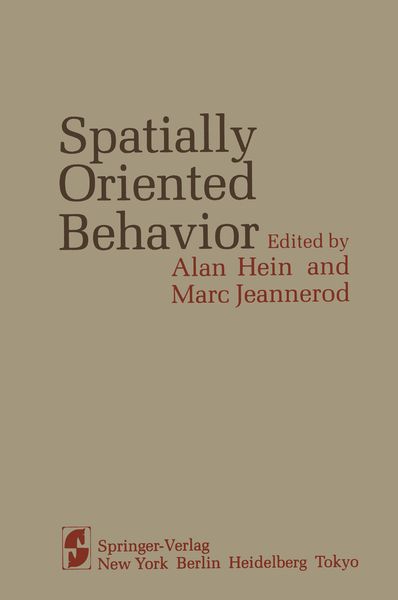
Spatially Oriented Behavior
-
- Hardcover
- Taschenbuch ausgewählt
-
Sprache:Englisch
Fr. 72.90
inkl. gesetzl. MwSt.,
Beschreibung
Produktdetails
Einband
Taschenbuch
Erscheinungsdatum
13.10.2011
Herausgeber
A. Hein + weitereVerlag
Springer UsSeitenzahl
365
Maße (L/B/H)
23.5/15.5/2.1 cm
Gewicht
581 g
Auflage
Softcover reprint of the original 1st ed. 1983
Sprache
Englisch
ISBN
978-1-4612-5490-4
1 How Do We Direct Our Actions in Space?.- Different Modes of Processing Visual Spatial Information.- Role of the Extraretinal Signal in Perceptual Stability of Visual Space.- The Paralyzed Eye Situation as a Cue for Understanding Visuomotor Localization.- The Role of Registered vs. Actual Gaze Position in Guiding Behavior.- 2 Maintenance of Equilibrium During Movement.- How Is Body Posture Established?.- How Do Movement and Posture Interact?.- Coordination Between Posture and Movement in the Quadruped.- Central Organization of Postural Changes.- Conclusions.- 3 Neural Mechanisms of Visual Orientation in Rodents: Targets Versus Places.- Visually Guided Movements Toward Targets.- Visually Guided Movements Toward Places.- Conclusions.- 4 Role of the Monkey Superior Colliculus in the Spatial Localization of Saccade Targets.- Role of the Superior Colliculus in Saccadic Eye Movements.- Models of the Saccadic Eye Movement System.- Neural Representations of Saccade Targets.- 5 Interface of Visual Input and Oculomotor Command for Directing the Gaze on Target.- Internal Medullary Lamina.- Experimental Examination of the Hypothesis of Adequate Response.- Visual Responses to Target Location in Space.- Discussion.- 6 Coordination of Eye-Head Movements in Alert Monkeys: Behavior of Eye-Related Neurons in the Brain Stem.- Experimental Method.- Behavior of PRF Preoculomotor Neurons During Eye-Head Coordination.- Coordination of Head and Eyes in the Saccadic Changes of Gaze.- Conclusions.- 7 Contribution of Eye Movement to the Representation of Space.- How Is Visual Direction Given?.- What Is the Source of Knowledge of Eye Position?.- Conclusions.- 8 Control of the Optokinetic Reflex by the Nucleus of the Optic Tract in the Cat.- Functional Anatomy of NOT.- Relationship Between NOT Output and OKN.- Conclusions.- 9 Development of Optokinetic Nystagmus and Effects of Abnormal Visual Experience During Infancy.- Human OKN Development.- Other Studies.- Future Research.- 10 Spatially Determined Visual Activity in Early Infancy.- Appreciation of Spatial Relations.- Visual Anticipation of Spatiotemporal Events.- Spatial Sensitivity at Birth.- Conclusions.- 11 Spatial Sense of the Human Infant.- Experiments in Reaching.- Experiments in Intermodal Spatial Coordination.- Orienting to Touch.- Conclusions.- 12 Space, the Organism and Objects, Their Cognitive Elaboration in the Infant.- The Development of Organized Movements for Tracking a Moving Visual Object.- 13 Motion Parallax Sensitivity and Space Perception.- Space Perception.- Psychophysical Observations in Motion Parallax.- Implications for Space Perception.- 14 Perceptual Consequences of Experimental Extraocular Muscle Paralysis.- The Kernel Observation under Partial Paralysis: Perceived Change in Elevation.- Quantitative Measurements of Perceived Eye-Level Horizontal.- Illusory Changes in Visual Localization of the Median Plane.- Influence of Level of Paralysis.- Three-Parameter Model of the Influence of Paralysis on Visual Localization and Oculomotor Control.- Illumination Versus Darkness.- Auditory-Visual Matches.- EEPI and Cancellation Are Not Suppressed in Illumination; Visual Localization and Intersensory Localization Are Guided by Cancellation in Darkness.- A Paradox and Its Resolution.- Source of EEPI.- 15 Mechanisms of Space Constancy.- Beyond Corollary Discharge.- Rules of Motion Perception During Saccades Versus During Fixation.- Exploring Space Constancy with Figure-Ground Reversible Images.- Mechanisms of Stabilization.- 16 Visual Information Processing for Saccadic Eye Movements.- ProcessesInvolved in Saccade Generation.- Retinal Eccentricity and Saccade Direction.- Saccade Latency.- Saccade Amplitude.- Conclusions.- 17 Optic Ataxia: A Specific Disorder in Visuomotor Coordination.- Case Reports.- Neuropsychological Symptoms.- Proximal and Distal Deficits in Optic Ataxia.- Comparison with Findings from Experiments in Monkeys.- Effects of Altering Spatial Cues on Reaching Behavior in O
Noch keine Bewertungen vorhanden
Verfassen Sie die erste Bewertung zu diesem Artikel
Helfen Sie anderen Kundinnen und Kunden durch Ihre Meinung.