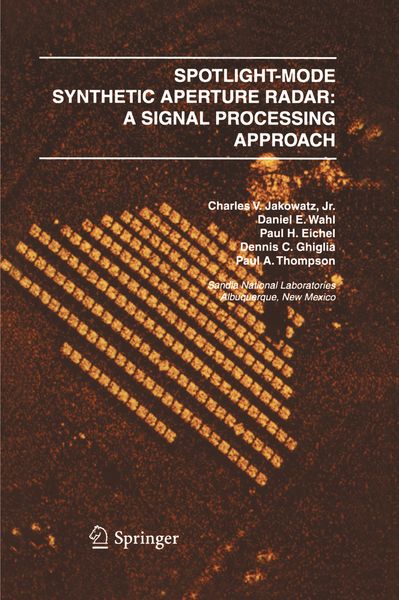
Spotlight-Mode Synthetic Aperture Radar: A Signal Processing Approach A Signal Processing Approach
-
- Hardcover
- Taschenbuch ausgewählt
- eBook
-
Sprache:Englisch
Fr. 336.00
inkl. gesetzl. MwSt.,
Beschreibung
Produktdetails
Einband
Taschenbuch
Erscheinungsdatum
26.09.2011
Verlag
Springer UsSeitenzahl
430
Maße (L/B/H)
23.5/15.5/2.4 cm
Gewicht
668 g
Auflage
Softcover reprint of the original 1st ed. 1996
Sprache
Englisch
ISBN
978-1-4612-8573-1
Modern airborne and spaceborne imaging radars, known as synthetic aperture radars (SARs) , are capable of producing high-quality pictures of the earth's surface while avoiding some of the shortcomings of certain other forms of remote imaging systems. Primarily, radar overcomes the nighttime limitations of optical cameras, and the cloud- cover limitations of both optical and infrared imagers. In addition, because imaging radars use a form of coherent illumination , they can be used in certain special modes such as interferometry , to produce some unique derivative image products that incoherent systems cannot. One such product is a highly accurate digital terrain elevation map (DTEM). The most recent (ca. 1980) version of imaging radar, known as spotlight-mode SAR, can produce imagery with spatial resolution that begins to approach that of remote optical imagers. For all of these reasons, synthetic aperture radar imaging is rapidly becoming a key technology in the world of modern remote sensing.
Much of the basic `workings' of synthetic aperture radars is rooted in the concepts of signal processing . Starting with that premise, this book explores in depth the fundamental principles upon which the spotlight mode of SAR imaging is constructed, using almost exclusively the language, concepts, and major building blocks of signal processing.
Spotlight-Mode Synthetic Aperture Radar: A Signal Processing Approach is intended for a variety of audiences. Engineers and scientists working in the field of remote sensing but who do not have experience with SAR imaging will find an easy entrance into what can seem at times a very complicated subject. Experienced radar engineers will find that the book describes several modern areas of SAR processing that they might not have explored previously, e.g. interferometric SAR for change detection and terrain elevation mapping, or modern non-parametric approaches to SAR autofocus. Senior undergraduates (primarily in electrical engineering) who have had courses in digital signal and image processing, but who have had no exposure to SAR could find the book useful in a one-semester course as a reference.
Much of the basic `workings' of synthetic aperture radars is rooted in the concepts of signal processing . Starting with that premise, this book explores in depth the fundamental principles upon which the spotlight mode of SAR imaging is constructed, using almost exclusively the language, concepts, and major building blocks of signal processing.
Spotlight-Mode Synthetic Aperture Radar: A Signal Processing Approach is intended for a variety of audiences. Engineers and scientists working in the field of remote sensing but who do not have experience with SAR imaging will find an easy entrance into what can seem at times a very complicated subject. Experienced radar engineers will find that the book describes several modern areas of SAR processing that they might not have explored previously, e.g. interferometric SAR for change detection and terrain elevation mapping, or modern non-parametric approaches to SAR autofocus. Senior undergraduates (primarily in electrical engineering) who have had courses in digital signal and image processing, but who have had no exposure to SAR could find the book useful in a one-semester course as a reference.
Noch keine Bewertungen vorhanden
Verfassen Sie die erste Bewertung zu diesem Artikel
Helfen Sie anderen Kundinnen und Kunden durch Ihre Meinung.