• Produktbild: Aerosol Inhalation: Recent Research Frontiers
  • Produktbild: Aerosol Inhalation: Recent Research Frontiers

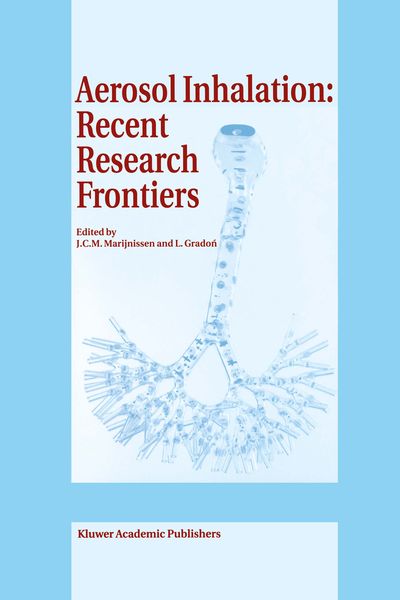
Aerosol Inhalation: Recent Research Frontiers Prodeedings of the International Workshop on Aerosol Inhalation, Lung Transport, Deposition and the Relation to the Environment: Recent Research Frontiers, Warsaw, Poland, September 14–16, 1995

Fr. 191.00

inkl. gesetzl. MwSt., Versandkostenfrei


Beschreibung

Produktdetails

Einband

Taschenbuch

Erscheinungsdatum

20.09.2011

Herausgeber

J.C. Marijnissen + weitere

Verlag

Springer Netherland

Seitenzahl

302

Maße (L/B/H)

24/16/1.8 cm

Auflage

1. Auflage

Sprache

Englisch

ISBN

978-94-010-7259-5

Beschreibung

Produktdetails

Einband

Taschenbuch

Erscheinungsdatum

20.09.2011

Herausgeber

Verlag

Springer Netherland

Seitenzahl

302

Maße (L/B/H)

24/16/1.8 cm

Auflage

1. Auflage

Sprache

Englisch

ISBN

978-94-010-7259-5

Herstelleradresse

Springer-Verlag GmbH
Tiergartenstr. 17
69121 Heidelberg
DE

Email: ProductSafety@springernature.com

Kundinnen und Kunden meinen

0 Bewertungen

Informationen zu Bewertungen

Zur Abgabe einer Bewertung ist eine Anmeldung im Konto notwendig. Die Authentizität der Bewertungen wird von uns nicht überprüft. Wir behalten uns vor, Bewertungstexte, die unseren Richtlinien widersprechen, entsprechend zu kürzen oder zu löschen.

Die Bewertungen sind nach Format, Anzahl Sterne und Datum sortiert.

Verfassen Sie die erste Bewertung zu diesem Artikel

Helfen Sie anderen Kund*innen durch Ihre Meinung

Kundinnen und Kunden meinen

0 Bewertungen filtern

  • Produktbild: Aerosol Inhalation: Recent Research Frontiers
  • Produktbild: Aerosol Inhalation: Recent Research Frontiers
  • Foreword. Introduction. The Challenge of the Epidemiologic Evidence for Excess Mortality and Morbidity Associated with Atmospheric Aerosols; M. Lippman. A Mechanistic Approach to Assessing the Lung Cancer Risk of Diesel Exhaust and Carbon Black; R. McClellan. Measurement of Highly Concentrated Fine Aerosols; W. Szymanski. Lung Morphometry and Particle Transport and Deposition: Overview of Existing Models; W. Hofmann. The Behavior of Aerosols in the Human Nasal and Oral Airways, Including the Ultrafine Size Region; D. Swift. A Deposition Model for Fibres in the Deep Parts of the Lung Based on Similarities of Bead Beds and Human Lungs; J. Marijnissen, et al. Deposition of Hygroscopic Aerosol Particles in the Lungs; G. Ferron, B. Busch. The Influence of Charge on the Deposition Behavior of Aerosol Particles with Emphasis on Singly Charged Nanometer Sized Particles; B. Cohen, et al. Effects of Ultrafine Particles in the Lung and Potential Relevance to Environmental Particles; G. Oberdörster. Atmospheric Particulate Pollutants and Environmental Health, Physico-Chemical Standpoint; K. Spurny. Flow-Induced Mixing at Low Reynolds Number in an Expanding and Contracting Alveolus Model; Y. Otani, et al. The Influence of Normal and Pathological Inhomogeneities of the Lung Tissue son Particle Transport and Deposition; D. Orlicki, L. Gradon. Methods for Predicting Total Size Dependent Particle Collection Efficiencies with More than One Mechanism Acting; J. Gentry, N.C. Liu. The Retention of Inhaled Particles in the Human Respiratory System. Cytotoxic Effects; L. Gradon, A. Podgórski. Quantitative Fit Testing Techniques for Respirators Protecting the Human Respiratory System Against Environmental Aerosols; K. Willeke, D.-H. Han. Aerosol Delivery to the RespiratoryTract in Experimental Animals; M. Dahlbäck, et al. Experimental Investigation of Deposition and Fate of Particles: Animal Models and Interspecies Difference; R. Wolff. Pollen Grains, their Role in Allergy; G. Peltre. Atmosphere at Altitude, Another Approach; R. Roos. Panel Discussion. Keyword Index. List of Authors.