Gutscheinbedingungen

*Gültig bis 05.07.2026 auf (fast) alles. Ausgeschlossen sind Smartboxen, Zeitschriften, Tickets, Lebensmittel, Gaming-Elektroartikel, Tinte/Toner, Gutscheine, Geschenkkarten, Blumen und Abos | Einlösbar in allen Buchhandlungen von Orell Füssli, Barth Bücher, Buchladen Rapunzel, Papeterie Köhler, Schuler Orell Füssli, Stauffacher und ZAP unter Vorweisung des Gutscheins, auf www.orellfüssli.ch durch Eingabe des Gutscheincodes. Beim Service „eBooks verschenken“ und bei eBook-Käufen via eReader nicht einlösbar | Mindesteinkaufswert: Fr. 30.- | Nicht mit anderen Rabatten kumulierbar.

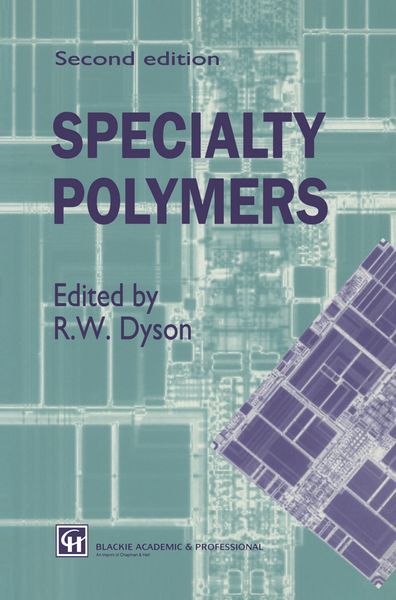
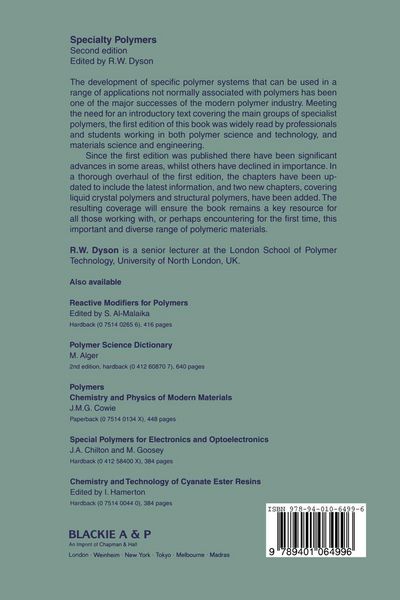
  • Produktbild: Specialty Polymers
  • Produktbild: Specialty Polymers

Specialty Polymers

Fr. 137.00

inkl. gesetzl. MwSt., Versandkostenfrei


Beschreibung

Produktdetails

Einband

Taschenbuch

Erscheinungsdatum

28.09.2011

Herausgeber

R.W. Dyson

Verlag

Springer Netherland

Seitenzahl

280

Maße (L/B/H)

23.5/15.5/1.6 cm

Gewicht

423 g

Auflage

2. Auflage

Sprache

Englisch

ISBN

978-94-010-6499-6

Beschreibung

Rezension

about the first edition

`
This is a book well worth having on your shelves. The book is so well contrived and presented that I am greedy for information from the publishers for books on other aspects of polymer technology.
'

Plastics and Rubber International

Produktdetails

Einband

Taschenbuch

Erscheinungsdatum

28.09.2011

Herausgeber

R.W. Dyson

Verlag

Springer Netherland

Seitenzahl

280

Maße (L/B/H)

23.5/15.5/1.6 cm

Gewicht

423 g

Auflage

2. Auflage

Sprache

Englisch

ISBN

978-94-010-6499-6

Herstelleradresse

Springer-Verlag KG
Sachsenplatz 4-6
1201 Wien
AT

Email: GPSR Kontakt

Noch keine Bewertungen vorhanden

Verfassen Sie die erste Bewertung zu diesem Artikel

Helfen Sie anderen Kundinnen und Kunden durch Ihre Meinung.

Kundinnen und Kunden meinen

Bewertungen (0)

  • Produktbild: Specialty Polymers
  • Produktbild: Specialty Polymers
  • 1 Polymer structures and general properties.- 1.1 Introduction.- 1.2 Polymer structures.- 1.3 Morphology and softening behaviour.- 1.4 Amorphous polymers and softening behaviour.- 1.5 Semi-crystalline polymers and softening behaviour.- 1.6 Molecular weight.- 1.7 Copolymers.- 1.8 Chemical behaviour.- 1.9 Solubility.- 1.10 Electrical properties.- 1.11 Conclusion.- Further reading.- 2 Polymerization.- 2.1 Introduction.- 2.2 Addition polymerization.- 2.3 Step-growth polymerization.- 2.4 Copolymer formation.- 2.5 Chemical conversion.- 2.6 Polyblends.- 2.7 Conclusion.- 3 High-temperature and fire resistant polymers.- 3.1 Introduction.- 3.2 The need for thermally resistant polymers.- 3.3 Improving low-performance polymers for high-temperature use.- 3.4 The need for fire resistant polymers.- 3.5 Polymers for low fire-hazards.- 3.6 Polymers for high-temperature resistance.- 3.7 Heterocyclic polymers.- Further reading.- 4 Hydrophilic polymers.- 4.1 Introduction.- 4.2 Natural polymers.- 4.3 Semisynthetic polymers.- 4.4 Synthetic polymers.- 4.5 Superabsorbent polymers.- Further reading.- 5 Polymers with electrical and electronic properties.- 5.1 Introduction.- 5.2 Conducting polymers.- 5.3 Photoconducting polymers.- 5.4 Polymers in optoelectronics.- 5.5 Polymers with piezoelectric, pyroelectric and ferroelectric properties.- 5.6 Photoresists for semiconductor fabrication.- 5.7 Summary and conclusions.- References.- 6 Ionic layers.- 6.1 Introduction.- 6.2 Classification.- 6.3 Synthesis.- 6.4 Physical properties and applications.- 6.5 Ionomers based on polyethylene.- 6.6 Elastomeric ionomers.- 6.7 Ionomers based on polystyrene.- 6.8 Ionomers based on polytetrafluoroethylene.- 6.9 Ionomer with polyaromatic backbones.- 6.10 Polyelectrolytes for ion exchange.- 6.11 Polyelectrolytes based on carboxylates.- 6.12 Polymers with integral ions.- 6.13 Polyelectrolyte complexes.- 6.14 Blends of polymers and salts.- 6.15 Biological and inorganic ionic polymers.- 6.16 Conclusions.- References.- 7 Liquid crystal polymers.- 7.1 Introduction to thermotropie liquid crystals.- 7.2 Liquid crystal polymers.- 7.3 The structure of side-group liquid crystal polymers.- 7.4 Elastomeric liquid crystal polymers.- 7.5 Laterally attached liquid crystal side-group polymers.- 7.6 Cyclic polysiloxanes.- 7.7 Applications of side-group liquid polymers.- 7.8 In situ photopolymerization.- References.- 8 Structural polymers.- 8.1 Introduction.- 8.2 Introduction to composites.- 8.3 Thermosets.- 8.4 Thermoplastics.- 8.5 Recent and future directions.- Further reading.