
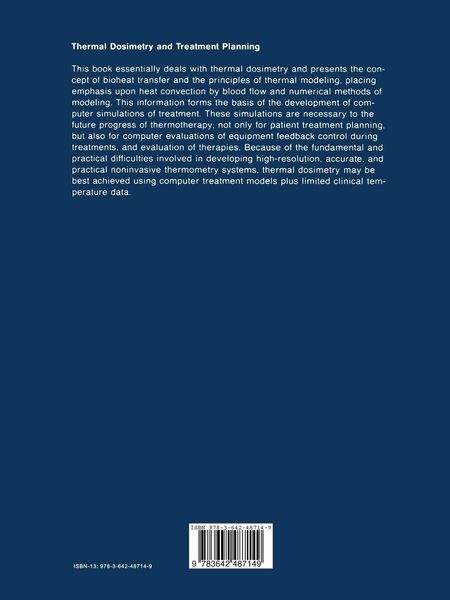
Thermal Dosimetry and Treatment Planning
Aus der Reihe
Thermotherapy
-
- Taschenbuch ausgewählt
- eBook
-
Sprache:Englisch
Fr. 138.00
inkl. gesetzl. MwSt.,
Beschreibung
Produktdetails
Einband
Taschenbuch
Erscheinungsdatum
14.04.2012
Herausgeber
Michel GautherieVerlag
Springer BerlinSeitenzahl
216
Maße (L/B/H)
27.9/21/1.3 cm
Gewicht
575 g
Auflage
Softcover reprint of the original 1st ed. 1990
Sprache
Englisch
ISBN
978-3-642-48714-9
When in the future improved and more flexible heating equipment becomes available, and when hyperthermia is applied more routinely, computerized simulations of treatments will become commonplace, as they are in radia tion therapy. For hyperthermia, however, such simulations will be used not only for the traditional role of planning patient treatment, but also for three other applications not needed in radiation therapy - the comparative evalu ation of equipment, feedback control during treatment, and the post-treat ment evaluation of therapy. The present simulations of hyperthermia are crude and simple when compared with what is required for these future ap plications, a fact which indicates the nedd for considerable research and de velopment in this area. Indeed, this research is proceeding rapidly within the hyperthermia community, whre three-dimensional power deposition and temperature calculations have just become available for realistic patief\t anatomies. Of equal significance are the even more rapid development in diagnostic imaging for the determination and display of patient anatomy and blood flow rates - information required for the planning of realistic hyperthermia treatment. These simulations will be very valuable tools which can be used to great ad vantage when combined with data obtained from treatments of patients.
Noch keine Bewertungen vorhanden
Verfassen Sie die erste Bewertung zu diesem Artikel
Helfen Sie anderen Kundinnen und Kunden durch Ihre Meinung.