
• Produktbild: Peritrophic Membranes
  • Produktbild: Peritrophic Membranes
Band 30

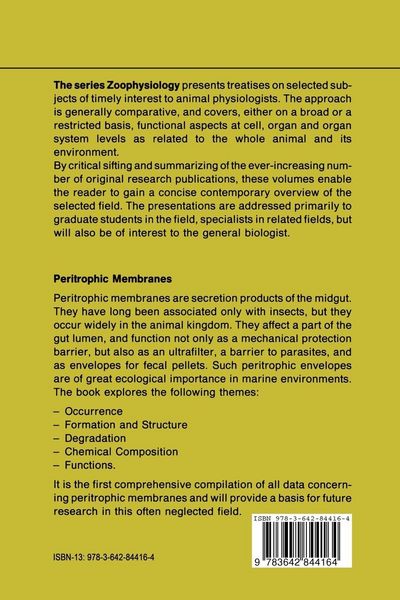
Peritrophic Membranes

Aus der Reihe Zoophysiology

Fr. 137.00

inkl. gesetzl. MwSt., Versandkostenfrei


Beschreibung

Produktdetails

Einband

Taschenbuch

Erscheinungsdatum

10.01.2012

Verlag

Springer Berlin

Seitenzahl

238

Maße (L/B/H)

23.5/15.5/1.5 cm

Gewicht

394 g

Auflage

Softcover reprint of the original 1st ed. 1992

Sprache

Englisch

ISBN

978-3-642-84416-4

Beschreibung

Produktdetails

Einband

Taschenbuch

Erscheinungsdatum

10.01.2012

Verlag

Springer Berlin

Seitenzahl

238

Maße (L/B/H)

23.5/15.5/1.5 cm

Gewicht

394 g

Auflage

Softcover reprint of the original 1st ed. 1992

Sprache

Englisch

ISBN

978-3-642-84416-4

Herstelleradresse

Springer-Verlag KG
Sachsenplatz 4-6
1201 Wien
AT

Email: GPSR Kontakt

Noch keine Bewertungen vorhanden

Verfassen Sie die erste Bewertung zu diesem Artikel

Helfen Sie anderen Kundinnen und Kunden durch Ihre Meinung.

Kundinnen und Kunden meinen

Bewertungen (0)

  • Produktbild: Peritrophic Membranes
  • Produktbild: Peritrophic Membranes
  • 1. Introduction.- 2. Occurrence of Peritrophic Membranes.- 3. Formation and Structure.- 3.1 Beginning of Secretion of Peritrophic Membranes.- 3.2 Textures of Microfibrils.- 3.3 Formation of Peritrophic Membranes.- 3.3.1 Formation Zones.- 3.3.2 Formation by the Whole Midgut Epithelium.- 3.3.3 Secretion of Peritrophic Membranes in Restricted Parts of the Midgut.- 3.3.3.1 Secretion of Peritrophic Membranes by Annular Groups of Cells in the Posterior Midgut.- 3.3.3.2 Secretion of Peritrophic Membranes in the Cardia.- 3.3.4 Crossbands in Peritrophic Membranes.- 3.3.5 Induction of Formation of Peritrophic Membranes.- 3.3.6 Rate of Formation of Peritrophic Membranes.- 3.3.7 Formation of Peritrophic Membranes in Vitro.- 3.3.8 Factors Influencing the Formation of Peritrophic Membranes.- 4. Degradation of Peritrophic Membranes.- 5. Chemical Composition.- 5.1 General Remarks.- 5.2 Chitin.- 5.2.1 Properties.- 5.2.2 The Chitosan Reaction.- 5.2.3 Enzymatic Degradation.- 5.2.4 Histochemical Methods for the Localization of Chitin.- 5.2.4.1 Electron Microscopy (TEM).- 5.2.4.2 Light Microscopy.- 5.3 Proteins and Glycoproteins.- 5.3.1 Amino Acids.- 5.3.2 Proteins.- 5.3.3 Glycoproteins.- 5.3.4 Lectins.- 5.4 Proteoglycans.- 6. Functions of Peritrophic Membranes.- 6.1 General Remarks.- 6.2 Lectins and the Association of Bacteria.- 6.3 Immobilized Enzymes.- 6.4 Permeability.- 6.4.1 Technical Problems.- 6.4.2 Water Transport Across Peritrophic Membranes.- 6.4.3 Permeability Properties of Peritrophic Membranes.- 6.4.4 Use of Peritrophic Membranes for Cellular Sieving.- 6.5 Compartmentalization of the Midgut by Peritrophic Membranes.- 6.5.1 Countercurrent Flow in the Midgut and the Role of the Midgut Caeca in Locusts.- 6.5.2 Countercurrent Flow in the Midgut and the Role of the Midgut Caeca of Mosquito Larvae.- 6.5.3 Compartmentalization of the Midgut and Diversity of Enzymes.- 6.6 Peritrophic Membranes as a Barrier to Parasites.- 6.6.1 Viruses.- 6.6.2 Bacteria.- 6.6.3 Actinomycetes.- 6.6.4 Flagellata.- 6.6.5 Sporozoa.- 6.6.6 Microsporida.- 6.6.7 Larvae of Cestoda.- 6.6.8 Microfilariae.- 6.6.9 Summary.- 6.7 Fecal Pellets or Ecological Aspects of Peritrophic Membranes.- 6.7.1 Aquatic Ecosystems.- 6.7.2 Fecal Pellet Membranes = Peritrophic Envelopes.- 6.7.3 Production.- 6.7.4 Contents of Fecal Pellets.- 6.7.5 Pollutants in Fecal Pellets.- 6.7.6 Sinking Rates.- 6.7.7 Digestion-Resistant Components.- 6.7.8 Nutritional Content.- 6.7.9 Colonization of Fecal Pellets by Microorganisms.- 6.7.10 Coprophagy.- 6.7.11 Coprorhexy.- 6.7.12 Sediment Formation.- 6.7.13 Element Depletion in Surface Layers and Recycling Problems.- 6.7.14 Terrestrial Ecosystems.- 6.8 Peritrophic Membranes Used as Cocoon Material for Pupation.- References.