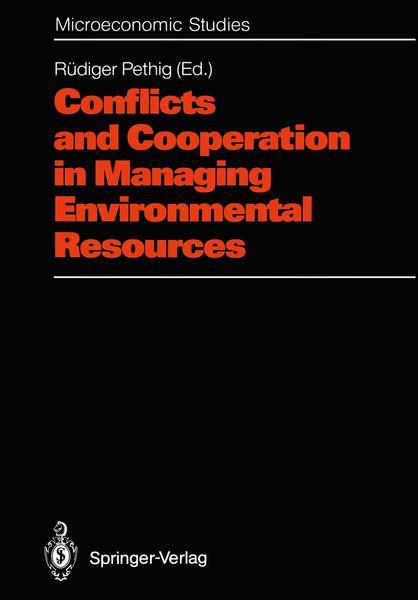
• Produktbild: Conflicts and Cooperation in Managing Environmental Resources
  • Produktbild: Conflicts and Cooperation in Managing Environmental Resources

Conflicts and Cooperation in Managing Environmental Resources

Aus der Reihe Microeconomic Studies

Fr. 137.00

inkl. gesetzl. MwSt., Versandkostenfrei


Portrait

The use of environmental resources involves strategic behavior to provoke or settle conflicts. This book contains ten papers: six investigate conceptual issues of international environmental conflicts and cooperation while four address conflicts in monitoring and enforcing environmental controls. Advanced game-theoretic concepts are used.

Produktdetails

Einband

Taschenbuch

Erscheinungsdatum

08.03.2012

Herausgeber

Rüdiger Pethig

Verlag

Springer Berlin

Seitenzahl

338

Maße (L/B/H)

24.4/17/2 cm

Gewicht

614 g

Auflage

Softcover reprint of the original 1st ed. 1992

Sprache

Englisch

ISBN

978-3-642-46767-7

Portrait

Produktdetails

Einband

Taschenbuch

Erscheinungsdatum

08.03.2012

Herausgeber

Rüdiger Pethig

Verlag

Springer Berlin

Seitenzahl

338

Maße (L/B/H)

24.4/17/2 cm

Gewicht

614 g

Auflage

Softcover reprint of the original 1st ed. 1992

Sprache

Englisch

ISBN

978-3-642-46767-7

Herstelleradresse

Springer-Verlag KG
Sachsenplatz 4-6
1201 Wien
AT

Email: ProductSafety@springernature.com

Kundinnen und Kunden meinen

0 Bewertungen

Informationen zu Bewertungen

Zur Abgabe einer Bewertung ist eine Anmeldung im Konto notwendig. Die Authentizität der Bewertungen wird von uns nicht überprüft. Wir behalten uns vor, Bewertungstexte, die unseren Richtlinien widersprechen, entsprechend zu kürzen oder zu löschen.

Die Bewertungen sind nach Format, Anzahl Sterne und Datum sortiert.

Verfassen Sie die erste Bewertung zu diesem Artikel

Helfen Sie anderen Kund*innen durch Ihre Meinung

Kundinnen und Kunden meinen

0 Bewertungen filtern

  • Produktbild: Conflicts and Cooperation in Managing Environmental Resources
  • Produktbild: Conflicts and Cooperation in Managing Environmental Resources
  • Editor’s Introduction.- Editor’s Introduction.- 1: International Dimensions.- 1 International Environmental Agreements as Games.- 1. Introduction.- 2. Reaching agreement.- 2.1. Identical countries.- 2.2. Cost differences.- 2.3. Benefit differences.- 2.4. Choice of a benchmark.- 2.5. Summary.- 3. Sustaining agreement.- References.- Comments by Henk Folmer.- 2 Emission Taxes in a Dynamic International Game of CO2 Emissions.- 1. Introduction.- 2. A static game.- 3. A dynamic game.- 4. The open loop equilibrium without taxes.- 5. The Markov perfect equilibrium without taxes.- 6. Other subgame perfect equilibria.- 7. Pigouvian taxes.- 8. Non-commitment and taxation.- References.- Comments by Otto Keck.- 3 Critical Loads and International Environmental Cooperation.- 1. Critical loads.- 2. Naive interpretations.- 3. Stock of pollutants — the case of one country.- 4. Stock of pollutants — several countries and the open loop equilibrium.- 5. Closed loop or feed back equilibria.- References.- Comments by Henry Tulkens.- 4 Environmental Conflicts and Strategic Commitment.- 1. Introduction.- 2. Analytical framework.- 3. Asymmetric players and endogenous strategic timing.- 4. N players and strategic team formation.- 5. Conclusion.- References.- Comments by Detlev Homann.- 5 The Choice of Environmental Policy Instruments and Strategic International Trade.- 1. Introduction.- 2. The model.- 3. Single stage Cournot model.- 4. Two stage Stackelberg model.- 5. Two stage Cournot model.- 6. Conclusions.- References.- Comments by Marji Lines.- 6 Economic Models of Optimal Energy Use under Global Environmental Constraints.- 1: The CO2 Problem in Basic Models of Optimal Use of Fossil Fuels.- 2. Background problem on climatic change and global environmental constraints.- 3. Economic studies on the CO2 problem.- 4. Preliminary definitions and the general model.- 5. A simplified model.- 5.1. Necessary conditions.- 5.2. Sufficient conditions.- 5.3. Definition and optimality of equilibrium.- 5.4. Illustration by a phase plane diagram.- 6. A discrete type impact of CO2 emissions.- 7. Further specification of the model.- 8. Discussion.- 2: Technical Change, International Co-operation, and Structural Uncertainty.- 10. A taxonomy of technical change.- 11. Neutral technical change in a general model.- 12. International co-operation.- 13. Structural uncertainty.- 13.1. Modelling uncertainty about critical CO2 levels as uncertainty about a critical, limited natural resource.- 13.2. Treating structural uncertainty.- 13.3. Numerical calculations.- 14. Conclusions and perspectives.- Appendix A: Existence and Uniqueness of the Optimal Solution.- Appendix B: Existence and Stability of Equilibrium.- References.- Comments by Oskar Von Dem Hagen.- Comments by Cees Withagen.- 2: Monitoring and Enforcement.- 7 Monitoring and Enforcement of Pollution Control Laws in Europe and the United States.- 1. Introduction.- 2. Differences among monitoring and enforcement problems and systems.- 3. Key dimensions of monitoring and enforcement systems.- 3.1. Probability of monitoring.- 3.2. Surprise.- 3.3. Definition of a violation.- 3.4. Penalties and other responses to violations.- 4. Some evidence on European & U.S. choices in monitoring & enforcement.- 5. A glimpse of the future? Recommendations from the U.K. (The “Kinnersley Report”).- 6. Concluding comments.- References.- Comments by Heinz Welsch.- 8 The Economics of Negotiations on Water Quality — An Application of Principal Agent Theory.- 1. Introduction.- 2. The basic model structure of a modified LEN-model.- 3. The basic model with a beta—distribution of water quality depending on abatement intensity.- 4. Possible extensions.- References.- Comments by Günther knieps.- 9 Monitoring the Emission of Pollutants by Means of the Inspector Leadership Method.- 1. Monitoring point sources of pollution.- 2. Decision theoretical formulation of the problem.- 3. Comparison of the solutions of the simple’ simultaneous’ and ‘leadership’ games.- 4. The general inspector leadership game and the Neyman —Pearson lemma.- 5. Application.- 6. Concluding remarks.- References.- Comments by Till Requate.- 10 Illegal Pollution and Monitoring of Unknown Quality — A Signaling Game Approach —.- 1. Introduction.- 1: Equilibrium Scenarios with Pooling and Signaling Behavior.- 2. The game model.- 3. A gallery of equilibrium scenarios.- 3.1. Pooled shirking and illegal waste disposal: ‘polluter’s paradise scenario’.- 3.2. Exploratory accidents and illegal waste disposal due to unqualified control: ‘signaling scenarios’.- 3.3. Absence of illegal pollution due to efficient control: ‘controller’s paradise scenario’.- 3.4. Intermediate illegal pollution: ‘constrained polluter’s paradise scenario’.- 3.5. Equilibrium scenarios and the multiplicity of equilibria.- 2: Perfect Equilibria and (Unique) Solutions via Equilibrium Selection.- 4. Uniformly perfect pure strategy equilibria.- 5. Comparison of signaling and pooling equilibria.- 5.1. Cell and truncation consistency.- 5.2. Payoff dominance.- 5.3. Risk dominance.- 5.4. Solutions in the range (4.14).- 5.5. The solution in the range (4.15).- 5.6. Discussion of the solution.- 6. Conclusions.- References.- Comments by Aart de Zeeuw.