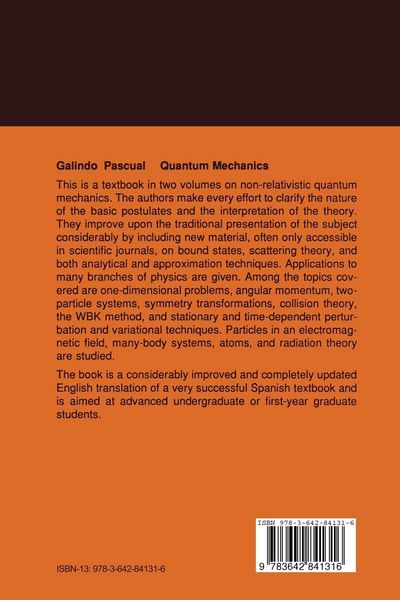
• Produktbild: Quantum Mechanics II
  • Produktbild: Quantum Mechanics II

Quantum Mechanics II

Fr. 119.00

inkl. gesetzl. MwSt., Versandkostenfrei


Beschreibung

Produktdetails

Einband

Taschenbuch

Erscheinungsdatum

06.01.2012

Verlag

Springer Berlin

Seitenzahl

374

Maße (L/B/H)

23.5/15.5/2.2 cm

Gewicht

598 g

Auflage

1991

Übersetzt von

Luis Alvarez-Gaume

Sprache

Englisch

ISBN

978-3-642-84131-6

Beschreibung

Produktdetails

Einband

Taschenbuch

Erscheinungsdatum

06.01.2012

Verlag

Springer Berlin

Seitenzahl

374

Maße (L/B/H)

23.5/15.5/2.2 cm

Gewicht

598 g

Auflage

1991

Übersetzt von

Luis Alvarez-Gaume

Sprache

Englisch

ISBN

978-3-642-84131-6

Herstelleradresse

Springer-Verlag KG
Sachsenplatz 4-6
1201 Wien
AT

Email: GPSR Kontakt

Noch keine Bewertungen vorhanden

Verfassen Sie die erste Bewertung zu diesem Artikel

Helfen Sie anderen Kundinnen und Kunden durch Ihre Meinung.

Kundinnen und Kunden meinen

Bewertungen (0)

  • Produktbild: Quantum Mechanics II
  • Produktbild: Quantum Mechanics II
  • 8. Scattering Theory.- 8.1 Introduction.- 8.2 General Description of Scattering Processes.- 8.3 Cross Sections.- 8.4 Invariance of the Cross Section. Change LAB ? C.M..- 8.5 Simple Scattering: Classical Case.- 8.6 Simple Scattering: Quantum Case.- 8.7 Scattering Operator or S Matrix. Unitarity of the S Matrix.- 8.8 Intertwining Property and Energy Conservation.- 8.9 d?/d? as a Function of TE.- 8.10 Scattering into Cones.- 8.11 The Optical Theorem.- 8.12 Computation of the Scattering Amplitude.- 8.13 Space-Time Description of Simple Scattering.- 8.14 Symmetries of the Scattering Operator.- 8.15 Scattering by a Central Potential: Partial Waves and Phase Shifts.- 8.16 Computation and Properties of Phase Shifts.- 8.17 Scattering by a Central Square Well.- 8.18 Analyticity Properties of the Partial Amplitudes.- 8.19 Analyticity Properties of the Scattering Amplitude.- 8.20 Coulomb Scattering.- 8.21 Two Body Elastic Scattering.- 8.22 Multichannel Scattering.- 8.23 General Form of the Optical Theorem.- 8.24 Symmetries in Multichannel Scattering.- 8.25 The Optical Potential.- 9. The W.B.K. Method.- 9.1 Introduction.- 9.2 The W.B.K. Method in One-Dimensional Problems.- 9.3 Connection Formulae.- 9.4 Bound State Energies.- 9.5 The Potential Barrier.- 9.6 The Miller-Good Method.- 9.7 Transmission by Double Potential Barriers.- 9.8 Potential Wells: Several Turning Points.- 9.9 Central Potentials.- 10. Time-Independent Perturbation Theory and Variational Method.- 10.1 Introduction.- 10.2 Time-Independent Perturbations. The Non-Degenerate Case.- 10.3 The Harmonic Oscillator with ?x4 Perturbation.- 10.4 The Harmonic Oscillator with ?x3 Perturbation.- 10.5 Two-Electron Atoms (I).- 10.6 Van der Waals Forces (I).- 10.7 Kato’s Theory.- 10.8 The Stark Effect.- 10.9 The Variational Method.- 10.10 Two-Electron Atoms (II).- 10.11 Van der Waals Forces (II).- 10.12 One-Electron Atoms.- 10.13 Eigenvalues for Large Coupling Constants.- 11. Time-Dependent Perturbation Theory.- 11.1 Introduction.- 11.2 Nuclear Spin Resonance.- 11.3 The Forced Harmonic Oscillator.- 11.4 The Interaction Picture.- 11.5 Transition Probability.- 11.6 Constant Perturbations.- 11.7 Turning on Perturbations Adiabatically.- 11.8 Periodic Perturbations.- 11.9 Sudden Perturbations.- 11.10 The Adiabatic Theorem.- 11.11 The Adiabatic Approximation.- 11.12 The Decay Law for Unstable Quantum Systems.- 12. Particles in an Electromagnetic Field.- 12.1 Introduction.- 12.2 The Schrödinger Equation.- 12.3 Uncertainty Relations.- 12.4 The Aharonov-Bohm Effect.- 12.5 Spin-1/2 Particles in an E.M. Field.- 12.6 A Particle in a Constant Uniform Magnetic Field.- 12.7 The Fine Structure of Hydrogen-Like Atoms.- 12.8 One-Electron Atoms in a Magnetic Field.- 13. Systems of Identical Particles.- 13.1 Introduction.- 13.2 Symmetrization of Wave Functions.- 13.3 Non-Interacting Identical Particles.- 13.4 Fermi Gas.- 13.5 Bose Gas.- 13.6 Creation and Annihilation Operators.- 13.7 Correlation Functions.- 13.8 Superfluidity.- 13.9 Superconductivity.- 14. Atoms.- 14.1 Introduction.- 14.2 The Thomas-Fermi Method.- 14.3 The Hartree-Fock Method.- 14.4 The Central Field Approximation.- 14.5 Perturbative Calculations.- 14.6 Russell-Saunders or LS Coupling.- 14.7 jj Coupling.- 15. Quantum Theory of Radiation.- 15.1 Introduction.- 15.2 Plane Wave Expansions.- 15.3 Quantization of the E.M. Field.- 15.4 Multipole Waves.- 15.5 Interaction Between Matter and Radiation.- 15.6 Transition Probabilities.- 15.7 Emission and Absorption of Photons.- 15.8 Angular Distribution of Multipole Radiation.- 15.9 Electric Dipole Transitions in Atoms.- 15.10 Radiative Transitions in Nuclei.- 15.11 Low Energy Compton Scattering.- of Quantum Mechanics I.