
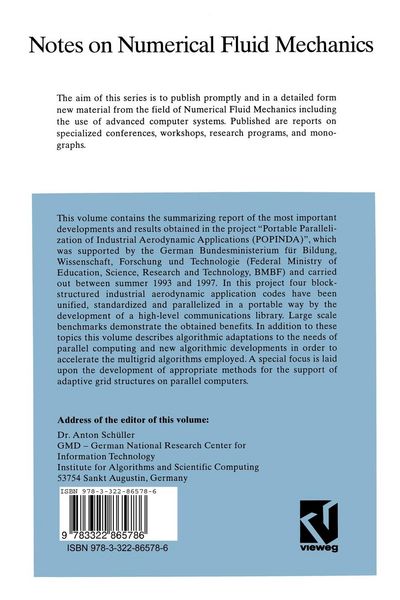
• Produktbild: Portable Parallelization of Industrial Aerodynamic Applications (POPINDA)
  • Produktbild: Portable Parallelization of Industrial Aerodynamic Applications (POPINDA)
Band 71

Portable Parallelization of Industrial Aerodynamic Applications (POPINDA) Results of a BMBF Project

Fr. 137.00

inkl. gesetzl. MwSt., Versandkostenfrei


Beschreibung

Produktdetails

Einband

Taschenbuch

Erscheinungsdatum

19.02.2012

Herausgeber

Anton Schüller

Verlag

Vieweg & Teubner

Seitenzahl

223

Maße (L/B/H)

23.5/15.5/1.3 cm

Gewicht

365 g

Auflage

Softcover reprint of the original 1st ed. 1999

Sprache

Englisch

ISBN

978-3-322-86578-6

Beschreibung

Produktdetails

Einband

Taschenbuch

Erscheinungsdatum

19.02.2012

Herausgeber

Anton Schüller

Verlag

Vieweg & Teubner

Seitenzahl

223

Maße (L/B/H)

23.5/15.5/1.3 cm

Gewicht

365 g

Auflage

Softcover reprint of the original 1st ed. 1999

Sprache

Englisch

ISBN

978-3-322-86578-6

Herstelleradresse

Springer Heidelberg
Tiergartenstr. 17
69121 Heidelberg
DE
buchhandel-buch@springer.com

Noch keine Bewertungen vorhanden

Verfassen Sie die erste Bewertung zu diesem Artikel

Helfen Sie anderen Kundinnen und Kunden durch Ihre Meinung.

Kundinnen und Kunden meinen

Bewertungen (0)

  • Produktbild: Portable Parallelization of Industrial Aerodynamic Applications (POPINDA)
  • Produktbild: Portable Parallelization of Industrial Aerodynamic Applications (POPINDA)
  • 1 Overview.- 1.1 Basis, Goals and Results of POPINDA.- 1.1.1 Introduction and Summary.- 1.1.2 Background.- 1.1.3 Basis.- 1.1.4 Approach and Ideas.- 1.1.5 Results.- 1.1.6 Reasons for the Success of POPINDA.- 1.1.7 Impact and Outlook.- 1.2 POPINDA — the Industrial Qualification.- 2 Parallelization and Benchmarking.- 2.1 Unified Block Structures — the Basis for Parallelization.- 2.1.1 Requirements for the Parallelization of Large CFD Codes.- 2.1.2 Parallelization Strategies.- 2.1.3 Parallelization of Block-Structured Flow Solvers within the POPINDA Project.- 2.1.4 Basic Concept of Block Structure.- 2.1.5 Standardization of Production Codes.- 2.2 The High-Level Communications Library CLIC.- 2.2.1 Introduction.- 2.2.2 Overview on Functionality of the CLIC-3D.- 2.2.3 CLIC-3D Design Issues.- 2.2.4 Analysis of the Block Structure.- 2.2.5 Distribution of Alteration Rights on Block Boundaries.- 2.2.6 Special Communication Requirements on Block-Structured Grids..- 2.2.7 Creation of Node Processes and Mapping of the Blocks.- 2.2.8 Special Communication Tasks Performed on Node Processes.- 2.2.9 Parallel Output.- 2.2.10 Global Operations over Ail Node Processes.- 2.2.11 Future Tasks to Be Realized by the CLIC-3D.- 2.3 Porting CLIC from PARMACS to MPI.- 2.3.1 The Objective.- 2.3.2 The Conversion.- 2.3.3 Schematic Representation of Conversion by Means of PM2MPI.- 2.3.4 The GMD Conversion Tool PM2MPI.- 2.3.5 Tools for Conversion.- 2.3.6 Further Developments and Improvements.- 2.3.7 Results.- 2.4 FLOWer.- 2.4.1 Governing Equations.- 2.4.2 Spatial Discretization.- 2.4.3 Time Integration.- 2.4.4 Acceleration Techniques for Steady Calculations.- 2.4.5 Exchange of Solution Data at Block Boundaries.- 2.4.6 Parallelization of the FLOWer Code.- 2.5 NSFLEX-P.- 2.5.1 Governing Equations.- 2.5.2 The Navier-Stokes Solver NSFLEX-P.- 2.6 Benchmarks and Large Scale Examples.- 2.6.1 Benchmarks.- 2.6.2 Large Scale Examples.- 3 Algorithmic Aspects.- 3.1 Singularities of Block-Structured Meshes — a Special Parallelizable Approach.- 3.2 Dual-Time Stepping Method.- 3.3 Scalability of Parallel Multigrid.- 3.3.1 Introduction.- 3.3.2 LiSS — a Package for the Parallel Solution of Partial Differential Equations.- 3.3.3 Multigrid Treatment of Block Boundaries.- 3.3.4 The Solution on the Coarsest Grid.- 3.3.5 Conclusions.- 3.4 Convergence for Increasing Numbers of Blocks.- 3.4.1 Introduction.- 3.4.2 Test Cases.- 3.4.3 FLOWer.- 3.4.4 LiSS.- 3.5 New Smoothers for Higher Order Upwind Discretizations of Convection-Dominated Problems like the Euler Equations.- 3.5.1 Introduction.- 3.5.2 The Discretization and the Solution Method.- 3.5.3 Fourier Analysis Results.- 3.5.4 Numerical Results.- 3.5.5 Conclusions.- 3.6 Krylov Subspace Acceleration for Linear and Nonlinear Multigrid Schemes.- 3.6.1 Introduction.- 3.6.2 The Krylov Acceleration for Linear Multigrid Methods.- 3.6.3 The Krylov Acceleration for Nonlinear Mnltigrid Methods.- 3.6.4 Conclusions.- 3.7 Multiple Semi-Coarsening for 3D Singularly Perturbed Scalar Partial Differential Equations.- 3.7.1 Introduction.- 3.7.2 The 3D Solution Method.- 3.7.3 3D Numerical Results.- 3.7.4 Conclusions.- 4 Adaptive Local Refinements.- 4.1 Why to Use Adaptive Grids?.- 4.1.1 Future Applications.- 4.1.2 Idea.- 4.1.3 A Simple Example.- 4.1.4 Multigrid on Adaptive Grids.- 4.1.5 Refinement Criteria.- 4.1.6 Discretization at Boundaries of Refinement Areas.- 4.1.7 Problems of the Parallelization for Block-Structured Multigrid.- 4.2 Self-Adaptive Local Refinements Supported by the CLIC-3D Library.- 4.2.1 Introduction.- 4.2.2 Overview of CLIC Functions Supporting Self-Adaptive Local Refinements.- 4.2.3 Adaptive Multigrid (MLAT) on Block-Structured Grids.- 4.2.4 The Refinement Criteria of CLIC-3D.- 4.2.5 Creation of a New “Refined” Block Structure.- 4.2.6 Transfer of Grid Function Values.- 4.2.7 Future Tasks to Be Realized for Local Refinements by the CLIC-3D.- 4.3 Load-Balancing Strategies.- 4.3.1 Introduction.- 4.3.2 Communication Model.- 4.3.3 Example.- 4.4 Experiences LiSS.- 4.4.1 Introduction.- 4.4.2 Applications and Results.- 4.5 Experiences FLOWer.- 4.5.1 Local Refinement Procedure.- 4.5.2 First Results of the Local Refinement Procedure.- 5 Special Aspects and Related Activities.- 5.1 Software Engineering and Software Quality Issues.- 5.2 Real Applications on Parallel Systems — the RAPS Initiative.- 5.2.1 Summary.- 5.2.2 Background.- 5.2.3 Benchmarking Parallel Computers.- 5.2.4 The RAPS Approach.- 5.2.5 Exploitation of Results.- 5.2.6 Industrial Impact and Knowledge Flow.- 5.3 MEGAFLOW.