
• Produktbild: Structural Analysis of Point Defects in Solids
  • Produktbild: Structural Analysis of Point Defects in Solids
Band 43

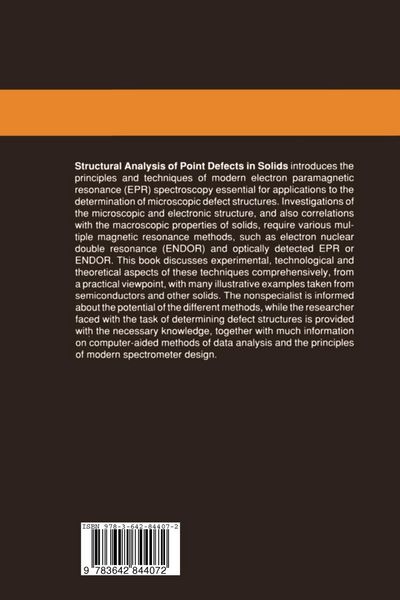
Structural Analysis of Point Defects in Solids An Introduction to Multiple Magnetic Resonance Spectroscopy

Fr. 72.90

inkl. gesetzl. MwSt., Versandkostenfrei


Beschreibung

Produktdetails

Einband

Taschenbuch

Erscheinungsdatum

11.01.2012

Verlag

Springer Berlin

Seitenzahl

367

Maße (L/B/H)

23.5/15.5/2.1 cm

Gewicht

581 g

Auflage

Softcover reprint of the original 1st ed. 1992

Sprache

Englisch

ISBN

978-3-642-84407-2

Beschreibung

Produktdetails

Einband

Taschenbuch

Erscheinungsdatum

11.01.2012

Verlag

Springer Berlin

Seitenzahl

367

Maße (L/B/H)

23.5/15.5/2.1 cm

Gewicht

581 g

Auflage

Softcover reprint of the original 1st ed. 1992

Sprache

Englisch

ISBN

978-3-642-84407-2

Herstelleradresse

Springer-Verlag KG
Sachsenplatz 4-6
1201 Wien
AT

Email: ProductSafety@springernature.com

Kundinnen und Kunden meinen

0 Bewertungen

Informationen zu Bewertungen

Zur Abgabe einer Bewertung ist eine Anmeldung im Konto notwendig. Die Authentizität der Bewertungen wird von uns nicht überprüft. Wir behalten uns vor, Bewertungstexte, die unseren Richtlinien widersprechen, entsprechend zu kürzen oder zu löschen.

Die Bewertungen sind nach Format, Anzahl Sterne und Datum sortiert.

Verfassen Sie die erste Bewertung zu diesem Artikel

Helfen Sie anderen Kund*innen durch Ihre Meinung

Kundinnen und Kunden meinen

0 Bewertungen filtern

  • Produktbild: Structural Analysis of Point Defects in Solids
  • Produktbild: Structural Analysis of Point Defects in Solids
  • 1. Introduction.- 1.1 Structure of Point Defects.- 1.2 Basic Concepts of Defect Structure Determination by Electron Paramagnetic Resonance.- 1.3 Superhyperfine and Electronic Structures of Defects in Solids.- 2. Fundamentals of Electron Paramagnetic Resonance.- 2.1 Magnetic Properties of Electrons and Nuclei.- 2.2 Electrons and Nuclei in an External Magnetic Field.- 2.3 Some Useful Relations for Angular Momentum Operators.- 2.4 Time Dependence of Angular Momentum Operators and Macroscopic Magnetization.- 2.5 Basic Magnetic Resonance Experiment.- 2.6 Spin-Lattice Relaxation.- 2.7 Rate Equations for a Two-Level System.- 2.8 Bloch Equations.- 2.9 Conventional Detection of Electron Paramagnetic Resonance and Its Sensitivity.- 3. Electron Paramagnetic Resonance Spectra.- 3.1 Spin Hamiltonian.- 3.2 Electron Zeeman Interaction.- 3.3 g-Factor Splitting of EPR Spectra.- 3.4 Fine-Structure Splitting of EPR Spectra.- 3.5 Hyperfine Splitting of EPR Spectra.- 3.6 Superhyperfine Splitting of EPR Spectra.- 3.7 Inhomogeneous Line Widths of EPR lines.- 4. Optical Detection of Electron Paramagnetic Resonance.- 4.1 Optical Transitions of Defects in Solids.- 4.2 Spectral Form of Optical Transitions of Defects in Solids.- 4.3 EPR Detected with Magnetic Circular Dichroism of Absorption Method.- 4.4 MCDA Excitation Spectra of ODEPR Lines (MCDA “Tagged” by EPR).- 4.5 Spatially Resolved MCDA and ODEPR Spectra.- 4.6 Measurement of Spin-Lattice Relaxation Time T1 with MCDA Method 105.- 4.7 Determination of Spin State with MCDA Method.- 4.8 EPR of Ground and Excited States Detected with Optical Pumping.- 4.9 EPR Optically Detected in Donor-Acceptor Pair Recombination Luminescence.- 4.10 Optically Detected EPR of Triplet States.- 4.11 ODEPR of Trapped Excitons with MCDA Method.- 4.12 Sensitivity of ODEPR Measurements.- 5. Electron Nuclear Double Resonance.- 5.1 The Resolution Problem, a Simple Model.- 5.2 Type of Information from EPR and NMR Spectra.- 5.3 Indirect Detection of NMR, Double Resonance.- 5.4 Examples of ENDOR Spectra.- 5.5 Relations Between EPR and ENDOR Spectra, ENDOR-Induced EPR.- 5.6 Electron Nuclear Nuclear Triple Resonance (Double ENDOR).- 5.7 Temperature Dependence and Photo-Excitation of ENDOR Spectra.- 5.7.1 Temperature Dependence of ENDOR Spectra.- 5.7.2 Photo-Excitation of ENDOR Spectra.- 6. Determination of Defect Symmetries from ENDOR Angular Dependences.- 6.1 Definition of Neighbor Shells.- 6.2 Neighbor Shells and Transformation of Interaction Tensors.- 6.3 Interaction Tensor Symmetries and ENDOR Angular Dependence.- 6.4 Neighbor Shell Symmetries and ENDOR Angular Dependences.- 6.4.1 Simple Example.- 6.4.2 General Case.- 6.4.3 Defect Structure and Symmetry Matrices.- 6.5 Low Symmetry Defects in Higher Symmetry Environments.- 6.6 Ways to Distinguish Between High and Low Symmetry Defects.- 6.7 Role of EPR Spectrum for an ENDOR Analysis.- 6.8 Solution of the Spin Hamiltonian.- 6.8.1 Concept of Effective Spin.- 6.8.2 Nuclear Spin Hamiltonian.- 6.8.3 Calculation of Effective Spin.- 6.8.4 Mutual Interactions Between Neighbor Nuclei.- 6.8.5 Large hf or shf Interaction for One Nucleus.- 6.8.6 Numerical Calculation of EPR Angular Dependences..- 6.8.7 Fitting of Free Parameters in a Simulated ENDOR Angular Dependence.- 6.8.8 Examples of Results Obtained from Analysis of ENDOR Angular Dependences.- 6.9 Software Treatment of ENDOR Spectra.- 7. Theoretical Interpretation of Superhyperfine and Quadrupole Interactions.- 7.1 Structures of Point Defects.- 7.1.1 Impurities in Insulators.- 7.1.2 Color Centers.- 7.1.3 Defects in Semiconductors.- 7.2 Origin of Zeeman, Hyperfine and Quadrupole Interactions.- 7.2.1 Origin of the Hamiltonian.- 7.2.2 Wigner-Eckart Theorem.- 7.2.3 Zeeman Interaction.- 7.2.4 Hyperfine Interaction.- 7.2.5 Quadrupole Interaction.- 7.2.6 Total Hamiltonian.- 7.3 Central Ion Hyperfine Structure.- 7.3.1 Free Ion Electronic Structure.- 7.3.2 Crystal Field Splitting.- 7.3.3 Spin Hamiltonian.- 7.4 Covalency and Superhyperfine Interaction.- 7.4.1 Molecular Orbitals and Configuration Mixing.- 7.4.2 Superhyperfine Interaction.- 7.4.3 Ligand Core Polarization.- 7.4.4 Ligand Quadrupole Interaction.- 7.4.5 Pseudopotential.- 7.4.6 Lattice Dynamical Effects.- 7.5 Orthogonalized Envelope Functions.- 7.5.1 Wannier’s Theorem and Effective-Mass Theory.- 7.5.2 Continuum Models.- 7.5.3 Point-Ion Model and Ion-Size Corrections.- 7.5.4 Green’s Function Method for Deep-Level Impurities.- 7.5.5 Orthogonalization to Core Orbitals.- 7.6 Simple Approximations and Illustrations for Interpretation of shf and Quadrupole Interactions.- 7.6.1 Point Dipole-Dipole Interaction.- 7.6.2 Calculation of Isotropic shf Constants with Orthogonalized Envelope Function.- 7.6.3 Transferred shf Interactions.- 7.6.4 Calculation of Anisotropic shf Constant b with Orthogonalized Envelope Function.- 7.6.5 Dynamical Contributions to shf Interactions.- 7.6.6 Quadrupole Interactions.- 8. Technology of ENDOR Spectrometers.- 8.1 Experimental Constraints for Conventional ENDOR.- 8.1.1 Modulation Frequency.- 8.1.2 Sensitivity.- 8.1.3 Temperature.- 8.1.4 Microwave and Radio-Frequency Field Intensities.- 8.1.5 Microwave and ENDOR Frequency.- 8.1.6 Static Magnetic Field.- 8.1.7 Modulation of Parameters.- 8.2 ENDOR Spectrometer Design.- 8.3 Components of ENDOR Spectrometer.- 8.3.1 Signal Pre-Amplifier.- 8.3.2 Microwave Detector.- 8.3.3 Microwave Sources.- 8.3.4 ENDOR Microwave Cavities.- 8.3.5 Radio-Frequency Generators.- 9. Experimental Aspects of Optically Detected EPR and ENDOR.- 9.1 Sensitivity Considerations.- 9.1.1 Magnetic Circular Dichroism of Absorption.- 9.1.2 Optically Detected EPR.- 9.2 ODMR Spectrometers Monitoring Light Emission.- 9.3 ODMR Spectrometers Monitoring Magnetic Circular Properties of Absorption and Emission.- 9.3.1 General Description of the Spectrometer.- 9.3.2 Measurement of Magnetic Circular Dichroism of Absorption.- 9.3.3 Measurement of Magnetic Circular Polarization of Emission.- 9.4 Experimental Details of the Components of an MCDA/MCPE ODMR Spectrometer.- 9.4.1 Light Sources.- 9.4.2 Monochromators.- 9.4.3 Imaging Systems.- 9.4.4 Linear Polarizers.- 9.4.5 Photo-Elastic Modulator.- 9.4.6 Detectors.- 9.4.7 Cryostat.- 9.4.8 Magnet.- 9.4.9 Microwave System and Cavity.- 9.4.10 Radio-Frequency System for ODENDOR.- 9.4.11 Control and Registration Electronics.- Appendices.- B. The Cayley Transformation Formula.- C. Algorithm for the Subtraction of an Unknown Background.- D. Digital Filters for Application in ENDOR Spectra.- E. Deconvolution of ENDOR Spectra.- F. Peak Search Algorithm.- G. Simulation of EPR Spectra.- References.