• Produktbild: Nonlinear Laser Chemistry
  • Produktbild: Nonlinear Laser Chemistry
Band 22

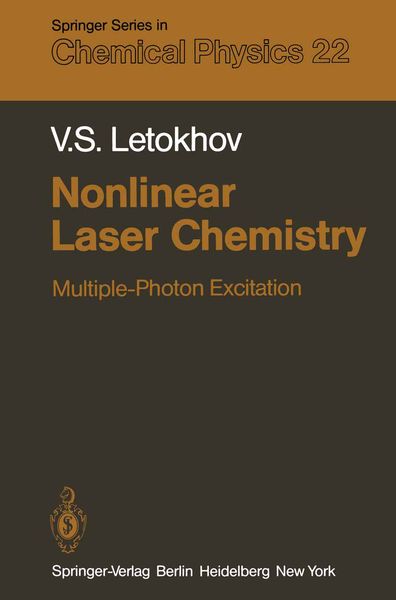
Nonlinear Laser Chemistry Multiple-Photon Excitation

Fr. 137.00

inkl. gesetzl. MwSt., Versandkostenfrei


Beschreibung

Produktdetails

Einband

Taschenbuch

Erscheinungsdatum

19.04.2012

Verlag

Springer Berlin

Seitenzahl

418

Maße (L/B/H)

23.5/15.5/2.4 cm

Gewicht

657 g

Auflage

Softcover reprint of the original 1st ed. 1983

Sprache

Englisch

ISBN

978-3-642-87648-6

Beschreibung

Produktdetails

Einband

Taschenbuch

Erscheinungsdatum

19.04.2012

Verlag

Springer Berlin

Seitenzahl

418

Maße (L/B/H)

23.5/15.5/2.4 cm

Gewicht

657 g

Auflage

Softcover reprint of the original 1st ed. 1983

Sprache

Englisch

ISBN

978-3-642-87648-6

Herstelleradresse

Springer-Verlag KG
Sachsenplatz 4-6
1201 Wien
AT

Email: ProductSafety@springernature.com

Kundinnen und Kunden meinen

0 Bewertungen

Informationen zu Bewertungen

Zur Abgabe einer Bewertung ist eine Anmeldung im Konto notwendig. Die Authentizität der Bewertungen wird von uns nicht überprüft. Wir behalten uns vor, Bewertungstexte, die unseren Richtlinien widersprechen, entsprechend zu kürzen oder zu löschen.

Die Bewertungen sind nach Format, Anzahl Sterne und Datum sortiert.

Verfassen Sie die erste Bewertung zu diesem Artikel

Helfen Sie anderen Kund*innen durch Ihre Meinung

Kundinnen und Kunden meinen

0 Bewertungen filtern

  • Produktbild: Nonlinear Laser Chemistry
  • Produktbild: Nonlinear Laser Chemistry
  • 1. Introduction.- 1.1 General Concepts of Selective Photophysics and Photochemistry.- 1.1.1 Inter- and Intramolecular Selectivity.- 1.1.2 Photochemical and Photophysical Processes.- 1.1.3 History of Selective Photochemistry and Photophysics.- 1.2 Classification of Selective Molecular Photoprocesses Induced by Laser Radiation.- 1.2.1 Laser Radiation Properties.- 1.2.2 Nonlinear (Multi-Step and Multi-Photon) Photoexcitation.- 1.2.3 Type of Selective Molecular Photoprocess.- 1.3 Selectivity and Yields of Photochemical Processes.- 1.3.1 Processes Leading to Losses in Selectivity.- 1.3.2 Photochemical Collisional Reaction.- 1.3.3 Photochemical Monomolecular Reactions.- 1.3.4 The Yield of the Photoprocess with Multi-Photon Excitation.- 1.4 Applications of Selective Laser Photochemistry.- 1.4.1 Various Aggregate States of Substance.- 1.4.2 Various Trends of Applications.- 2. Selective Photoexcitation of Atoms and Molecules.- 2.1 Isotopic Selectivity in Linear Photoexcitation of Atoms and Molecules.- 2.1.1 Isotopic Shifts for Atoms.- 2.1.2 Hyperfine Structure and Nuclear Spin for Atoms.- 2.1.3 Isotope Shifts in Molecular Spectra.- 2.1.4 Nuclear Spin Effects in Molecules.- 2.2 Limitations of Linear Selectivity of Photoexcitation and Methods for Its Enhancement.- 2.2.1 Overlapping of Spectral Lines. Atomic Beams.- 2.2.2 Overlapping of Vibrational-Rotational Absorption Bands. Cooling of Molecules.- 2.3 Methods for the Enhancement of Selectivity with Nonlinear Photoexcitation.- 2.3.1 Selectivity Multiplication in a Multi-Step Process.- 2.3.2 Selectivity of Two-Photon Excitation of Overlapping Doppler-Broadened Lines.- 2.3.3 Selectivity of Multi-Step Excitation of Overlapping Nonhomogeneously Broadened Lines.- 2.3.4 Selectivity of Multi-Step Photoexcitation with Temporal Pulse Selection.- 2.4 Overall Selectivity of Photochemical Processes.- 3. Multi-Step Selective Photoionization of Atoms.- 3.1 Introduction.- 3.1.1 Qualitative Considerations.- 3.1.2 First Experiments.- 3.2 Characteristics of Multi-Step Photoionization.- 3.2.1 Kinetics of Two-Step Ionization.- 3.2.2 Coherent Interaction Effects.- 3.2.3 Various Methods of Ionizing Excited Atoms.- 3.3 Photoionization from Excited States to the Continuum and Autoionization States.- 3.3.1 Measurement of the Photoionization Cross-Section by the Method of Quantum State Depletion.- 3.3.2 Frequency Dependence of the Photoionization Cross-Section.- 3.3.3 Autoionization Resonances of Excited States.- 3.4 Ionization of Highly Excited (Rydberg) Atomic States.- 3.4.1 Properties of Highly Excited Atoms.- 3.4.2 Electric Field Ionization.- a) Theoretical Treatment.- b) Experimental Results.- c) Total Ionization Yield.- 3.4.3 Photoionization Through IR Radiation.- 3.5 Collision Processes in the Multi-Step Ionization of Atoms.- 3.5.1 Resonance Energy Transfer Between Atoms.- 3.5.2 Collisional Ionization of Excited Atoms.- a) Electron Capture.- b) Associative Ionization.- c) Electron Escape.- 3.5.3 Resonant Charge Transfer.- 4. Selective Monomolecular Photoprocesses with Nonlinear Excitation of Electronic States.- 4.1 Methods Used in the Multi-Step Excitation of Molecular Electronic States.- 4.2 Photodissociation of Molecules by Two-Step Excitation Through Vibrational States.- 4.2.1 Electronic Absorption Spectrum from Excited Vibrational States.- 4.2.2 Effect of the Rotational “Bottleneck” on Photoexcitation of Vibrations.- 4.2.3 Selectivity of Two-Step IR-UV Photoexcitation.- a) Ultimate Spectral Selectivity.- b) Influence of Thermal Excitation of Vibrations.- 4.2.4 Isotopically-Selective IR-UV Photodissociation.- 4.2.5 Loss of Selectivity Due to Collisions.- a) V-V Exchange Between Lower Vibrational Levels.- b) Secondary Photochemical Processes.- 4.3 Monomolecular Photoprocesses with Multi-Photon Vibrational and Subsequent Electronic Excitation.- 4.3.1 Distortion of the Electronic Absorption Spectrum Due to Multi-Photon Excitation of Vibrations.- 4.3.2 Selective IR-UV Photodissociation of Isotopic Molecules.- 4.3.3 UV-IR Photoisomerization of Molecules.- a) Schemes of Photoisomerization.- b) Stepwise IR-UV Photoisomerization.- c) Competition Between Isomerization and Dissociation.- 4.3.4 IR-VUV Photoionization of Molecules.- 4.4 Photoionization of Molecules Through Nonlinear Excitation of Electronic States.- 4.4.1 Two-Step UV-VUV Photoionization.- 4.4.2 Photoionization and Photofragmentation Using Intense Resonant UV Laser Light.- 4.4.3 Multi-Photon Photoionization Using Very Intense Laser Light.- 5. Multi-Photon Monomolecular Photoprocesses in the Ground Electronic State.- 5.1 Introduction to IR Multi-Photon Laser Chemistry.- 5.1.1 Early Papers and the First Experiments.- 5.1.2 Basic Processes.- 5.2 Multi-Photon (MP) Absorption of IR Radiation and Excitation of Molecules Through Lower Vibrational Levels.- 5.2.1 MP Absorption Characteristics.- 5.2.2 Fraction of Excited Molecules.- 5.2.3 Theory of the Excitation of Lower Vibrational Levels.- a) Model for MP Transitions.- b) Model for Anharmonicity Compensation.- c) Model for Weak Transitions.- 5.2.4 Comparison of Theory with Experiment.- 5.3 Multi-Photon Excitation of Molecules in the Vibrational Quasi-Continuum and Distribution of Vibrational Energy.- 5.3.1 Properties of the Vibrational Quasi-Continuum.- 5.3.2 Excitation and Vibrational Distribution of Molecules in the Quasi-Continuum.- 5.3.3 Stochastization of Vibrational Energy.- 5.3.4 Comparison of Theory with Experiment.- 5.4 Dissociation of Highly Excited Molecules.- 5.4.1 Characteristics of the MP Dissociation.- 5.4.2 MP Dissociation in Two-Frequency IR Fields.- 5.4.3 Statistical Theory of Monomolecular Decay.- 5.4.4 Kinetic Model of the MP Dissociation.- 5.4.5 MP Dissociation Products.- 5.4.6 Collision Effects.- a) Collisions with Buffer Gas.- b) Collisions Between Molecules.- c) Secondary Processes.- 5.5 Molecular Isomerization under MP Excitation.- 5.5.1 Features of the MP Isomerization.- 5.5.2 Experimental Data.- 5.6 Isotopic Selectivity of the MP Dissociation.- 5.6.1 Methods of Measuring the Selectivity.- 5.6.2 Dependence of Selectivity on Frequency and Intensity of Laser Pulses.- a) Spectral Dependence.- b) Intensity Dependence.- c) Selectivity of the MP Dissociation Using IR Pulses of Two Different Frequencies.- 5.6.3 Role of V-V Exchange.- 6. Laser Photoseparation on an Atomic and a Molecular Level.- 6.1 Introduction to Methods of Laser Photoseparation.- 6.1.1 Characteristics of the Separation Cell.- a) Selectivity of Isotope Separation.- b) Degree of Isotope Extraction.- c) Energy Consumption of the Photoseparation.- 6.1.2 Potential Advantages of Laser Separation.- 6.2 Separation of Atoms Through Photoionization.- 6.2.1 General Characteristics of the Method.- 6.2.2 Isotope Separation.- 6.2.3 Separation of Radioactive Isotopes and Nuclear Isomers.- 6.2.4 Pure Materials Technology at an Atomic Level.- 6.3 Separation of Molecules Through Photodissociation.- 6.3.1 General Characteristics of the Method.- a) Optimal Photoseparation Process.- b) Chemical Cycle.- c) Choice of the Starting Material.- 6.3.2 Isotope Separation.- a) Isotopes of Light and Medium Mass. Scaling of the Process of Laser Separation.- b) Isotopes of Uranium.- c) Hydrogen Isotopes.- 6.3.3 Laser Purification.- 7. Selective Laser Detection of Atoms and Molecules.- 7.1 Detection of Single Atoms by Selective Multi-Step Photoionization.- 7.1.1 Detection of Atoms in a Beam.- 7.1.2 Detection of Atoms in a Buffer Gas.- 7.1.3 Modifications of the Photoionization Method.- 7.1.4 Detection Selectivity and Isotopes of Cosmogenic Origin.- 7.2 Detection of Molecules by Selective Photoionization and Mass Spectrometry.- 7.2.1 Idea of a Two-Dimensional Optical Mass Spectrometer.- 7.2.2 Detection of Single Molecules in a Photoionization Mass Spectrometer.- 7.2.3 Selective Laser Photoionization Detector.- a) Molecular Photoionization Through Intermediate Electronic States.- b) Molecular Photoionization Through Intermediate Vibrational States.- 7.3 Laser Photoionization Visualization of Molecules and Spatial Localization of Molecular Bonds.- 7.3.1 Principle of a Laser Photoelectron (Photoion) Microscope.- 7.3.2 Ultimate Spatial Resolution.- 7.3.3 Photodetachment of Molecular Photoions from a Surface.- 7.3.4 Wave-Corpuscular (Photoion or Photoelectron) Microscopy.- 8. Laser Photochemistry and Photobiochemistry.- 8.1 IR Multi-Photon Photochemistry.- 8.1.1 Classification of IR Laser Methods in Photochemistry.- 8.1.2 Mode- (or Bond-)Selective Photochemistry.- 8.1.3 Molecule-Selective Laser-Induced Chemical Synthesis.- a) Photochemical Syntheses of High Yield.- b) Combined (Thermal and IR Laser) Chemical Synthesis.- c) Photochemical Synthesis at Higher Pressures.- d) Competition of Different Channels in Photochemical Synthesis.- 8.1.4 Nonselective IR Photochemistry.- 8.2 Nonlinear Photochemistry of Biomolecules in Solution.- 8.2.1 Nonlinear Photoexcitation of Complex Molecules in Solution.- a) Nonlinear Photoexcitation Through Intermediate Vibrational States.- b) Nonlinear Photoexcitation Through Intermediate Electronic States.- 8.2.2 Photochemical Reactions of Molecules in Solution After Two-Step Excitation.- a) Photodecomposition of the Bases of Nucleic Acids by Picosecond UV Pulses.- b) Photochemical Synthesis of Amino Acids Using Picosecond UV Pulses.- c) Action of Picosecond UV Pulses on the DNA of Viruses and Cells.- Main Notations.- References.- Additional Reading.