• Produktbild: OPEC and the Price of Petroleum
  • Produktbild: OPEC and the Price of Petroleum

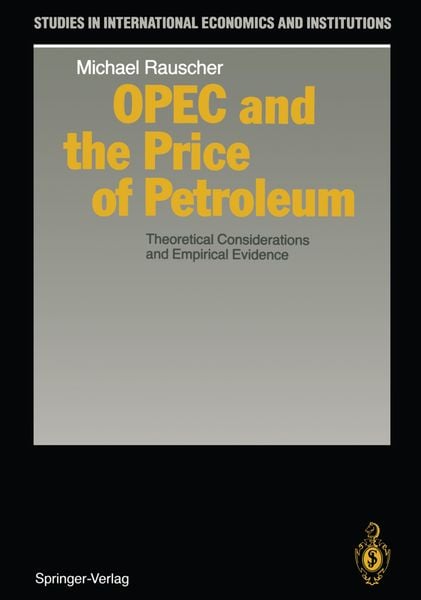
OPEC and the Price of Petroleum Theoretical Considerations and Empirical Evidence

Fr. 73.90

inkl. gesetzl. MwSt., Versandkostenfrei


Beschreibung

Produktdetails

Einband

Taschenbuch

Erscheinungsdatum

14.03.2012

Verlag

Springer Berlin

Seitenzahl

206

Maße (L/B/H)

24.2/17/1.3 cm

Gewicht

392 g

Auflage

Softcover reprint of the original 1st ed. 1989

Sprache

Englisch

ISBN

978-3-642-83928-3

Beschreibung

Produktdetails

Einband

Taschenbuch

Erscheinungsdatum

14.03.2012

Verlag

Springer Berlin

Seitenzahl

206

Maße (L/B/H)

24.2/17/1.3 cm

Gewicht

392 g

Auflage

Softcover reprint of the original 1st ed. 1989

Sprache

Englisch

ISBN

978-3-642-83928-3

Herstelleradresse

Springer-Verlag GmbH
Tiergartenstr. 17
69121 Heidelberg
DE

Email: ProductSafety@springernature.com

Kundinnen und Kunden meinen

0 Bewertungen

Informationen zu Bewertungen

Zur Abgabe einer Bewertung ist eine Anmeldung im Konto notwendig. Die Authentizität der Bewertungen wird von uns nicht überprüft. Wir behalten uns vor, Bewertungstexte, die unseren Richtlinien widersprechen, entsprechend zu kürzen oder zu löschen.

Die Bewertungen sind nach Format, Anzahl Sterne und Datum sortiert.

Verfassen Sie die erste Bewertung zu diesem Artikel

Helfen Sie anderen Kund*innen durch Ihre Meinung

Kundinnen und Kunden meinen

0 Bewertungen filtern

  • Produktbild: OPEC and the Price of Petroleum
  • Produktbild: OPEC and the Price of Petroleum
  • 1. Introduction.- 1.1. Oil price fluctuations and their impact on economic performance.- 1.2. Plan of the study.- 2. The world petroleum market: history and institutions.- 2.1. Petroleum as an exhaustible resource.- 2.1.1. Some basic concepts.- 2.1.2. Measurement of reserves.- 2.1.3. The development of production and reserves.- 2.1.4. The regional distribution of consumption, production, and reserves.- 2.2. The Organization of Petroleum Exporting Countries.- 2.3. The price of petroleum.- 2.3.1. Long-term contracts with fixed prices.- 2.3.2. The spot market.- 2.3.3. Netback contracts.- 2.3.4. Futures markets for crude oil and petroleum products.- 2.3.5. Petroleum prices and scarcity.- 2.4. A brief history of the world petroleum market.- 2.4.1. The oil market before OPEC.- 2.4.2. Alteration of property rights.- 2.4.3. New contractual relationships.- 2.4.4. OPEC and the oil price in the seventies and eighties: A chronology of events.- 2.5. Summary of some stylised facts.- 3. The price of petroleum in economic theory.- 3.1. Types of oil market models.- 3.2. The economic theory of exhaustible resources.- 3.2.1. The Ricardian approach.- 3.2.2. A simple model of exhaustibility.- 3.2.3. Different market structures.- 3.2.4. The resource-exporting country.- 3.2.5. Uncertainty.- 3.2.6. Testing Hotelling’s model.- 3.3. Parameter changes in the standard model.- 3.3.1. The size of the resource stock.- 3.3.2. Changing property rights.- 3.3.3. Cartelisation.- 3.3.4. The backstop technology.- 3.3.5. Additional variables.- 3.4. Approaches without exhaustibility.- 3.4.1. The impact of GDP fluctuations.- 3.4.2. The backward-bending supply curve.- 3.4.3. Static monopoly theory.- 3.4.4. Lagged demand reactions.- 3.4.5. Downstream activities.- 3.4.6. Some empirical models of oil price determination.- 3.4.7. Is OPEC a cartel ?.- 3.5. An evaluation.- 4. An intertemporal model of OPEC’s pricing policy.- 4.1. Basic assumptions.- 4.1.1. Consumption, foreign assets, and the resource stock.- 4.1.2. Demand for petroleum.- 4.1.3. Petroleum supply from non-OPEC sources.- 4.1.4. The literature on dynamic monopoly models.- 4.2. Necessary conditions of optimality.- 4.3. The consumption path.- 4.4. Accumulation of foreign assets and the existence of an optimal solution.- 4.5. The price path.- 4.5.1. The long-run equilibrium price.- 4.5.2. The effects of parameter changes.- 4.5.3. Second-order conditions.- 4.5.4. Behaviour near the equilibrium.- 4.5.5. A numerical example.- 4.6. The equilibrium in the long run.- 4.7. An evaluation of the model and its results.- 5. A simplified version of the model.- 5.1. The assumptions.- 5.2. Optimality conditions.- 5.3. The optimal pricing policy.- 5.3.1. The long-run equilibrium.- 5.3.2. Behaviour near the equlibrium.- 5.3.3. The long-run optimal path.- 5.4. Imperfect information and the occurrence of price shocks.- 5.4.1. The first and second oil shocks.- 5.4.2. Declining oil prices in the eighties.- 5.4.3. Heterogeneity of OPEC and endogenous price cycles.- 5.5. Theoretical results and the empirical oil price cycle: a comparison.- 6. An econometric model of the world petroleum market.- 6.1. Objectives of the investigation.- 6.2. OPEC and oil price fluctuations.- 6.2.1. A rule-of-the-thumb approach to determining the oil price.- 6.2.2. The interaction of supply and demand.- 6.3. Empirical results.- 6.3.1. Specification of equations.- 6.3.1.1. Demand.- 6.3.1.2. Non-OPEC supply.- 6.3.1.3. The price of petroleum.- 6.3.2. Estimation results.- 6.3.2.1. Concavity and convexity.- 6.3.2.2. Demand for petroleum.- 6.3.2.3. Non-OPEC supply of petroleum.- 6.3.2.4. OPEC behaviour and price adjustments.- 6.3.3. Summary of the empirical results.- 6.4. Optimal pricing policies in the empirical model.- 6.4.1. Misspecification of adjustment processes.- 6.4.2. Adjustment processes and long-run demand and supply functions.- 6.4.3. Long-run equilibrium prices and quantities.- 7. Final remarks.- 7.1. Summary and conclusions.- 7.2. A remark on policy implications.- 7.3. Areas of future research.- Appendix: Optimal control theory.- A.1. The problem.- A.2. Necessary and sufficient conditions.- A.3. Saddle points and the stability of optimal solutions.- References.