• Produktbild: Modern Crystallography II
  • Produktbild: Modern Crystallography II
Band 21

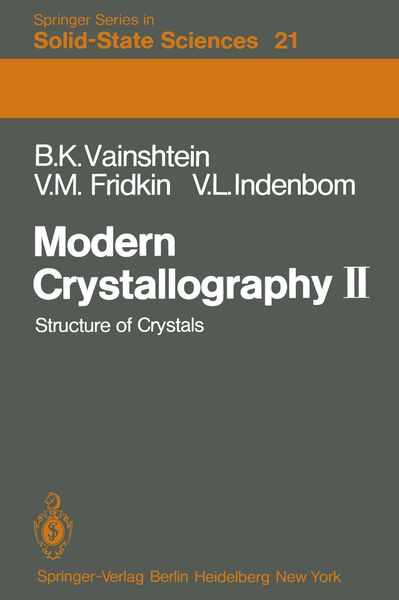
Modern Crystallography II Structure of Crystals

Fr. 137.00

inkl. gesetzl. MwSt., Versandkostenfrei


Beschreibung

Produktdetails

Einband

Taschenbuch

Erscheinungsdatum

19.01.2012

Verlag

Springer Berlin

Seitenzahl

436

Maße (L/B/H)

22.9/15.2/2.5 cm

Gewicht

656 g

Auflage

1982

Sprache

Englisch

ISBN

978-3-642-96621-7

Beschreibung

Produktdetails

Einband

Taschenbuch

Erscheinungsdatum

19.01.2012

Verlag

Springer Berlin

Seitenzahl

436

Maße (L/B/H)

22.9/15.2/2.5 cm

Gewicht

656 g

Auflage

1982

Sprache

Englisch

ISBN

978-3-642-96621-7

Herstelleradresse

Springer-Verlag KG
Sachsenplatz 4-6
1201 Wien
AT

Email: ProductSafety@springernature.com

Kundinnen und Kunden meinen

0 Bewertungen

Informationen zu Bewertungen

Zur Abgabe einer Bewertung ist eine Anmeldung im Konto notwendig. Die Authentizität der Bewertungen wird von uns nicht überprüft. Wir behalten uns vor, Bewertungstexte, die unseren Richtlinien widersprechen, entsprechend zu kürzen oder zu löschen.

Die Bewertungen sind nach Format, Anzahl Sterne und Datum sortiert.

Verfassen Sie die erste Bewertung zu diesem Artikel

Helfen Sie anderen Kund*innen durch Ihre Meinung

Kundinnen und Kunden meinen

0 Bewertungen filtern

  • Produktbild: Modern Crystallography II
  • Produktbild: Modern Crystallography II
  • 1. Principles of Formation of the Atomic Structure of Crystals.- 1.1 The Structure of Atoms.- 1.1.1 A Crystal as an Assembly of Atoms.- 1.1.2 Electrons in an Atom.- 1.1.3 Multielectron Atoms and the Periodic System.- 1.2 Chemical Bonding Between Atoms.- 1.2.1 Types of Chemical Bonding.- 1.2.2 Ionic Bond.- 1.2.3 Covalent Bond. Valence-Bond Method.- 1.2.4 Hybridization. Conjugation.- 1.2.5 Molecular-Orbital (MO) Method.- 1.2.6 Covalent Bond in Crystals.- 1.2.7 Electron Density in a Covalent Bond.- 1.2.8 Metallic Bond.- 1.2.9 Weak (van der Waals) Bonds.- 1.2.10 Hydrogen Bonds.- 1.2.11 Magnetic Ordering.- 1.3 Energy of the Crystal Lattice.- 1.3.1 Experimental Determination of the Crystal Energy.- 1.3.2 Calculation of the Potential Energy.- 1.3.3 Organic Structures.- 1.4 Crystallochemical Radii Systems.- 1.4.1 Interatomic Distances.- 1.4.2 Atomic Radii.- 1.4.3 Ionic Radii.- 1.4.4 The System of Atomic-Ionic Radii of a Strong Bond.- 1.4.5 System of Intermolecular Radii.- 1.4.6 Weak-and Strong-Bond Radii.- 1.5 Geometric Regularities in the Atomic Structure of Crystals.- 1.5.1 The Physical and the Geometric Model of a Crystal.- 1.5.2 Structural Units of a Crystal.- 1.5.3 Maximum-Filling Principle.- 1.5.4 Relationship Between the Symmetry of Structural Units and Crystal Symmetry.- 1.5.5 Statistics of the Occurrence of Space Groups.- 1.5.6 Coordination.- 1.5.7 Classification of Structures According to the Dimensionality of Structural Groupings.- 1.5.8 Coordination Structures.- 1.5.9 Relationship Between Coordination and Atomic Sizes.- 1.5.10 Closest Packings.- 1.5.11 Structures of Compounds Based on Close Packing of Spheres.- 1.5.12 Insular, Chain and Layer Structures.- 1.6 Solid Solutions and Isomorphism.- 1.6.1 Isostructural Crystals.- 1.6.2 Isomorphism.- 1.6.3 Substitutional Solid Solutions.- 1.6.4 Interstitial Solid Solutions.- 1.6.5 Modulated and Incommensurate Structures.- 1.6.6 Composite Ultrastructures.- 2. Principal Types of Crystal Structures.- 2.1 Crystal Structures of Elements.- 2.1.1 Principal Types of Structures of Elements.- 2.1.2 Crystallochemical Properties of Elements.- 2.2 Intermetallic Structures.- 2.2.1 Solid Solutions and Their Ordering.- 2.2.2 Electron Compounds.- 2.2.3 Intermetallic Compounds.- 2.3 Structures with Bonds of Ionic Nature.- 2.3.1 Structures of Halides, Oxides and Salts.- 2.3.2 Silicates.- 2.3.3 Superionic Conductors.- 2.4 Covalent Structures.- 2.5 Structure of Complex and Related Compounds.- 2.5.1 Complex Compounds.- 2.5.2 Compounds with Metal Atom Clusters.- 2.5.3 Metal-Molecular Bonds (? Complexes of Transition Metals).- 2.5.4 Compounds of Inert Elements.- 2.6 Principles of Organic Crystal Chemistry.- 2.6.1 The Structure of Organic Molecules.- 2.6.2 Symmetry of Molecules.- 2.6.3 Packing of Molecules in a Crystal.- 2.6.4 Crystals with Hydrogen Bonds.- 2.6.5 Clathrate and Molecular Compounds.- 2.7 Structure of High-Polymer Substances.- 2.7.1 Noncrystallographic Ordering.- 2.7.2 Structure of Chain Molecules of High Polymers.- 2.7.3 Structure of a Polymer Substance.- 2.7.4 Polymer Crystals.- 2.7.5 Disordering in Polymer Structures.- 2.8 Structure of Liquid Crystals.- 2.8.1 Molecule Packing in Liquid Crystals.- 2.8.2 Types of Liquid-Crystal Ordering.- 2.9 Structures of Substances of Biological Origin.- 2.9.1 Types of Biological Molecules.- 2.9.2 Principles of Protein Structure.- 2.9.3 Fibrous Proteins.- 2.9.4 Globular Proteins.- 2.9.5 Structure of Nucleic Acids.- 2.9.6 Structure of Viruses.- 3. Band Energy Structure of Crystals.- 3.1 Electron Motion in the Ideal Crystal.- 3.1.1 Schrödinger Equation and Born-Karman Boundary Conditions.- 3.1.2 Energy Spectrum of an Electron.- 3.2 Brillouin Zones.- 3.2.1 Energy Spectrum of an Electron in the Weak-Bond Approximation.- 3.2.2 Faces of Brillouin Zones and the Laue Condition.- 3.2.3 Band Boundaries and the Structure Factor.- 3.3 Isoenergetic Surfaces. Fermi Surface and Band Structure.- 3.3.1 Energy Spectrum of an Electron in the Strong-Bond Approximation.- 3.3.2 Fermi Surfaces.- 4. Lattice Dynamics and Phase Transitions.- 4.1 Atomic Vibrations in a Crystal.- 4.1.1 Vibrations of a Linear Atomic Chain.- 4.1.2 Vibration Branches.- 4.1.3 Phonons.- 4.2 Heat Capacity, Thermal Expansion, and Thermal Conductivity of Crystals.- 4.2.1 Heat Capacity.- 4.2.2 Linear Thermal Expansion.- 4.2.3 Thermal Conductivity.- 4.3 Polymorphism. Phase Transitions.- 4.3.1 Phase Transitions of the First and Second Order.- 4.3.2 Phase Transitions and the Structure.- 4.4 Atomic Vibrations and Polymorphous Transitions.- 4.5 Ordering-Type Phase Transitions.- 4.6 Phase Transitions and Electron—Phonon Interaction.- 4.6.1 Contribution of Electrons to the Free Energy of the Crystal.- 4.6.2 Interband Electron—Phonon Interaction.- 4.6.3 Photostimulated Phase Transitions.- 4.6.4 Curie Temperature and the Energy Gap Width.- 4.7 Debye’s Equation of State and Grüneisen’s Formula.- 4.8 Phase Transitions and Crystal Symmetry.- 4.8.1 Second-Order Phase Transitions.- 4.8.2 Description of Second -Order Transitions with an Allowance for the Symmetry.- 4.8.3 Phase Transitions Without Changing the Number of Atoms in the Unit Cell of a Crystal.- 4.8.4 Changes in Crystal Properties on Phase Transitions.- 4.8.5 Properties of Twins (Domains) Forming on Phase Transformations.- 4.8.6 Stability of the Homogeneous State of the Low-Symmetry Phase.- 5. The Structure of Real Crystals.- 5.1 Classification of Crystal Lattice Defects.- 5.2 Point Defects of the Crystal Lattice.- 5.2.1 Vacancies and Interstitial Atoms.- 5.2.2 Role of Impurities, Electrons, and Holes.- 5.2.3 Effect of External Influences.- 5.3 Dislocations.- 5.3.1 Burgers Circuit and Vector.- 5.3.2 Elastic Field of Straight Dislocation.- 5.3.3 Dislocation Reactions.- 5.3.4 Polygonal Dislocations.- 5.3.5 Curved Dislocations.- 5.4 Stacking Faults and Partial Dislocations.- 5.5 Continuum Description of Dislocations.- 5.5.1 Dislocation-Density Tensor.- 5.5.2 Example: A Dislocation Row.- 5.5.3 Scalar Dislocation Density.- 5.6 Subgrain Boundaries (Mosaic Structures) in Crystals.- 5.6.1 Examples of Subgrain Boundaries: A Tilt Boundary and a Twist Boundary.- 5.6.2 The Dislocation Structure of the Subgrain Boundary in General.- 5.6 3 Subgrain Boundary Energy.- 5.6.4 Incoherent Boundaries.- 5.7 Twins.- 5.7.1 Twinning Operations.- 5.7.2 Twinning With a Change in Crystal Shape.- 5.7.3 Twinning Without a Change in Shape.- 5.8 Direct Observation of Lattice Defects.- 5.8.1 Ionic Microscopy.- 5.8.2 Electron Microscopy.- 5.8.3 X-Ray Topography.- 5.8.4 Photoelasticity Method.- 5.8.5 Selective Etching Method.- 5.8.6 Investigation of the Crystal Surface.- References.