Band 85
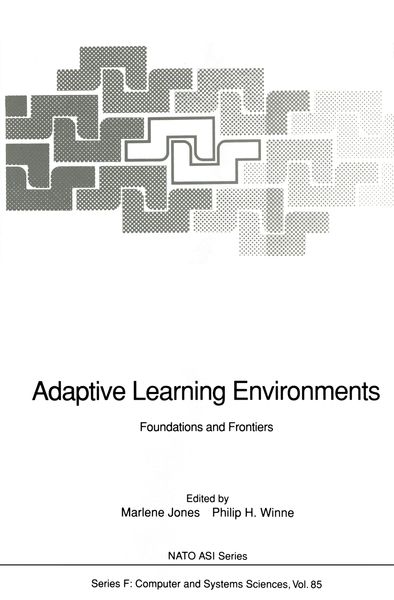
Adaptive Learning Environments Foundations and Frontiers
Aus der Reihe
NATO ASI Subseries F:
-
- Taschenbuch ausgewählt
- eBook
-
Sprache:Englisch
Fr. 137.00
inkl. gesetzl. MwSt.,
Beschreibung
Produktdetails
Einband
Taschenbuch
Erscheinungsdatum
16.12.2011
Herausgeber
Marlene Jones + weitereVerlag
Springer BerlinSeitenzahl
408
Maße (L/B/H)
24.2/17/2.3 cm
Gewicht
723 g
Auflage
Softcover reprint of the original 1st ed. 1992
Sprache
Englisch
ISBN
978-3-642-77514-7
Adaptive Learning Environments (ALEs) can be viewed as the
intersection of two traditionally distinct areas of
research: instructional science and computer science. They
encompass intelligent tutoring systems, interactive learning
environments, and situated learning environments. There is
increasing interest in effective instructional systems from
education, industry, military and government sectors. Given
recent advances in hardware architecture and reduction of
hardware costs, the time is right to define the next steps
in research and development of ALEs.
This book is an outgrowth of the presentations and
discussions that took place at the NATO Advanced Study
Institute held at the University of Calgary in July 1990. It
contains chapters from both researchers in instructional
science and researchers in computer science on the following
topics:
- Systems and architectures for instruction
- Representing curriculum and designing instructional tasks
- Environments to support learning
- Diagnosing students' learning and adjusting plans for
instruction
- Models of students' metacognition, motivation and learning
strategies
- Student-system interactions.
The book containsintroductions/critiques of each pair of
chapters, and a final chapter discusses the synthesis of
instructional science and computer science.
intersection of two traditionally distinct areas of
research: instructional science and computer science. They
encompass intelligent tutoring systems, interactive learning
environments, and situated learning environments. There is
increasing interest in effective instructional systems from
education, industry, military and government sectors. Given
recent advances in hardware architecture and reduction of
hardware costs, the time is right to define the next steps
in research and development of ALEs.
This book is an outgrowth of the presentations and
discussions that took place at the NATO Advanced Study
Institute held at the University of Calgary in July 1990. It
contains chapters from both researchers in instructional
science and researchers in computer science on the following
topics:
- Systems and architectures for instruction
- Representing curriculum and designing instructional tasks
- Environments to support learning
- Diagnosing students' learning and adjusting plans for
instruction
- Models of students' metacognition, motivation and learning
strategies
- Student-system interactions.
The book containsintroductions/critiques of each pair of
chapters, and a final chapter discusses the synthesis of
instructional science and computer science.
Kundinnen und Kunden meinen
Verfassen Sie die erste Bewertung zu diesem Artikel
Helfen Sie anderen Kund*innen durch Ihre Meinung