• Produktbild: Synchrotron Radiation
  • Produktbild: Synchrotron Radiation
Band 10

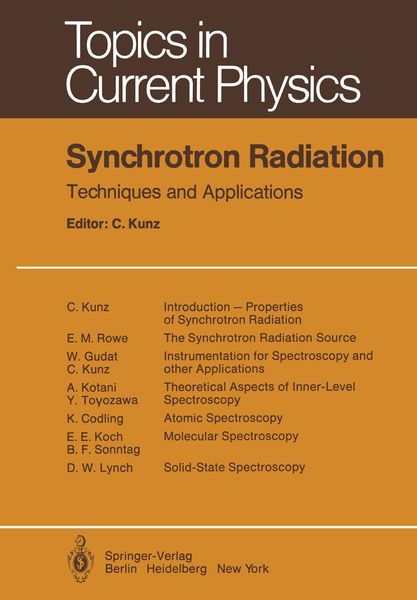
Synchrotron Radiation Techniques and Applications

Fr. 72.90

inkl. gesetzl. MwSt., Versandkostenfrei


Beschreibung

Produktdetails

Einband

Taschenbuch

Erscheinungsdatum

15.12.2011

Herausgeber

C. Kunz

Verlag

Springer Berlin

Seitenzahl

444

Maße (L/B/H)

24.4/17/2.5 cm

Gewicht

794 g

Auflage

Softcover reprint of the original 1st ed. 1979

Sprache

Englisch

ISBN

978-3-642-81299-6

Beschreibung

Produktdetails

Einband

Taschenbuch

Erscheinungsdatum

15.12.2011

Herausgeber

C. Kunz

Verlag

Springer Berlin

Seitenzahl

444

Maße (L/B/H)

24.4/17/2.5 cm

Gewicht

794 g

Auflage

Softcover reprint of the original 1st ed. 1979

Sprache

Englisch

ISBN

978-3-642-81299-6

Herstelleradresse

Springer-Verlag KG
Sachsenplatz 4-6
1201 Wien
AT

Email: ProductSafety@springernature.com

Kundinnen und Kunden meinen

0 Bewertungen

Informationen zu Bewertungen

Zur Abgabe einer Bewertung ist eine Anmeldung im Konto notwendig. Die Authentizität der Bewertungen wird von uns nicht überprüft. Wir behalten uns vor, Bewertungstexte, die unseren Richtlinien widersprechen, entsprechend zu kürzen oder zu löschen.

Die Bewertungen sind nach Format, Anzahl Sterne und Datum sortiert.

Verfassen Sie die erste Bewertung zu diesem Artikel

Helfen Sie anderen Kund*innen durch Ihre Meinung

Kundinnen und Kunden meinen

0 Bewertungen filtern

  • Produktbild: Synchrotron Radiation
  • Produktbild: Synchrotron Radiation
  • 1. Introduction — Properties of Synchrotron Radiation.- 1.1 Historical Development.- 1.2 Quantitative Properties.- 1.2.1 Equations for Ideal Orbits.- 1.2.2 Considerations for Real Orbits.- a) Coherence.- b) Periodic Wigglers.- c) Synchrotron Accelerators.- d) Beam Cross Section and Divergency.- 1.2.3 Time Structure.- 1.3 Comparison with other Sources.- 1.3.1 Infrared and Visible Range.- 1.3.2 Vacuum Ultraviolet Range.- 1.3.3 X-rays.- 1.4 Acknowledgments.- References.- 2. The Synchrotron Radiation Source.- 2.1 Fundamental Concepts.- 2.1.1 Orbit Dynamics.- a) Betatron Oscillations.- b) Betatron Oscillations of Off-energy Particles.- c) Phase Focusing and Synchrotron Oscillations.- 2.1.2 Radiation Damping.- 2.1.3 Beam Lifetime.- 2.1.4 Beam Cross Section.- 2.2 Design Considerations.- 2.2.1 Magnetic Field and Energy.- 2.2.2 Lattice.- 2.2.3 Injector.- 2.2.4 Accelerating System.- 2.2.5 Energy Shifter Wigglers.- 2.2.6 Multipole Wigglers (Undulator).- 2.3. Design Examples.- 2.3.1 Aladdin.- a) Lattice.- b) Vacuum System.- c) Accelerating System.- d) Injector.- e) Computer Control.- 2.3.2 The National Synchrotron Light Source (NSLS).- References.- 3. Instrumentation for Spectroscopy and other Applications.- 3.1 Layout and Operation of Laboratories.- 3.1.1 VUV Laboratory at a Small Storage Ring.- 3.1.2 VUV and X-Ray Laboratory at a Large Storage Ring.- 3.1.3 Beam Line Optics.- a) General Considerations.- b) The Phase Space Method.- c) Magic Mirrors.- 3.2 Optical Components.- 3.2.1 Mirrors and Reflective Coatings.- a) General Remarks.- b) Reflectivity in the Vacuum Ultraviolett.- c) Coating Materials and Multilayer Coatings.- d)Sattering and Stray Light.- e) Mirror Substrate Materials.- f) Imaging in VUV.- 3.2.2 Dispersive Elements.- a) Reflection Grating Dispersors.- b) Spherical Concave Gratings.- c) Aspherical Concave Gratings.- d) Efficiency and Blaze.- e) Holographic Gratings.- f) Zone Plates and Transmission Gratings.- g) Crystals for Monochromators.- 3.2.3 Filters and Polarizers.- a) Filters and higher Order Problems.- b) Polarizers.- 3.3 VUV Monochromators.- 3.3.1 General Considerations.- 3.3.2 Normal Incidence Monochromators.- 3.3.3 Grazing Incidence Monochromators.- a) Plane Grating Monochromators.- b) Rowland Mountings.- c) Non-Rowland Monochromators.- 3.3.4 New Concepts.- 3.4 X-Ray Monochromators.- 3.4.1 Plane Crystal Instruments.- 3.4.2 Higher Order Rejection.- 3.4.3 Bent Crystal Monochromators.- 3.5 Photon Detectors.- 3.5.1 Detectors for the Vacuum Ultraviolet.- 3.5.2 X-Ray Detectors.- 3.6 Typical Experimental Arrangements.- 3.6.1 Experiments in the Vacuum Ultraviolet.- a) Absorption Reflection, Ellipsometry.- b) Luminescence, Fluorescence.- c) Photoionisation, Fotofragmentation.- d) Photoemission.- e) Radiometry.- f) Microscopy.- 3.6.2 Experiments in the X-Ray Range.- a) Single Crystal Diffraction.- b) Small Angle Diffraction.- c) Small Angle Scattering.- d) Mössbauer Scattering.- e) Energy Dispersive Diffraction.- f) Interferometry.- g) Absorption (EXAFS).- h) Topography.- i) Standing wave excited Fluorescence.- j) Fluorescence Excitation.- k) Compton Scattering.- 1) Resonant Raman Scattering.- m) Photoelectron Spectroscopy (XPS).- 3.7 Acknowledgements.- References.- 4. Theoretical Aspects of Inner-Level Spectroscopy.- 4. 1. Basic Concepts and Relations in Radiative Processes.- 4.1.1 Polarizability and Dielectric Function.- a) Self-consistent field Method.- b) Direct Method for Longitudinal Part.- 4.1.2 Absorption Coefficient and Oscillator Strength.- 4.1.3 Dispersion Relations and Sum Rules.- 4.2 Distribution of Oscillator Strength.- 4.2.1 Absorption Spectra in Atoms.- 4.2.2 A Unified Picture for Spectra in Atoms, Molecules and Solids.- a) Cancellation of Oscillator Strength, Giant and Subgiant Bands.- b) Pseudo Potential and Energy Band Effect.- c) Effect of Coulomb Attraction.- 4.2.3 Extended X-Ray Absorption Fine Structure (EXAFS).- 4.3 Electron-Hole Interactions.- 4.3.1 General Treatment of Excitons.- 4.3.2 Wannier and Frenkel Excitons.- a) Wannier Exciton.- b) Frenkel Exciton.- 4.3.3 Optical Absorption Spectra.- a) First Class Transition.- b) Second Class Transition.- 4.3.4 Effects of Spin and Orbital Degeneracies.- 4.4 Configuration Interactions.- 4.4.1 Aulger Process.- 4.4.2 Fano Effect.- 4.5 Simultaneous Excitations and Relaxations.- 4.5.1 Localized Excitation and Relaxation in Deformable Lattice.- 4.5.2 Host Excitation in Deformable Medium.- a) Slow Modulation Limit.- b) Rapid Modulation Limit.- 4.5.3 Sideband Structures.- 4.5.4 Relaxation in Exciton-Phonon Systems.- 4.6 Many Body Effects in Metals.- 4.6.1 Friedel Sum Rule and Anderson Orthogonality Theorem.- 4.6.2 Infrared Divergence.- 4.6.3 Fermi Edge Singularity.- 4.7 Final State Interactions Associated with Incomplete Shells.- 4.7.1 Multipiet Splitting.- 4.7.2 Local Versus Band Pictures.- 4.7.3 Correlation Effects in Narrow d-Band.- 4.8 Inelastic X-Ray Scattering.- 4.8.1 Compton and Raman Scattering.- 4.8.2 Resonant Raman Scattering.- 4.9. Topics of Recent and Future Interest.- References.- 5. Atomic Spectroscopy.- 5.1. Atomic Photoabsorption Spectroscopy in the Extreme Ultraviolet.- 5.2 The Basic Experiments in Photoabsorption Spectroscopy.- 5.2.1 Photoabsorption Spectroscopy.- 5.2.2 Photoelectron Spectroscopy.- 5.2.3 Mass Spectrometry.- 5.2.4 Fluorescence.- 5.3 Limitations of Photon Absorption Experiments.- 5.4 The General Theoretical Framework.- 5.5 Experimental Results.- 5.5.1 Photoabsorption Spectroscopy.- a) Discrete Resonances.- b) Gross Features.- 5.5.2 Photoelectron Spectroscopy.- a) Partial Photoionisation Cross Sections.- b) Angular Distributions of Photoelectrons.- 5.5.3 Mass Spectrometry.- 5.6 Future Work.- References.- 6. Molecular Spectroscopy.- 6.1 Concepts.- 6.2 Absorption Spectroscopy.- 6.2.1 Valence Spectra of Simple Di- and Tri-Atomic Molecules.- 6.2.2 Valence and Rydberg Excitations in N2.- 6.2.3 Rydberg Series in the Valence Absorption Spectrum of H2O and D2O.- 6.2.4 Core-Spectra of Simple Di-Atomic and Tri-Atomic Molecules.- a) N2.- b) NO.- 6.2.5 d-Spectra of Se2, Te2 and I2.- a) Se2.- b) Te2.- c) I2.- 6.2.6 Alkali Halides.- a) Li ls-absorption in LiF.- b) Cs-halides.- 6.2.7 Xenon Fluorides.- 6.2.8 Inner-well Resonances.- 6.2.9 EXAFS.- 6.2.10 Valence Shell Spectra of Organic Compounds.- a) Saturated Hydrocarbons: Alkanes, Neopentane.- b) Molecules with bonding o- and -?-orbitals.- 6.2.11 Core Spectra of Organic Compounds.- 6.3 Photoelectron Spectroscopy.- 6.3.1 Intensities of Photoelectron Spectra and Partial Photoionization Cross Sections.- 6.3.2 Photoionization Resonance Spectroscopy and Coincidence Measurements.- 6.4 Fluorescence.- 6.4.1 Fluorescence- and Excitation-Spectra.- 6.4.2 Time resolved Fluorescence Spectroscopy.- 6.5 Mass-Spectrometry.- 6.6. Acknowledgments.- 6.7. Appendix.- References.- 7. Solid-State Spectroscopy.- 7.1 Quantitative Description of Optical Properties.- 7.1.1 Macroscopic Optical Properties.- 7.1.2 Microscopic Description.- 7.1.3 Modulation Spectroscopy.- 7.1.4 Summary.- 7.2 Metals and Alloys.- 7.2.1 Vacuum Ultraviolet.- a) Simple Metals.- b) Noble Metals.- c) Transition Metals.- d) Rare Earths.- 7.2.2 Soft X-Ray.- a) Simple Metals.- b) Transition Metals.- c) Rare Earths.- 7.2.3 Summary.- 7.3 Semi conductors.- 7.3.1 Vacuum Ultraviolet.- a) II-VI Compounds.- b) Pb-Chalcogenides.- c) Other Semiconductors.- 7.3.2 Soft X-ray.- 7.3.3 Summary.- 7.4 Insulators.- 7.4.1 Rare Gas Solids.- 7.4.2 Alkali Hal ides.- 7.4.3 Other Metal Hal ides.- 7.4.4 Other Inorganic Insulators.- 7.4.5 Organic Insulators.- 7.4.6 Summary.- References.- Additional References with Titles.