• Produktbild: The Oculomotor System of the Rabbit and Its Plasticity
  • Produktbild: The Oculomotor System of the Rabbit and Its Plasticity
Band 5

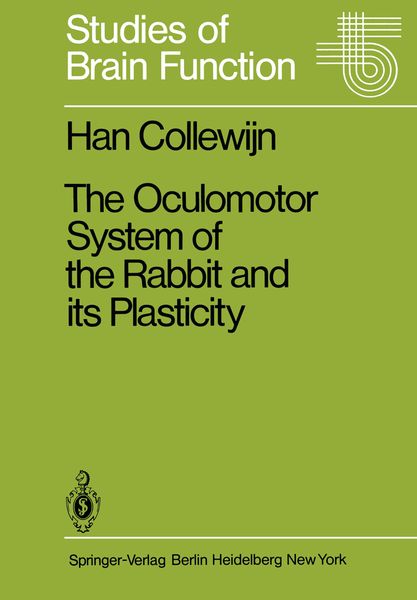
The Oculomotor System of the Rabbit and Its Plasticity

Fr. 138.00

inkl. gesetzl. MwSt., Versandkostenfrei


Beschreibung

Produktdetails

Einband

Taschenbuch

Erscheinungsdatum

25.12.2011

Abbildungen

IX, 28 illus., schwarz-weiss Illustrationen

Verlag

Springer Berlin

Seitenzahl

240

Maße (L/B/H)

24.4/17/1.5 cm

Gewicht

448 g

Auflage

Softcover reprint of the original 1st ed. 1981

Sprache

Englisch

ISBN

978-3-642-81629-1

Beschreibung

Produktdetails

Einband

Taschenbuch

Erscheinungsdatum

25.12.2011

Abbildungen

IX, 28 illus., schwarz-weiss Illustrationen

Verlag

Springer Berlin

Seitenzahl

240

Maße (L/B/H)

24.4/17/1.5 cm

Gewicht

448 g

Auflage

Softcover reprint of the original 1st ed. 1981

Sprache

Englisch

ISBN

978-3-642-81629-1

Herstelleradresse

Springer-Verlag KG
Sachsenplatz 4-6
1201 Wien
AT

Email: ProductSafety@springernature.com

Kundinnen und Kunden meinen

0 Bewertungen

Informationen zu Bewertungen

Zur Abgabe einer Bewertung ist eine Anmeldung im Konto notwendig. Die Authentizität der Bewertungen wird von uns nicht überprüft. Wir behalten uns vor, Bewertungstexte, die unseren Richtlinien widersprechen, entsprechend zu kürzen oder zu löschen.

Die Bewertungen sind nach Format, Anzahl Sterne und Datum sortiert.

Verfassen Sie die erste Bewertung zu diesem Artikel

Helfen Sie anderen Kund*innen durch Ihre Meinung

Kundinnen und Kunden meinen

0 Bewertungen filtern

  • Produktbild: The Oculomotor System of the Rabbit and Its Plasticity
  • Produktbild: The Oculomotor System of the Rabbit and Its Plasticity
  • 1 Introduction.- 1.1 Orientation of the Eyes.- 1.2 Retinal Organization.- 1.3 Visual Acuity.- 2 Eye Movements in Spontaneous Behavior.- 2.1 Techniques.- 2.2 Spontaneous Activity.- 2.3 Structure of Saccades.- 2.4 Intersaccadic Gaze Stability.- 2.5 Active Pursuit.- 2.6 Vergence.- 2.7 Conclusions.- 3 Eye Movements During Passive Oscillation.- 3.1 Rotation Around the Three Principal Axes.- 3.2 Properties of the Horizontal Canal-Ocular Reflex.- 3.3 Visual Suppression of the VOR.- 3.4 Maculo-Ocular Reflexes.- 3.5 Conclusions.- 4 Optokinetic and Postrotatory Nystagmus.- 4.1 The Nature of the Optokinetic Reflex.- 4.2 Optokinetic Responses to Sinusoidal Stimulation.- 4.3 Optokinetic Nystagmus.- 4.4 Open-Loop Optokinetic Nystagmus.- 4.5 Optokinetic Reactions in Different Directions.- 4.6 Vestibulo-Ocular and Optokinetic Responses During and After Rotations at a Constant Velocity.- 4.7 Conclusions.- 5 Signal Processing.- 5.1 Retinal Motion Detection.- 5.2 Relevance of Different Primary Optic Projections for OKN.- 5.2.1 The Geniculo-Cortical Projection.- 5.2.2 The Superior Colliculus.- 5.3 Direction-Selectivity in the Nucleus of the Optic Tract.- 5.4 Direction-Selectivity in the Posterior Accessory Optic System.- 5.5 Efferent Connections from the Nucleus of the Optic Tract.- 5.6 Effects of Bilateral Labyrinthectomy.- 5.7 The Effect of Cerebellectomy on OKN.- 5.8 Modeling of the Rabbit’s Optokinetic System.- 6 Adaptation and its Limits.- 6.1 Unilateral Labyrinthectomy.- 6.2 Dark-Rearing.- 6.2.1 Responses to Sinusoidal Movement in Darkness (VOR).- 6.2.2 Responses to Sinusoidal Movement with Eyes Open (VOR and OKN).- 6.2.3 Optokinetic Nystagmus.- 6.3 Long-Term Adaptation of VOR and OKN.- 6.3.1 Adaptive Phenomena in the VOR.- 6.3.2 Conditions for Visual Adaptation of the VOR.- 6.3.3 Adaptation to Inverted Motion yision, Restricted Visual Field.- 6.3.4 Adaptation to Inverted Motion Vision, Whole Visual Field.- 6.3.5 Adaptation by Visual Stimulation Only.- 6.3.6 Frequency Specificity of Adaptation.- 6.3.7 Adaptation in Synergic Operation of VOR and OKN.- 6.3.8 Conclusions on Adaptation.- 6.4 Optokinetic Anomalies in Albino Rabbits.- 6.4.1 Inverted OKN in Albino Rabbits.- 6.4.2 Anomalous Receptive Fields in the Nucleus of the Optic Tract in Albino Rabbits.- 6.4.3 Adaptation Experiments in Albino Rabbits.- 6.5 Conclusions.- References.- 1 Introduction.- 2 The Optokinetic Nystagmus in the Rabbit.- 2.1 The Conditions for the Eliciting of OKN.- 2.1.1 Size of the Moving Field.- 2.1.2 Velocity of Moving Contrasts.- 2.1.3 Nature of the Stimulus.- 2.2 Slow and Fast Phase.- 2.3 Quantitative Relations Between Stimulus and Effect.- 2.3.1 Equilibrium Between Stimulus and Nystagmus, at Different Velocities of the Moving Contrasts.- 2.3.2 Behavior of Nystagmus at the Beginning and End of Stimulation.- 2.4 A Theoretical Model of the Central Mechanism of Stare Nystagmus.- 2.5 Optokinetic and Vestibular Nystagmus.- 3 Stare Nystagmus in Other Species of Animals.- 4 The Localization of Stare Nystagmus in the Central Nervous System.- 5 Look Nystagmus.- 6 The Localization of Look Nystagmus in the Central Nervous System.- References.