• Produktbild: Models of Massive Parallelism
  • Produktbild: Models of Massive Parallelism

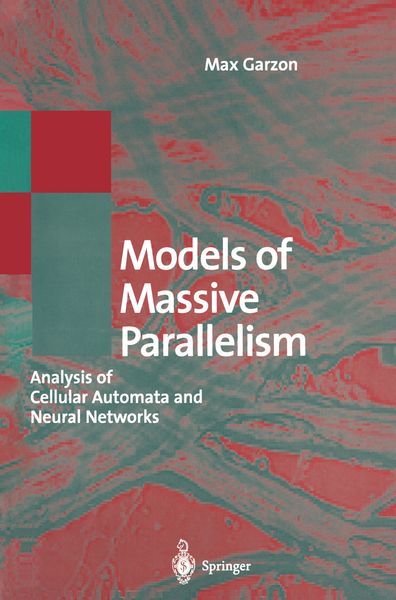
Models of Massive Parallelism Analysis of Cellular Automata and Neural Networks

Fr. 72.90

inkl. gesetzl. MwSt., Versandkostenfrei


Beschreibung

Produktdetails

Einband

Taschenbuch

Erscheinungsdatum

12.02.2012

Verlag

Springer Berlin

Seitenzahl

272

Maße (L/B/H)

23.5/15.5/1.6 cm

Gewicht

447 g

Auflage

Softcover reprint of the original 1st ed. 1995

Sprache

Englisch

ISBN

978-3-642-77907-7

Beschreibung

Produktdetails

Einband

Taschenbuch

Erscheinungsdatum

12.02.2012

Verlag

Springer Berlin

Seitenzahl

272

Maße (L/B/H)

23.5/15.5/1.6 cm

Gewicht

447 g

Auflage

Softcover reprint of the original 1st ed. 1995

Sprache

Englisch

ISBN

978-3-642-77907-7

Herstelleradresse

Springer-Verlag KG
Sachsenplatz 4-6
1201 Wien
AT

Email: ProductSafety@springernature.com

Kundinnen und Kunden meinen

0 Bewertungen

Informationen zu Bewertungen

Zur Abgabe einer Bewertung ist eine Anmeldung im Konto notwendig. Die Authentizität der Bewertungen wird von uns nicht überprüft. Wir behalten uns vor, Bewertungstexte, die unseren Richtlinien widersprechen, entsprechend zu kürzen oder zu löschen.

Die Bewertungen sind nach Format, Anzahl Sterne und Datum sortiert.

Verfassen Sie die erste Bewertung zu diesem Artikel

Helfen Sie anderen Kund*innen durch Ihre Meinung

Kundinnen und Kunden meinen

0 Bewertungen filtern

  • Produktbild: Models of Massive Parallelism
  • Produktbild: Models of Massive Parallelism
  • 1. Turing Computability and Complexity.- 1.1 Models of Sequential Computation.- 1.1.1 A Simple Model: the Finite-State Machine.- 1.1.2 Turing Machines.- 1.2 Complexity.- 1.2.1 Nondeterministic Computations.- 1.2.2 Randomized Algorithms.- 1.2.3 Parallel Computation.- 1.3 Cellular Machines.- 1.4 Prerequisites.- References.- 2. Cellular Automata.- 2.1 Finite-State Automata.- 2.2 Regular Graphs.- 2.3 Local Rules and Global Maps.- 2.3.1 Cellular Spaces.- 2.3.2 Local Rules.- 2.3.3 Global Maps and Dynamical Systems.- 2.4 Fundamental Questions.- 2.5 Notation.- 2.6 Problems.- 2.7 Notes.- References.- 3. Linear Cellular Automata.- 3.1 Linear Rules.- 3.2 Basic Properties.- 3.2.1 Global Injectivity and Surjectivity Modulo m.- 3.2.2 Self-reproduction with Linear Automata.- 3.2.3 Linear Automata on Rings and Semigroups.- 3.3 Global Dynamics via Fractals.- 3.4 The Role of Linear Rules.- 3.5 Problems.- 3.6 Notes.- References.- 4. Semi-totalistic Automata.- 4.1 Semi-totalistic Rules.- 4.1.1 An Example: Conway’s Game of LIFE.- 4.1.2 Nomenclature for Totalistic Rules.- 4.2 Construction and Computation Universality.- 4.2.1 Computation Universality of LIFE.- 4.2.2 Constructibility and Self-reproduction.- 4.2.3 Provable Computation Universality.- 4.3 Restricted Totalistic Rules.- 4.4 Threshold Automata.- 4.5 Problems.- 4.6 Notes.- References.- 5. Decision Problems.- 5.1 Algorithmic and Dynetic Problems.- 5.2 ID Euclidean Automata.- 5.3 2D Euclidean Automata.- 5.3.1 Reversibility is Unsolvable.- 5.3.2 Surjectivity is Unsolvable.- 5.4 Noneuclidean Automata.- 5.5 Complexity Questions.- 5.6 Problems.- 5.7 Notes.- References.- 6. Neural and Random Boolean Networks.- 6.1 Types of Generalizations.- 6.2 Other Parallel Models.- 6.3 Summary of Results.- 6.4 Proofs.- 6.4.1 A Hierarchy.- 6.4.2 A Universal Neural Network.- 6.4.3 Equivalence of Cellular Automata and Neural Networks.- 6.4.4 Equivalence of Neural Networks and Random Networks.- 6.4.5 The Stability Problem is Neurally Unsolvable.- 6.5 Problems.- 6.6 Notes.- References.- 7. General Properties.- 7.1 Metric Preliminaries.- 7.1.1 Metrics and Topologies.- 7.1.2 Convergence and Continuity.- 7.2 Basic Results.- 7.2.1 The Moore-Myhill Theorem.- 7.2.2 Nondeterministic Cellular Automata.- 7.3 Injeetivity, Surjectivity and Local Reversibility.- 7.4 Some Generalizations.- 7.4.1 Neural and Random Networks.- 7.4.2 Combinatorial Generalizations on Euclidean Spaces.- 7.5 Problems.- 7.6 Notes.- References.- 8. Classification.- 8.1 Finite Networks.- 8.1.1 The Difficulties.- 8.1.2 Complexity of Classifying Finite Networks.- 8.2 Wolfram Classification.- 8.3 Classification via Limit Sets.- 8.3.1 Culik-Yu’s Classes and Ishii’s Classes.- 8.3.2 About Entropy.- 8.4 Mean Field Theory.- 8.5 Local Structure Theory.- 8.5.1 Zeroth-order and First-order Local Structure Theories.- 8.5.2 Higher-order Local Structure Theories.- 8.6 Other Classifications.- 8.7 Problems.- 8.8 Notes.- References.- 9. Asymptotic Behavior.- 9.1 Linear Rules.- 9.1.1 Linear Automata on Tori.- 9.1.2 Linear Automata on the Line.- 9.2 Exact Solution.- 9.3 Simulation in Continuous Systems.- 9.3.1 Discrete Computation by Continuous Systems.- 9.3.2 Nonlocal Properties.- 9.3.2.1 The ø-transform.- 9.3.2.2 Sarkovskii’s Theorem.- 9.4 Observability.- 9.4.1 Observability of the Identity.- 9.4.2 Toggle Rules and the Extension Property.- 9.4.3 Observability of Linear Cellular Automata.- 9.4.4 Observability in Neural Networks.- 9.5 Problems.- 9.6 Notes.- References.- 10. Some Inverse Problems.- 10.1 Signals and Synchronization.- 10.1.1 Synchronization of a Line.- 10.1.2 Synchronization of a Network.- 10.1.3 Signals in Dimension 1.- 10.1.4 Clocks.- 10.2 Formal Language Recognition.- 10.2.1 Models.- 10.2.2 A Speedup Theorem.- 10.3 Picture Languages.- 10.3.1 The Issue of Representation.- 10.3.2 ?-Languages in Spaces of Linear Growth.- 10.3.3 2D-Euclidean Languages.- 10.3.4 Recognition over Spaces of Exponential Growth.- 10.3.5 Recognition over Spaces of Subexponential Growth.- 10.4 Problems.- 10.5 Notes.- References.- 11. Real Computation.- 11.1 Representation and Primitives.- 11.2 Exact Computation.- 11.2.1 Constant-time Computation.- 11.2.2 Variable-time Computation.- 11.3 Approximate Computation by Neural Nets.- 11.3.1 Relative Shadowing.- 11.3.2 Shadowing Bases.- 11.4 Problems.- 11.5 Notes.- References.- 12. A Bibliography of Applications.- 12.1 Physics.- 12.2 Chemistry.- 12.3 Biology.- 12.4 Computer Science.- 12.5 Artificial Intelligence and Cognitive Science.- 12.6 Miscellaneous.- References.- Author Index.- Symbol Index.