
• Produktbild: Invertebrate Immune Responses
  • Produktbild: Invertebrate Immune Responses
Band 23

Invertebrate Immune Responses Cells and Molecular Products

Fr. 137.00

inkl. gesetzl. MwSt., Versandkostenfrei


Beschreibung

Produktdetails

Einband

Taschenbuch

Erscheinungsdatum

14.12.2011

Herausgeber

Edwin L. Cooper

Verlag

Springer Berlin

Seitenzahl

216

Maße (L/B/H)

23.5/15.5/1.3 cm

Gewicht

365 g

Auflage

Softcover reprint of the original 1st ed. 1996

Sprache

Englisch

ISBN

978-3-642-79695-1

Beschreibung

Produktdetails

Einband

Taschenbuch

Erscheinungsdatum

14.12.2011

Herausgeber

Edwin L. Cooper

Verlag

Springer Berlin

Seitenzahl

216

Maße (L/B/H)

23.5/15.5/1.3 cm

Gewicht

365 g

Auflage

Softcover reprint of the original 1st ed. 1996

Sprache

Englisch

ISBN

978-3-642-79695-1

Herstelleradresse

Springer-Verlag KG
Sachsenplatz 4-6
1201 Wien
AT

Email: ProductSafety@springernature.com

Kundinnen und Kunden meinen

0 Bewertungen

Informationen zu Bewertungen

Zur Abgabe einer Bewertung ist eine Anmeldung im Konto notwendig. Die Authentizität der Bewertungen wird von uns nicht überprüft. Wir behalten uns vor, Bewertungstexte, die unseren Richtlinien widersprechen, entsprechend zu kürzen oder zu löschen.

Die Bewertungen sind nach Format, Anzahl Sterne und Datum sortiert.

Verfassen Sie die erste Bewertung zu diesem Artikel

Helfen Sie anderen Kund*innen durch Ihre Meinung

Kundinnen und Kunden meinen

0 Bewertungen filtern

Weitere Artikel finden Sie in

  • Produktbild: Invertebrate Immune Responses
  • Produktbild: Invertebrate Immune Responses
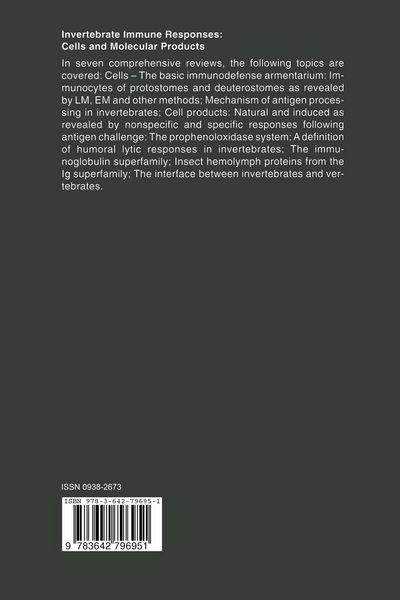
  • Cells: The Basic Immunodefense Armentarium.- 1 The Immunocytes of Protostomes and Deuterostomes as Revealed by LM, EM and Other Methods.- 1 Introduction.- 2 Immune Mechanism and Immunocytes.- 3 Cells Participating in Immune Reactions.- 4 Phylogenic Lineages of Immunocytes.- 5 Various Approaches to Immunocytes.- 6 Problems and Possible Solutions.- References.- 2 Mechanisms of Antigen Processing in Invertebrates: Are There Receptors?.- 1 Introduction.- 2 General Armamentarium of Earthworm Natural Resistance.- 3 Adaptive Response to Antigenic Stimulation.- 4 Coelomocyte Superficial Molecules.- 5 Concluding Remarks.- References.- Cell Products: Natural and Induced as Revealed by Non-specific and Specific Responses Following Antigenic Challenge.- 3 The Prophenoloxidase Activating System: A Common Defence Pathway for Deuterostomes and Protostomes?.- 1 Introduction.- 2 The Prophenoloxidase Activating System in Arthropods.- 3 Phenoloxidase Activity in Other Protostome Groups.- 4 Phenoloxidase Activity in Deuterostome Invertebrates.- 5 Discussion: the pro PO System in Host Defence and Immune Phylogeny.- 6 Conclusions and Future Perspectives.- 7 Acknowledgements.- References.- 4 A Definition of Cytolytic Responses in Invertebrates.- 1 Introduction.- 2 Invertebrate Lytic Activities.- 3 Cell-Target Susceptibility.- 4 Species-to-Species and Individual Variability.- 5 The Hemolytic Reaction.- 6 Membrane Binding and Damage.- 7 Induction and Regulation.- 8 Hemolytic Molecules.- 9 Hemolysin-Producing Cells and Granules.- 10 Relationship with Cytotoxicity.- 11 Are Hemolysins Ancestor Immune Molecules?.- 12 Final Comment.- References.- 5 The Immunoglobulin Superfamily: Where Do Invertebrates Fit In?.- 1 Introduction.- 2 Molecular Architecture of the Ig Fold.- 3 When Did Ig Appear in Evolution?.- 4 When Did the TCR and MHC Appear in Evolution?.- 5 The Origin of Peptide-Binding Domains of MHC Molecules.- 6 The Ig Superfamily in Invertebrates.- 7 The Ig Superfamily in Microorganisms.- 8 The Immune System vs the Nervous System.- 9 Strategy for the Development of Self-Defense Systems in the Animal Kingdom.- 10 The Origin of Polymorphic Molecules: a Hypothesis.- 11 The Ig Superfamily in Perspective.- References.- 6 Insect Hemolymph Proteins from the Ig Superfamily.- 1 Introduction.- 2 Properties of Hemolin.- 3 Regulation of Hemolin Expression.- 4 Sequence Analysis of Hemolin.- 5 Possible Functions of Hemolin.- 6 Conclusion.- References.- 7 The Interface Between Invertebrates and Vertebrates: Complement vs Ig.- 1 Introduction.- 2 Humoral Immunity in the Agnatha.- 3 Structural Characterization of the Hagfish “Antibody”.- 4 Functional Properties of Hagfish Complement-Like Protein.- 5 Complement in the Agnatha.- 6 Chemotaxis in the Hagfish.- 7 Conclusion.- References.