• Produktbild: Wastewater Management for Coastal Cities
  • Produktbild: Wastewater Management for Coastal Cities

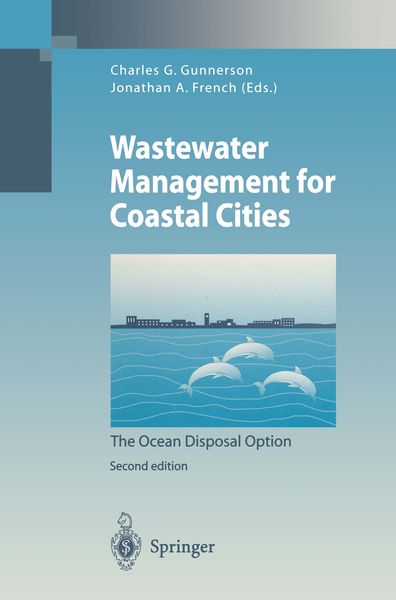
Wastewater Management for Coastal Cities The Ocean Disposal Option

Fr. 137.00

inkl. gesetzl. MwSt., Versandkostenfrei


Beschreibung

Produktdetails

Einband

Taschenbuch

Erscheinungsdatum

14.12.2011

Herausgeber

Charles G. Gunnerson + weitere

Verlag

Springer Berlin

Seitenzahl

345

Maße (L/B/H)

23.5/15.5/2 cm

Gewicht

574 g

Auflage

Second Edition 1996

Sprache

Englisch

ISBN

978-3-642-79731-6

Beschreibung

Produktdetails

Einband

Taschenbuch

Erscheinungsdatum

14.12.2011

Herausgeber

Verlag

Springer Berlin

Seitenzahl

345

Maße (L/B/H)

23.5/15.5/2 cm

Gewicht

574 g

Auflage

Second Edition 1996

Sprache

Englisch

ISBN

978-3-642-79731-6

Herstelleradresse

Springer-Verlag KG
Sachsenplatz 4-6
1201 Wien
AT

Email: ProductSafety@springernature.com

Kundinnen und Kunden meinen

0 Bewertungen

Informationen zu Bewertungen

Zur Abgabe einer Bewertung ist eine Anmeldung im Konto notwendig. Die Authentizität der Bewertungen wird von uns nicht überprüft. Wir behalten uns vor, Bewertungstexte, die unseren Richtlinien widersprechen, entsprechend zu kürzen oder zu löschen.

Die Bewertungen sind nach Format, Anzahl Sterne und Datum sortiert.

Verfassen Sie die erste Bewertung zu diesem Artikel

Helfen Sie anderen Kund*innen durch Ihre Meinung

Kundinnen und Kunden meinen

0 Bewertungen filtern

  • Produktbild: Wastewater Management for Coastal Cities
  • Produktbild: Wastewater Management for Coastal Cities
  • 1 Overview.- 2 Oceanography at the Margin.- 2.1 The Physical, Geological, and Chemical Framework.- 2.1.1 Oceanic Waters.- 2.1.2 Coastal Waters.- 2.1.3 Waves, Tides, and Sea Level.- 2.1.4 Marine Geology and Sedimentation.- 2.1.5 Chemistry of Seawater and Suspended Sediments.- 2.1.6 Stirring and Mixing.- 2.1.7 Bays, Estuaries, and Straits.- 2.2 The Living Sea.- 2.2.1 Ecological Relationships and Trophic Levels.- 2.2.2 Marine Productivity.- 2.2.3 Plankton.- 2.2.4 Nekton.- 2.2.5 Bacteria.- 2.2.6 Benthos.- 2.2.7 Fisheries.- 2.3 Special Topics.- 2.3.1 Public Health Aspects.- 2.3.2 Environmental Toxicity.- 2.3.3 Wave and Current Measurements.- 2.3.4 A Historical Note on Biological Oceanography.- 2.4 References.- 3 Ecological Design.- 3.1 Public Health.- 3.1.1 Marine Recreational Water.- 3.1.2 Shellfish and Finfish.- 3.2 Design for Marine Ecosystems.- 3.2.1 Eutrophication.- 3.2.2 Toxic Wastes.- 3.2.3 Minamata - A Special Case.- 3.2.4 Synthetic Organics.- 3.3 Ocean Dumping.- 3.4 References.- 4 Hydraulic Design.- 4.1 Concepts and Definitions.- 4.2 Qualitative Descriptions of Receiving Waters.- 4.2.1 Coastal Waters.- 4.2.2 Rivers.- 4.2.3 Estuaries.- 4.3 Methods of Analysis for Outfall Siting.- 4.3.1 First Questions.- 4.3.2 Worked Example of Near Field Dilution.- 4.3.3 Field Surveys.- 4.3.4 Numerical Modeling.- 4.3.5 Physical Hydraulic Models.- 4.4 Equations for Estimating Turbulent Diffusion.- 4.5 Comparisons of Results.- 4.6 Outfall and Outlet Location.- 4.6.1 Information Needs.- 4.6.2 Water Quality.- 4.6.3 Worked Example of Outfall Siting.- 4.7 Outlet Design and Initial Dilution.- 4.7.1 Single Open Ends, Rose Diffusers Caps, Multiport Diffusers.- 4.7.2 Initial Dilution for Plumes from Single Round Ports.- 4.7.3 Initial Dilution from a Line Source.- 4.7.4 Initial Dilution from a Line of Port Clusters.- 4.7.5 Quick Estimate of Likelihood of Plume Submergence.- 4.7.6 Diffuser Design.- 4.8 Other Hydraulic Design Considerations.- 4.8.1 Pipe Diameter.- 4.8.2 Thrust at Bends.- 4.8.3 Hydraulic Transients.- 4.8.4 Excess Hydrostatic Head.- 4.8.5 Drop Structures.- 4.8.6 Provision for Pigging.- 4.9 Appendix. A note on Post-Audits.- 4.10 References.- 5 Construction Materials.- 5.1 Pipe Materials.- 5.1.1 Cast Iron.- 5.1.2 Wrought Iron.- 5.1.3 Plastic.- 5.1.4 Reinforced Concrete.- 5.1.5 Coated Steel.- 5.2 Recommended Reading.- 6 On-Bottom Stability.- 6.1 Forces.- 6.1.1 Soil Forces.- 6.1.2 Hydrodynamic Forces.- 6.2 Vertical Stability of Unburied Pipelines.- 6.3 Vertical Stability of Buried Pipelines.- 6.4 Lateral Stability of Unburied Pipelines.- 6.4.1 Density Anchors.- 6.4.2 Mechanical Anchors.- 6.5 Lateral Stability of Buried Pipelines.- 6.6 References.- 7 Stress Analysis.- 7.1 Identifying and Analyzing Stress.- 7.1.1 Stress from Anchors.- 7.1.2 Unsupported Span Analysis.- 7.1.3 Collapse/Buckling Analysis.- 7.2 References.- 8 Corrosion Control.- 8.1 Corrosion Protection for Steel in Seawater.- 8.1.1 Cathodic Protection.- 8.1.2 External Coatings.- 8.1.3 Internal Coatings.- 8.1.4 Recommended Reading.- 9 Ocean Outfall Construction.- 9.1 Practical Limits to Current Construction Practices.- 9.1.1 Selecting a Construction Method.- 9.1.2 Classification of Construction Methods.- 9.1.3 State-of-the-Art Constraints.- 9.2 Construction Methods.- 9.2.1 Bottom Assembly Methods.- 9.2.2 Pipe Laying from a Mobile Jack-up Platform.- 9.2.3 Pipe Laying from a Trestle.- 9.2.4 Pipe Laying from a Floating Crane Barge.- 9.2.5 Surface Assembly from an Offshore Lay Barge.- 9.2.6 Bottom Pull Method.- 9.2.7 Floats and Chain Method.- 9.2.8 On-Bottom Connection of Short Lengths.- 9.2.9 Bottom Pull from Floating Work Platforms.- 9.2.10 Surface Pull (Flotation) Method.- 9.2.11 Remote Assembly Method.- 9.3 Trenching and Backfilling.- 9.3.1 Controlling Factors.- 9.3.2 Trenching Methods.- 9.3.3 Backfilling Methods.- 9.4 Shore Approach.- 9.4.1 Design Considerations.- 9.4.2 Construction Considerations.- 9.5 Tunneling.- 9.5.1 Horizontal Directional Drilling and Microtunneling.- 9.5.2 Large-diameter Tunnels.- 9.6 Construction Monitoring and Inspection.- 9.7 References.- 10 Monitoring.- 10.1 A Framework for Sustainable Monitoring.- 10.2 Some Performance Monitoring Principles.- 10.2.1 Equilibrium Response Times and Monitoring Design.- 10.3 Hydraulic and Structural Monitoring.- 10.4 Discharge Monitoring.- 10.5 Ecological Monitoring.- 10.5.1 Public Health.- 10.5.2 Ecological Interactions.- 10.5.3 Other Parameters.- 10.6 The Infaunal Trophic Index.- 10.7 Recovery of Damaged Ecosystems.- 10.8 Post-Audits.- 10.9 Regulatory and Zero-Discharge Models.- 10.10 Appendix. Power Spectrum Analysis.- 10.11 References.- 11 Case Studies.- 11.1 Scope of Case Studies.- 11.2 The Yangtze Estuary: The Second Shanghai Sewerage Project.- 11.2.1 Introduction.- 11.2.2 Organisation of Feasibility Studies.- 11.2.3 Master Plan.- 11.2.4 Layout of Outfall.- 11.2.5 Environmental Impact.- 11.2.6 Other Studies.- 11.2.7 References.- 11.3 The Thames Estuary.- 11.3.1 Recent History of a Maturing Remedial System.- 11.3.2 The DSIR Dissolved Oxygen Model.- 11.3.3 Hydrography of th Thames Estuary.- 11.3.4 Fish Populations.- 11.3.5 Principal Findings and Conclusions.- 11.3.6 References.- 11.4 The Bosporus and Sea of Marmara.- 11.4.1 Regional Geography and Oceanography.- 11.4.2 Oceanography of the Bosporus.- 11.4.3 Two-Layer Current System in the Turkish Straits.- 11.4.4 Evolving Environmental Engineering Design Criteria.- 11.4.5 Environmental Impact of Outfall Alternatives.- 11.4.6 Proposed and Constructed Outfalls.- 11.4.7 References.- 11.5 Boston Harbor.- 11.5.1 Early History of Boston Sewerage.- 11.5.2 Proposals for Long Outfalls.- 11.5.3 Selection of a Treatment Plant Site.- 11.5.4 Siting the Outfall, Hydraulic Design.- 11.5.5 Receiving Water Quality Modelling.- 11.5.6 Construction.- 11.5.7 Public Awareness, Community Participation.- 11.5.8 Recommended Reading.- 11.6 Southern California Bight.- 11.6.1 Ocean Disposal of Southern California Wastewaters.- 11.6.2 Recovery of Damaged Ecosystems.- 11.6.3 References.- 12 Cost and Sustainability Factors.- 12.1 What Costs? What Benefits? Who Pays?.- 12.1.1 Limits to Scale in Water Supply and Sanitation.- 12.1.2 Allocating Costs of Water and Sanitation Benefits.- 12.2 Costs of Ocean Outfalls.- 12.3 Estimating Marginal Costs and Benefits.- 12.3.1 Simulating Sewage Treatment Costs and Benefits.- 12.3.2 Measuring Sewage Treatment Costs and Benefits.- 12.4 Principles of Comparative Costing.- 12.4.1 Worked Example of Average Incremental Costing.- 12.5 Sustainable Water and Sanitation Management.- 12.5.1 Water Conflict Identification.- 12.5.2 Water Conflict Resolution.- 12.5.3 Information and Technology Transfer.- 12.5.4 Terms of Reference for Information and Technology Transfer.- 12.5 References.- 13 Index.