Gutscheinbedingungen

*Gültig bis 05.07.2026 auf (fast) alles. Ausgeschlossen sind Smartboxen, Zeitschriften, Tickets, Lebensmittel, Gaming-Elektroartikel, Tinte/Toner, Gutscheine, Geschenkkarten, Blumen und Abos | Einlösbar in allen Buchhandlungen von Orell Füssli, Barth Bücher, Buchladen Rapunzel, Papeterie Köhler, Schuler Orell Füssli, Stauffacher und ZAP unter Vorweisung des Gutscheins, auf www.orellfüssli.ch durch Eingabe des Gutscheincodes. Beim Service „eBooks verschenken“ und bei eBook-Käufen via eReader nicht einlösbar | Mindesteinkaufswert: Fr. 30.- | Nicht mit anderen Rabatten kumulierbar.

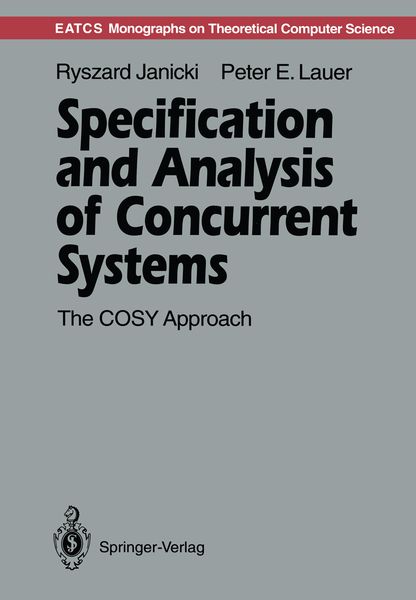
Produktbild: Specification and Analysis of Concurrent Systems

Specification and Analysis of Concurrent Systems The COSY Approach

Fr. 137.00

inkl. gesetzl. MwSt., Versandkostenfrei


Beschreibung

Produktdetails

Einband

Taschenbuch

Erscheinungsdatum

29.12.2011

Verlag

Springer Berlin

Seitenzahl

480

Maße (L/B/H)

24.2/17/2.7 cm

Gewicht

847 g

Auflage

Softcover reprint of the original 1st ed. 1992

Sprache

Englisch

ISBN

978-3-642-77339-6

Beschreibung

Produktdetails

Einband

Taschenbuch

Erscheinungsdatum

29.12.2011

Verlag

Springer Berlin

Seitenzahl

480

Maße (L/B/H)

24.2/17/2.7 cm

Gewicht

847 g

Auflage

Softcover reprint of the original 1st ed. 1992

Sprache

Englisch

ISBN

978-3-642-77339-6

Herstelleradresse

Springer-Verlag KG
Sachsenplatz 4-6
1201 Wien
AT

Email: GPSR Kontakt

Noch keine Bewertungen vorhanden

Verfassen Sie die erste Bewertung zu diesem Artikel

Helfen Sie anderen Kundinnen und Kunden durch Ihre Meinung.

Kundinnen und Kunden meinen

Bewertungen (0)

  • Produktbild: Specification and Analysis of Concurrent Systems
  • 1 What COSY Is and What It Is For.- 1.1 Introduction.- 1.2 Concepts, Objectives and Design Decisions.- 1.3 Structure of Bookevevr.- 1.4 Acknowledgements.- 2 Formal Theory of Basic COSY.- 2.1 Basic COSY Syntax and Semantics.- 2.2 VFS Semantics of COSY.- 2.2.1 Simple Properties of Vector Sequences.- 2.2.2 Vector Sequences and Partial Orders.- 2.2.3 Vector Sequences of Path Programs.- 2.2.4 Concurrent Product of Regular Expressions.- 2.3. Petri Net Semantics of COSY.- 2.3.1 Elements of Net Theory.- 2.3.2 VFS semantics of SMD nets.- 2.3.3 Semantics of Labelled Petri Nets.- 2.3.4 Labelled Petri Nets defined by Path Programs.- 2.3.5 Uniquely Named and Labelled Uniquely Named Regular Expressions.- 2.3.6 Labelled Nets and Products of Regular Expressions.- 2.3.7 Labelled Nets and COSY Path Programs.- 2.3.8 Other Constructions.- 2.4 Adequacy Properties of Path Programs.- 2.4.1 Syntactically Conflict-Free Path Programs.- 2.4.2 Checking Adequacy of SCF-Path Programs.- 2.4.3 Adequacy-Preserving Transformations.- Insertions Preserving Adequacy.- Deletions Preserving Adequacy.- Applications of Adequacy-Preserving Transformations.- 2.4.4 Free-Choice Path Programs.- 2.5 Execution Semantics for COSY.- 2.5.1 Execution Strategies.- 2.5.2 Maximally Concurrent Strategies.- 2.6 Semantics of COSY with Priorities.- 2.6.1 Observations and Multiple Sequences.- 2.6.2 MFS Semantics for Priority COSY.- 2.6.3 Starvation Problem.- 2.6.4 Infinite MFS and Formal Definition of Starvation.- 2.6.5 Simulation of Dynamic Priorities.- 2.6.6 VFS Semantics for Priority COSY.- 2.7 Bibliographic Notes.- 3 High-level COSY Programs and System Design.- 3.1 High-level COSY Syntax and Semantics.- 3.2 The Process Notation.- 3.3 Macro Generators for COSY Notation.- 3.3.1 The Macro Program.- 3.3.2 The Collectivisors.- 3.3.3 The Body-Replicators.- 3.3.4 Macro Paths and Macro Processes.- 3.3.5 Sequence Replicators.- 3.3.6 Left and Right Sequence Replicators.- 3.3.7 The Distributors.- 3.3.8 Expansion of Macro COSY Programs.- The Expansion of Replicators.- The Expansion of Distributors.- Expansion Theorem.- 3.4 The Semantics of Macro COSY Programs.- 3.5 The COSY Environment.- 3.5.1 The Architecture of BCS.- The BCS Analysis Mechanism.- The BCS Semantic Transformation Mechanism.- The BCS Interface.- 3.5.2 The Macro COSY Environment.- 3.6 The COSY System Dossier.- 3.7 Bibliographical Notes.- 4 COSY Applications.- 4.1 Two-Way Channel with Disconnect.- 4.1.1 Bibliographic Notes.- 4.2 The Hyperfast Banker.- 4.2.1 The Bank Director.- 4.2.2 The Vault.- 4.2.3 The Doors.- 4.2.4 The Fair Doormen.- 4.2.5 The Counters.- 4.2.6 The Clerks.- 4.2.7 The Fair Reimbursers.- 4.2.8 The Customers.- 4.2.9 Priority Constraints.- 4.2.10 Final Comment and Bibliographical Notes.- 4.3 Cigarette Smokers.- Bibliographic Notes.- 4.4 Merlin-Randell Problem of Train Journeys.- 4.4.1 Movement Graphs and Minimal Critical Patterns.- 4.4.2 COSY Specification of the Synchronization.- 4.4.3 Final Comment and Bibliographic Notes.- 4.5 Transforming Sequential Systems into Concurrent Systems.- 4.5.1 e-Paths and e-Path Programs.- 4.5.2 Concurrent e-Paths and Proper Concurrent e-Paths.- 4.5.3 Synchronized e-Path Programs.- 4.5.4 Final Comment and Bibliographic Notes.- 4.6 Modelling N-Modular Redundancy.- 4.6.1 Replicated Computation in Networks of Computing Nodes.- 4.6.2 Formal Specification.- 4.6.3 Bibliographical Notes.- 5 Comparison of COSY with Other Models.- 5.1 COSY and CCS.- 5.2 COSY and CSP.- Full COSY and Petri Nets.- 5.3.1 Uniquely Named Comma&Star-free Programs and Asymmetric Choice Nets.- 5.3.2 Priority Path Programs, Priority Nets and Inhibitor Net.- 5.4 Vector Sequences and Mazurkiewicz Traces.- 5.5 COSY and Synchronized Behaviours.- 6 Historical Perspective.- 6.1 Introduction.- 6.2 Conceptual and Methodological Framework of COSY Approach.- Appendices.- A Algebra of Relations.- B Automata and Formal Language Theory.- B.1 Strings.- B.2 Languages.- B.3 Regular Expressions and Languages.- B.4 Finite State Automata and Grammars.- C Elements of Graph Theory.- D Proofs of Theorems 2.25, 2.26 and 2.28.- E Proofs of Theorems 2.37 and 2.38.- F Proof of Theorem 2.29.- G Proof of Theorem 4.3.- H Basic COSY Notations and Macro COSY Notation.- List of Figures.- List of Algorithms.- List of Definitions.- List of Theorems.- List of Corollaries.- List of Lemmas.